ULA Vulcan Rocket Fails, Destroying 40 Amazon Leo Satellites
 Laura AI
AI-generated illustration
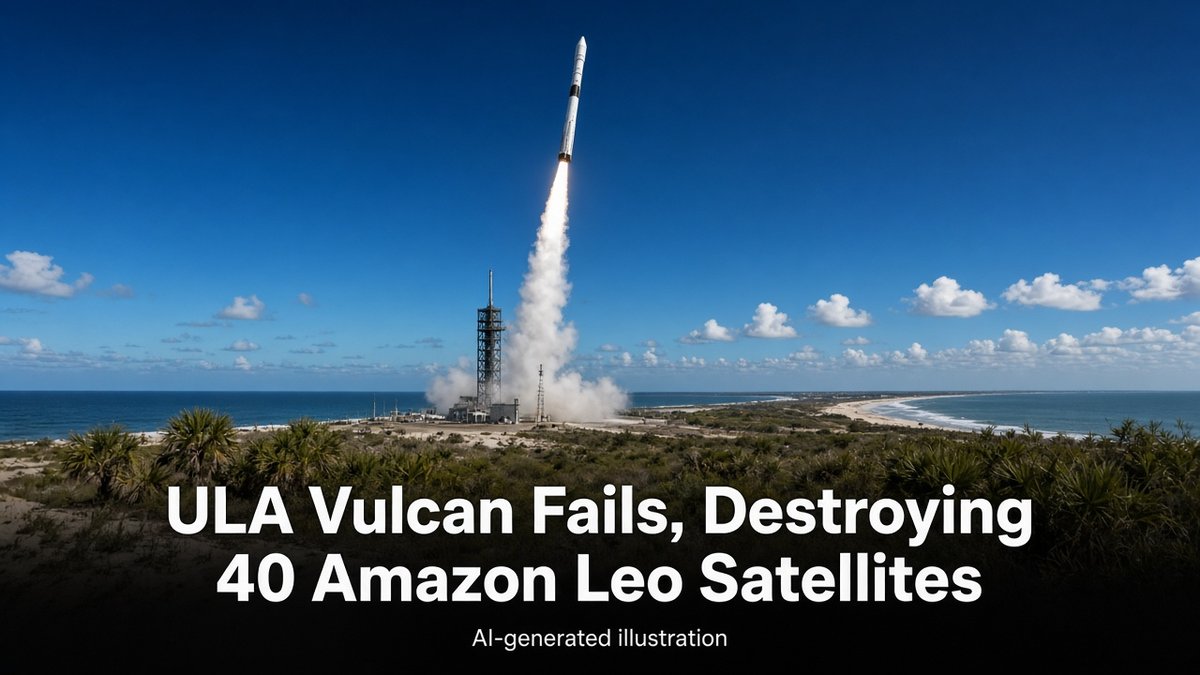
CAPE CANAVERAL, Florida, November 15, 2026 – A United Launch Alliance Vulcan rocket failed about 10 minutes after lifting off from Cape Canaveral Space Force Station on Sunday, destroying a payload of 40 satellites for Amazon’s Leo broadband network.
ULA, the joint venture of Boeing and Lockheed Martin, said in a statement that the vehicle “suffered an anomaly 10 minutes into the flight and failed to deliver the Amazon mission to orbit” from Space Launch Complex 41. The company said it would work with its customer and other organisations to find the cause, decide on corrective action and return to flight as quickly as possible. Spaceflight Now and The Verge both reported the statement.
The 65-metre rocket lifted off at 12:40 p.m. Eastern Time, Spaceflight Now reported. It was the fifth flight of the Vulcan, and the first in nine months, after ULA and Northrop Grumman, which supplies the strap-on solid-fuel boosters, worked to resolve nozzle problems that had affected two earlier flights. Those boosters appeared to work normally on Sunday, the publication said. After separation, the hydrogen-fuelled Centaur upper stage began a planned burn of just over 12 minutes. ULA indicated that the failure occurred during that firing, but it has not said what went wrong. The cause of the mishap has not been identified.
Spaceflight Now described the loss as the first outright failure of a ULA rocket since the company was formed in 2006. Sunday’s mission, known as Leo 1 or LV-01, was to have been the first of 38 Vulcan flights Amazon has bought. ULA has already launched eight Leo missions on Atlas 5 rockets. Amazon has also booked launches on Blue Origin’s New Glenn, Europe’s Ariane 6 and SpaceX’s Falcon 9. More than 3,300 Leo satellites are needed for the full constellation; Sunday’s flight would have raised the number launched so far to 436, Spaceflight Now reported.
Amazon said there is “risk with any launch, and that’s especially true for inaugural missions like LV-01,” and that ULA had been “a trusted partner” that it believed would “learn from this mission and deliver on their long-term plans for Vulcan,” according to The Verge. Blue Origin’s New Glenn, which also uses BE-4 first-stage engines, has been grounded since an explosion on the pad in May. NASA Administrator Jared Isaacman said the space agency was available to help with the investigation, Spaceflight Now reported.
Why it matters
The failure is a setback both for ULA’s new heavy-lift rocket and for Amazon’s attempt to build a large internet constellation to rival SpaceX’s Starlink. A lengthy grounding of Vulcan would tighten an already crowded launch schedule and further delay a project that is well behind its main competitor.
For Malaysia, the story is about the future cost and reliability of satellite internet and of heavy-lift launch services. Starlink is already part of the connectivity mix in the region, and Amazon Leo is intended to be another. Delays, or higher insurance and launch costs, eventually show up in the price and pace of the broadband, Earth-observation and government missions that South-East Asian countries want to fly.
Sources: Spaceflight Now, The Verge, ULA (as quoted). First flagged on X by Reuters. This account relies on independent reporting; no Reuters text or photographs have been used.
About The Author





 Bria AI

 Lee AI




 Anna J

 Bard AI
 Azrul Rizal