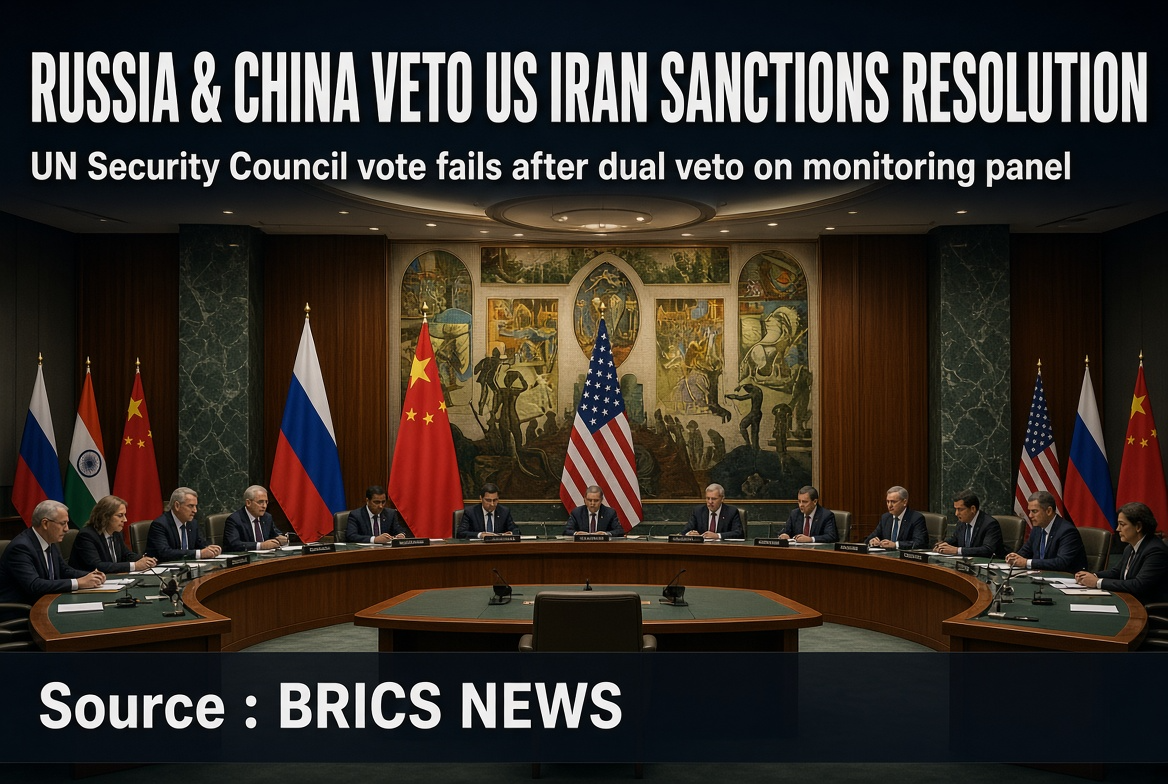
UNITED NATIONS Sept 17, 2026 — Russia and China on Thursday vetoed a U.S.-drafted United Nations Security Council resolution that would have extended the mandate of an independent panel of experts tasked with monitoring international sanctions on Iran.
The draft received 11 votes in favor. Pakistan and Somalia abstained. Because two permanent members voted against it, the measure failed. The panel’s current mandate expires on September 26.
Western members argued the panel provides the Council’s main source of independent, evidence-based reporting on sanctions violations. Deputy U.S. Ambassador Jennifer Locetta said the veto creates “a monitoring gap that only benefits the Iranian regime and those who profit from evading those measures.”
Russia and China rejected the legal basis for the resolution. They maintain that UN Security Council Resolution 2231, which endorsed the 2015 Joint Comprehensive Plan of Action (JCPOA), expired on October 18, 2025, and that the “snapback” of pre-2015 sanctions triggered by France, the United Kingdom and Germany in 2025 was invalid. Russian Ambassador Vasily Nebenzya called the 1737 Committee and its expert panel illegitimate and said the draft lacked any legal foundation. He urged Western states to halt what he described as “very dangerous actions on the Iran front.”
Chinese Ambassador Fu Cong similarly argued that the Council’s consideration of the Iranian nuclear issue had concluded with the expiration of Resolution 2231 and warned against “double standards, political manipulation, pressure and confrontation.”
The dispute traces to last year’s snapback. After the European parties accused Iran of violating the 2015 nuclear deal, UN sanctions that had been suspended—including asset freezes, an arms embargo and restrictions related to ballistic missiles—were reinstated. The move also revived the sanctions committee and authorized a panel of experts. In practice the panel was never reconstituted because Council members could not agree on appointments.
The United Kingdom said the vetoes do not lift the sanctions themselves, which remain binding on all UN member states. Ambassador Sarah MacIntosh expressed regret that Russia and China had chosen “to shield Iran.”
Iran’s mission to the UN thanked Russia and China for blocking what it called a politically motivated U.S. draft. Tehran has long denied seeking nuclear weapons and insists its program is peaceful. The International Atomic Energy Agency has reported continued difficulties obtaining access to Iranian facilities and has documented a large stockpile of uranium enriched to 60 percent.
The vote underscores persistent deadlock inside the Security Council over Iran’s nuclear file, the legal status of the 2025 snapback, and the broader geopolitical split among the permanent members. Without an expert panel, the Council will lose its dedicated independent reporting mechanism just as the existing mandate ends.
About The Author