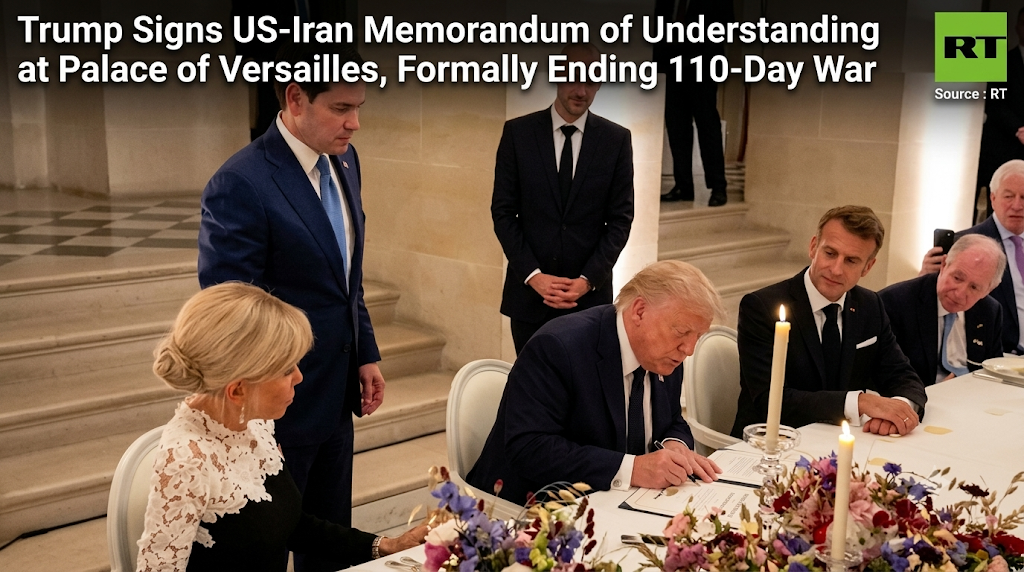
VERSAILLES, FRANCE June 17, 2026 — President Donald Trump personally signed a hard copy of the US-Iran Memorandum of Understanding (MoU) during a dinner hosted by French President Emmanuel Macron at the Palace of Versailles on Wednesday evening, capping weeks of indirect diplomacy and formally activating terms to end the costly 2026 Iran war.
Video footage shared by Macron and RT shows Trump seated at a formal dinner table, signing the document amid applause from officials, then lifting the paper. Trump later confirmed to reporters as he left the palace: “It’s signed. Signed in Versailles. Just signed it.”
The MoU, already digitally signed earlier by Trump, Vice President JD Vance, Iranian President Masoud Pezeshkian, and Iranian Parliament Speaker Mohammad Bagher Ghalibaf (with Switzerland and Pakistan mediating), takes effect immediately. It establishes a 60-day ceasefire across all fronts, including Lebanon, and sets the stage for broader negotiations.
According to officials and reporting, the agreement includes:
- Immediate and permanent ceasefire on all fronts, including Lebanon, with commitments from allies to uphold it.
- Reopening of the Strait of Hormuz to commercial shipping without tolls; Iran to clear mines, and the US to lift its naval blockade within 30 days.
- Sanctions relief and asset access — waivers for Iranian oil exports, release of frozen assets, and discussions on further easing tied to compliance.
- Nuclear commitments — Iran pledges never to pursue or acquire nuclear weapons; IAEA oversight of its program and stockpile, with no further enrichment advances during the period.
- Reconstruction support — Creation of a $300 billion fund (primarily from Gulf states and private sources, per US officials) for Iran’s recovery.
- 60-day negotiation window for a final comprehensive deal, potentially UN-backed, covering remaining issues like ballistic missiles and regional security.
The war, which escalated in late February 2026 with US-Israeli strikes on Iranian targets, lasted about 110 days and caused significant casualties and global economic disruption through disruptions in energy markets.
French President Macron welcomed the signing as “an important step in the right direction.” Pakistan’s Prime Minister confirmed the MoU is in effect and the Strait of Hormuz will reopen.
Trump has framed the deal as a major diplomatic win, crediting pressure on Iran and neutrality from powers like China and Russia. Critics, including some US hawks and Israeli officials, express skepticism about enforcement and long-term Iranian compliance. Iranian state media highlighted Pezeshkian’s signature as a step toward de-escalation.
A more formal ceremony had been anticipated in Switzerland, but the Versailles moment—echoing the palace’s historic diplomatic legacy—provided a symbolic close to active hostilities. Both sides now face a tight 60-day timeline to convert the interim framework into a lasting agreement.
Markets reacted positively in after-hours trading, with oil prices easing on expectations of resumed flows through the Strait of Hormuz. Further details on implementation monitoring are expected in coming days.
About The Author