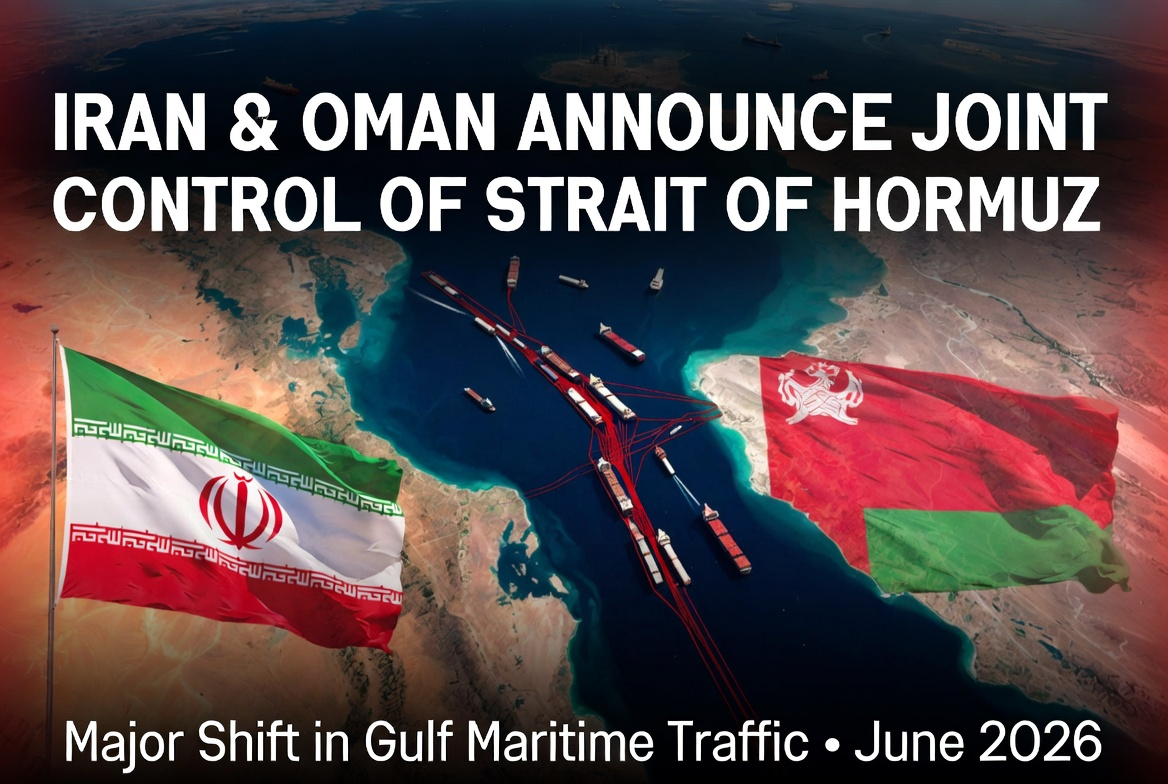
TEHRAN June 15, 2026 — Iran has declared it will jointly manage maritime traffic in the Gulf with Oman, focusing on the strategic Strait of Hormuz, according to statements reported by Iranian officials and amplified on social media.
The announcement, shared widely by accounts monitoring BRICS and geopolitical developments, highlights a bilateral framework between the two nations that border the critical waterway. Iranian Foreign Minister Abbas Araghchi and other officials have previously described the arrangement as aligned with international law, emphasizing the “natural right” of coastal states Iran and Oman to coordinate management, monitoring, and potential oversight of vessel transit.
The Strait of Hormuz, a narrow chokepoint between the Persian Gulf and the Gulf of Oman, handles roughly 20% of global seaborne oil trade. Shipping lanes primarily traverse Omani territorial waters on the south and Iranian waters on the north, making bilateral coordination geopolitically significant.
Talks between Iran and Oman on monitoring and supervising tanker traffic date back to at least April 2026, when Iranian Deputy Foreign Minister Kazem Gharibabadi announced progress on a draft protocol. The initiative gained momentum during heightened tensions in the 2026 Iran-related conflict, when Iran restricted shipping through the strait.
Recent reports indicate the two sides are preparing a joint statement on future management. This could include coordination on safety, navigation, and possibly fees or permits for commercial vessels, though details remain under discussion. Oman has historically served as a neutral mediator in Gulf affairs while maintaining ties with both Iran and the West.
The move has drawn scrutiny from the United States. President Donald Trump previously rejected any Iranian role in controlling the strait as part of potential peace deals, warning against joint toll systems and even issuing strong remarks toward Oman, a longtime U.S. partner.
U.S. officials and Gulf allies have expressed concerns that formalized Iran-Oman oversight could shift influence away from traditional Western naval presence, particularly the U.S. Fifth Fleet. However, proponents argue it could stabilize transit by establishing clearer rules post-conflict.
Oil markets have reacted sensitively to developments in the strait throughout 2026, with past restrictions causing sharp price fluctuations and rerouting of tankers.
No full text of the joint protocol has been publicly released, and implementation would likely depend on broader U.S.-Iran negotiations, including ceasefire extensions and sanctions relief. Oman has emphasized its discussions focus on safe passage without fully endorsing all Iranian proposals.
Analysts view the announcement as Iran seeking to legitimize its naval…
About The Author