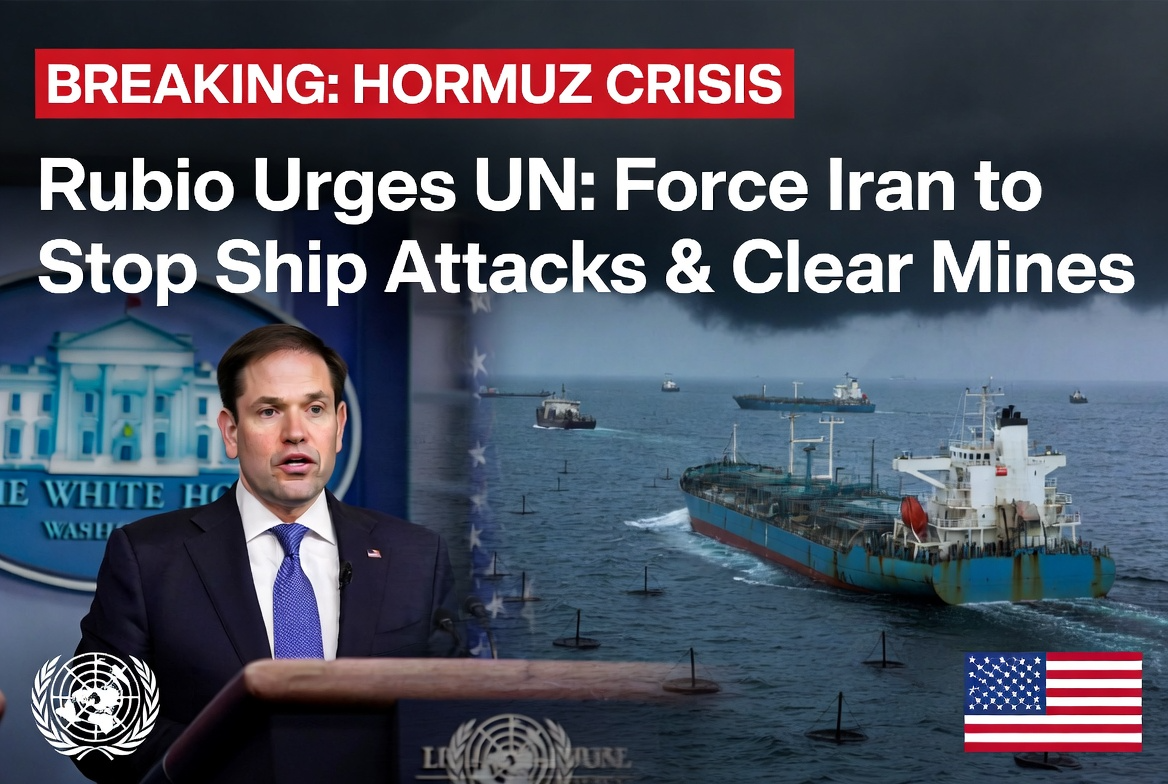
WASHINGTON, D.C. – May 6, 2026 – Secretary of State Marco Rubio urged the United Nations on Tuesday to hold Iran accountable for its ongoing disruption of the Strait of Hormuz, demanding that Tehran immediately stop attacking commercial vessels, remove sea mines, and allow humanitarian relief efforts in the vital waterway.
In pointed remarks captured in a video released by the State Department, Rubio framed the issue as a straightforward test of the UN’s relevance. “We’re asking the UN to call on Iran to stop blowing up ships, remove the mines, and allow humanitarian relief,” he said. “If the international community can’t rally behind this and solve something so straightforward, then I don’t know what the utility of the UN system is.”
The comments come as the U.S. and its Gulf partners prepare a draft Security Council resolution calling for Iranian compliance on freedom of navigation, full disclosure and removal of mines, and the creation of a humanitarian corridor for stranded crews and vessels.
The Strait of Hormuz — through which roughly 20-25% of global oil and liquefied natural gas flows — has been largely paralyzed since Iran retaliated against U.S. and Israeli strikes that began on February 28, 2026. Those operations targeted Iranian nuclear facilities, missile sites, and leadership compounds in a bid to curb Tehran’s nuclear ambitions and regional threats. Iran responded by mining the strait, attacking commercial shipping, and imposing an effective blockade, triggering sharp spikes in global energy prices and supply chain disruptions.
In recent days, the Trump administration launched “Project Freedom,” a U.S. Navy-led defensive operation to escort commercial vessels through the strait and protect them from Iranian aggression. Pentagon officials have described the mission as temporary, focused, and limited to safeguarding innocent shipping without entering Iranian waters or airspace.
Rubio’s latest statement also follows Iran’s reported conditional offers to reopen the strait in exchange for concessions — proposals the Secretary of State has swiftly rejected, insisting that international waterways cannot be subject to Iranian control, tolls, or permission-based access.
The administration has stressed that restoring free passage is not only an economic imperative but a matter of international law. Critics of the UN have pointed to the body’s past inaction on similar maritime threats, while supporters argue that a unified Security Council resolution could de-escalate the crisis and prevent further global economic fallout.
As of Tuesday, commercial traffic through the strait remains severely restricted, with stranded crews facing humanitarian concerns and
Life News Agency will continue to monitor developments at the United Nations and in the Strait of Hormuz.
About The Author