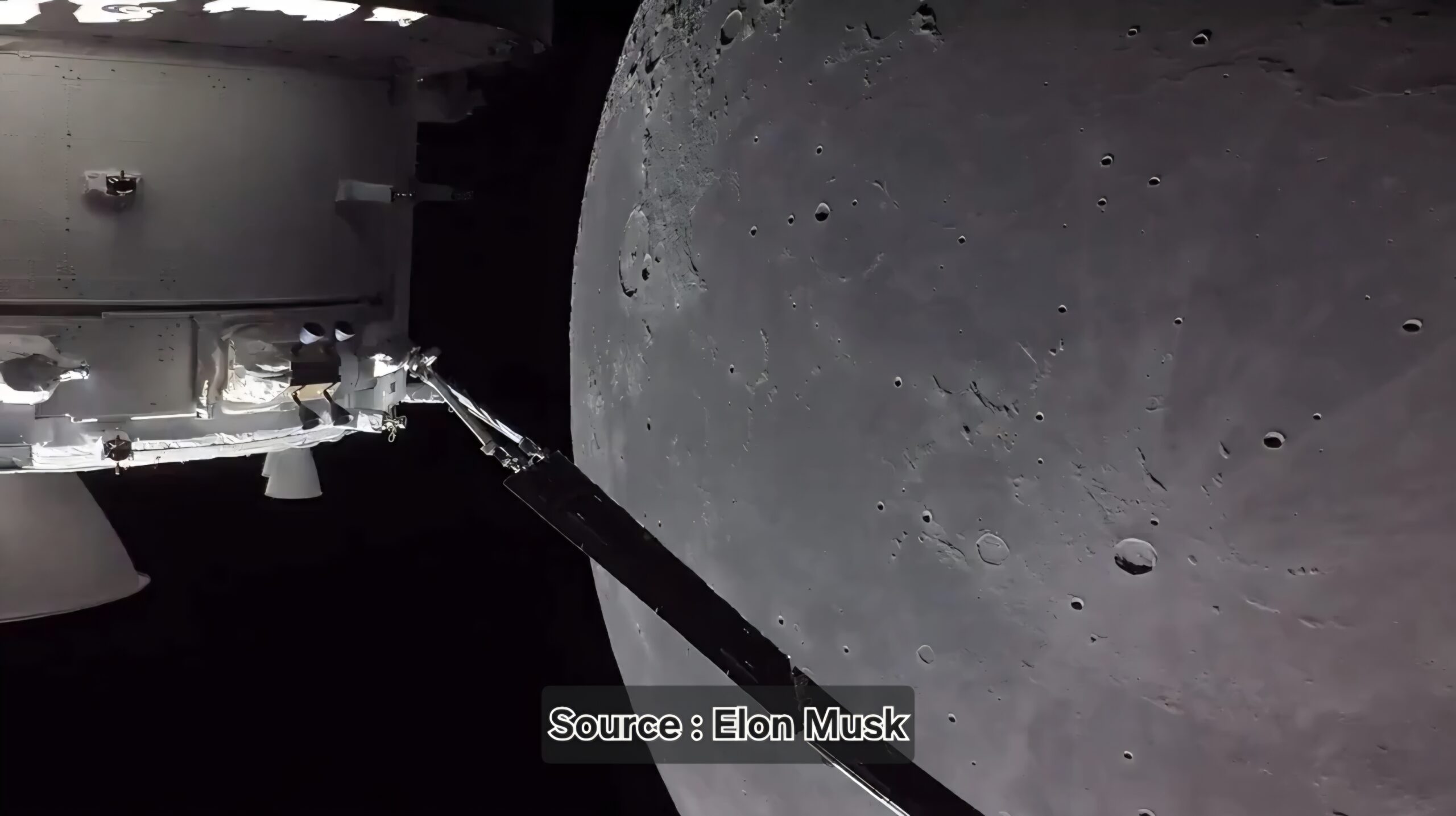
In a post that has already garnered over 23,000 likes and nearly 777,000 views within hours, SpaceX CEO Elon Musk shared stunning onboard footage of NASA’s Orion spacecraft from the Artemis II mission as it flew close to the Moon.
The video, captioned simply “NASA Artemis passing close to the Moon,” shows the white Orion capsule with its distinctive black heat shield panels and extended solar arrays gliding past the cratered lunar surface. Earth appears as a small blue marble in the distance in early frames, while later shots capture dramatic close-ups of the Moon’s rugged terrain against the blackness of space. The footage highlights the spacecraft’s proximity during the flyby, offering a visceral sense of humanity’s return to lunar vicinity.
The timing is no coincidence. Artemis II, NASA’s first crewed mission in the Artemis program, launched on April 1, 2026, from Kennedy Space Center in Florida. On April 6, the four-person crew — Commander Reid Wiseman, Pilot Victor Glover, Mission Specialist Christina Koch, and Canadian astronaut Jeremy Hansen — conducted a historic lunar flyby, passing as close as approximately 4,000 miles (about 6,400 km) from the Moon’s surface. During the six-hour flyby, the crew observed the far side of the Moon while briefly losing communications with Earth due to the lunar blackout. The mission also broke the Apollo 13 record for the farthest distance humans have traveled from Earth, reaching over 252,000 miles.
This marks the first time humans have ventured into deep space near the Moon since the Apollo era more than 50 years ago. Unlike Artemis I (the uncrewed test flight in 2022), Artemis II carries a live crew, testing the Orion spacecraft’s life-support systems, navigation, and re-entry capabilities ahead of future landings. The crew is scheduled to splash down in the Pacific Ocean around April 10.
Musk’s share of the footage comes as excitement builds around the Artemis program’s long-term goals: establishing a sustainable human presence on the Moon, including a lunar base, and eventually sending astronauts to Mars. Several replies to Musk’s post echoed this optimism, with users writing, “Soon we will have a permanent base on the moon” and “One day a Starship will land there.”
NASA scientists and lunar experts monitored the flyby in real time from mission control in Houston, using the opportunity for scientific observations of the lunar surface. The mission paves the way for Artemis III, which will attempt the first crewed lunar landing since 1972, with SpaceX’s Starship human landing system playing a key role.
The viral video has sparked widespread awe and discussion online, reminding the world of the wonder of space exploration. As one commenter put it: “God’s creations are incredible. God is good!”
Life News Agency will continue to monitor the Artemis II mission and provide updates as the crew completes their historic journey back to Earth. Stay tuned for more on this new chapter in humanity’s exploration of the Moon. 🚀🌕
About The Author