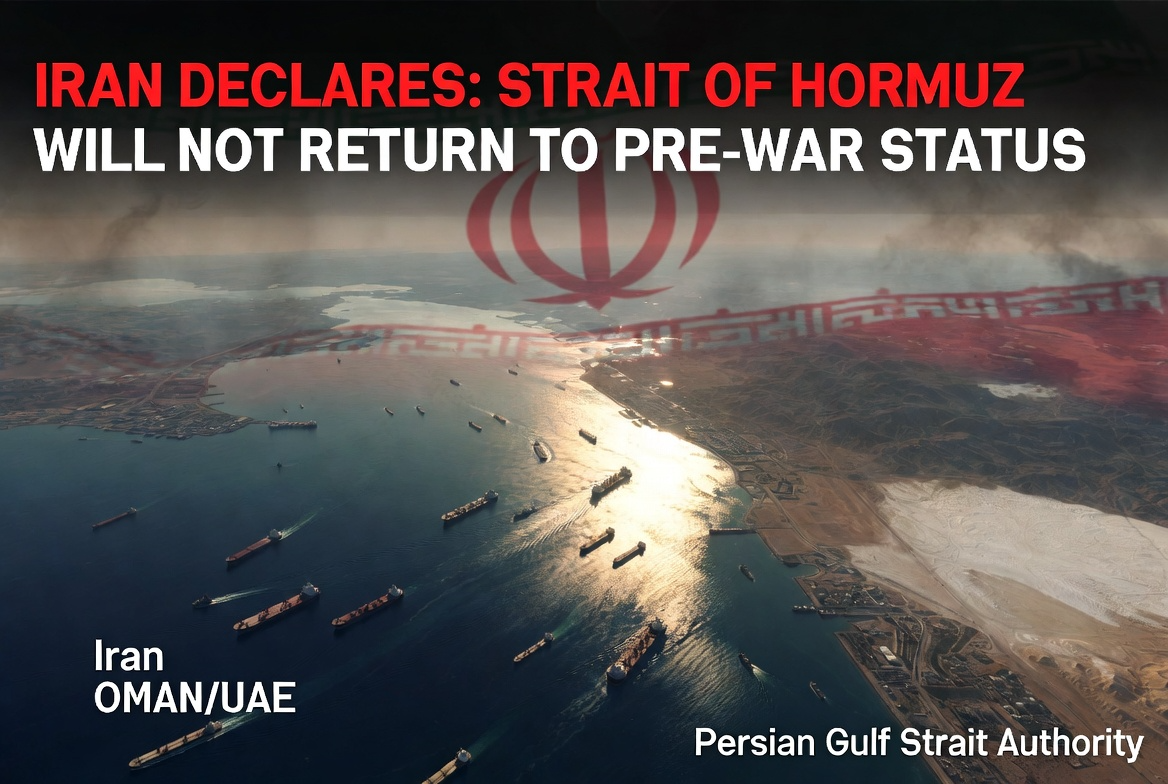
TEHRAN, May 25, 2026 — An Iranian official has stated that management of the strategically vital Strait of Hormuz will not revert to its pre-war conditions, even as diplomatic efforts between Iran, the United States, and other parties advance toward a potential ceasefire in the 2026 Iran conflict.
The declaration, reported via state-aligned media and amplified on social platforms, underscores Tehran’s intention to maintain enhanced sovereign controls over the waterway through its newly established Persian Gulf Strait Authority (PGSA).
Iran formally launched the PGSA on May 5, 2026, during the height of the Strait of Hormuz crisis. The agency requires vessels to obtain prior authorization for transit, submit detailed information (including ship identification, cargo, crew nationalities, and route plans), and coordinate with Iranian authorities, often via the Islamic Revolutionary Guard Corps (IRGC) Navy.
The PGSA has also published maps defining a broad “controlled maritime zone” that extends across much of the strait, reaching into areas claimed by the UAE and Oman. Officials describe this as a framework for traffic management, security, and potential fees framed as contributions for services like navigation support and environmental protection.
The strait — through which roughly 20% of global oil and liquefied natural gas transits — has been a flashpoint since late February 2026. Iran initially restricted shipping in response to U.S. and Israeli military actions, leading to attacks on vessels, a sharp drop in traffic, and mutual blockades. This contributed to global energy market volatility.
Recent reports indicate Iran has coordinated safe passage for dozens of vessels in recent days (e.g., 26–33 ships in 24-hour periods), but under its new regulatory regime rather than unrestricted pre-war norms.
U.S. President Donald Trump has claimed progress toward reopening the strait as part of broader negotiations, including sanctions relief and nuclear-related discussions. However, Iranian sources, including Fars News Agency, emphasize that any agreement would restore shipping volumes to pre-war levels (around 125–140 vessels daily) within 30 days but preserve Iranian management authority.
International reactions have been critical:
- Analysts and Western governments argue that imposing tolls or mandatory authorizations violates long-standing principles of freedom of navigation under international maritime law (e.g., UNCLOS transit passage regime).
- Shipping industry stakeholders face higher insurance costs, compliance risks with sanctions, and uncertainty over potential fees reportedly reaching up to $2 million per vessel in some proposals.
- Regional players like Oman and the UAE are reportedly engaged in parallel discussions, while alternatives such as expanded Red Sea routes are being pursued by Gulf states.
The PGSA’s operations have drawn comparisons to administrative bodies like the Panama Canal Authority, though critics note key differences in legal sovereignty and international recognition.
As fragile ceasefire talks continue, the future of the Strait of Hormuz remains a core sticking point. Iran’s firm stance signals a strategic shift toward long-term leverage over one of the world’s most critical energy chokepoints, with potential ripple effects for global oil prices, shipping insurance, and regional stability.
This situation continues to evolve rapidly. Further updates are expected from ongoing U.S.-Iran mediated negotiations.
About The Author