By TPr Prof. Dr Goh Hong Ching
Antarctica may be geographically distant from Malaysia, but its scientific significance extends far beyond the frozen continent. From understanding global environmental change to investigating the fundamental nature of the universe, polar research addresses questions that matter to countries across different geographical and climatic regions.
For Malaysia, the challenge goes beyond participating in Antarctic research; it is to determine how its scientific strengths and international partnerships can contribute meaningfully to this expanding field.
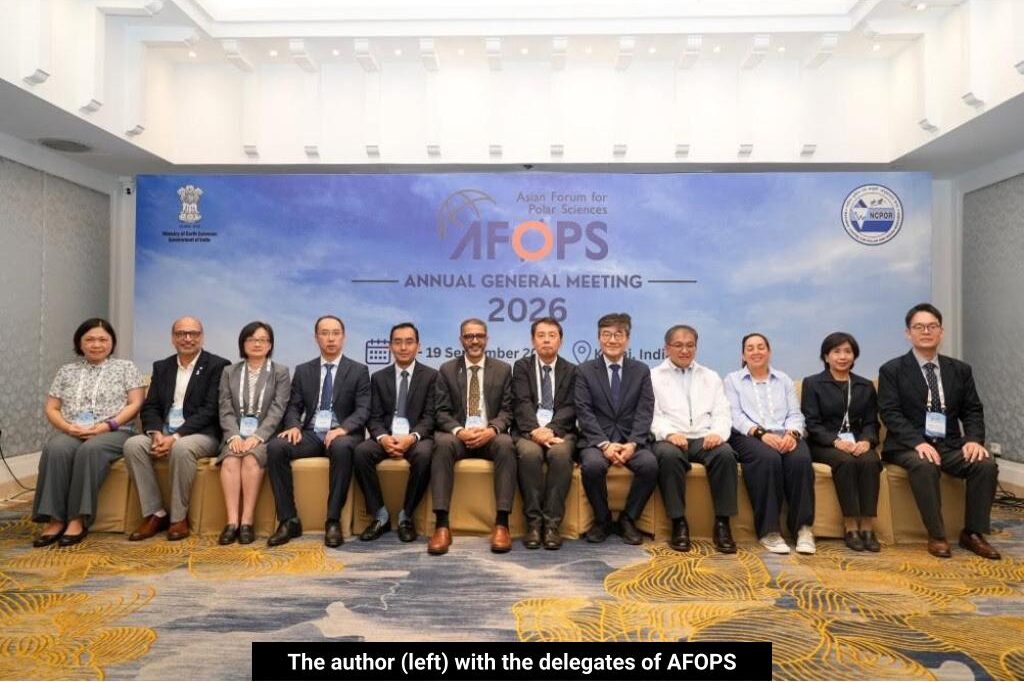
This question gained renewed relevance at the 2026 Annual General Meeting of the Asian Forum for Polar Sciences (AFoPS) in Kochi, India. The meeting brought together Asian polar institutions to strengthen regional cooperation and consider emerging priorities in international polar research.
Malaysia, represented in AFoPS by the National Antarctic Research Centre (NARC) at Universiti Malaya, has long recognised the importance of international partnerships in advancing its Antarctic research. Lacking the extensive polar infrastructure maintained by some established Antarctic nations, Malaysia relies on collaboration to access expertise, strengthen research capabilities and contribute to international scientific initiatives.
Yet the significance of such cooperation extends beyond access to facilities. It also concerns the knowledge Malaysia can contribute and the scientific relationships it can help shape.
Strengthening regional scientific partnerships
One important development is the strengthening of cooperation between NARC and the Polar Research Institute of China (PRIC) through a Memorandum of Understanding signed in conjunction with the AFoPS meeting.
The agreement provides a framework for joint research, researcher development and knowledge exchange, while opening opportunities for Malaysian scientists to engage with China’s established polar research expertise and infrastructure.
PRIC also hosts the permanent AFoPS Secretariat, reinforcing the importance of regional networks in connecting institutions with different scientific capabilities and resources.
For Malaysia, the value of these partnerships should ultimately be measured less by the number of agreements signed than by their ability to generate sustained research collaboration, scientific outputs and opportunities for researchers.
Investing in the next generation
Equally important is the development of young scientists who will shape the future of Asian polar research.
The AFoPS Summer School for Early-Career Polar Scientists, hosted by PRIC and Shanghai Jiao Tong University in July 2026, brought together 64 researchers from 10 countries and regions. Three Malaysian early-career researchers participated with full or partial funding support, while two established Malaysian Antarctic scientists contributed as invited speakers.
Beyond the physical and natural sciences, the programme addressed international polar governance, leadership, human impacts and cross-cultural collaboration, including a simulated AFoPS Future Polar Leaders Meeting.
This broader approach is significant. Future polar scientists must be able to work across disciplines, national boundaries and cultural contexts. Scientific expertise remains essential, but so too are the abilities to collaborate, negotiate and understand the wider environmental and societal responsibilities associated with polar research.
For Malaysia, nurturing researchers with these capabilities is an investment not only in Antarctic science, but also in international scientific leadership.
What can Malaysia contribute?
Malaysia’s role in polar research should not be defined solely by the infrastructure it possesses or its geographical distance from Antarctica.
As a tropical country, Malaysia can offer perspectives that complement those of established polar research nations, particularly in understanding polar–tropical connections, global environmental change, human–environment interactions, governance and the societal implications of environmental transformation.
The polar regions are closely connected to wider planetary systems. Changes occurring at high latitudes can have consequences far beyond the poles, making their study relevant to countries such as Malaysia.
Antarctica’s scientific importance also extends beyond climate and environmental research.
The 2026 Nobel Prize in Physics, awarded solely to Francis Halzen of the University of Wisconsin–Madison for his decisive contributions to the IceCube Neutrino Observatory and the discovery of high-energy neutrinos of astrophysical origin, provides a remarkable example. Using deep Antarctic ice to detect elusive particles from distant astrophysical sources, IceCube demonstrates how Antarctica can serve as a unique environment for fundamental scientific discovery.
This achievement offers inspiration to Malaysia’s scientific community, including our fellow researchers at the National Centre for Particle Physics (NCPP) based in Universiti Malaya. It illustrates the opportunities for interdisciplinary exchange and reminds us that Antarctic research can connect fields as diverse as environmental science, physics and international governance.
Looking towards the next International Polar Year
These developments are particularly timely as the international polar community prepares for the Fifth International Polar Year (IPY-5) in 2032–2033.
The Korea Polar Research Institute (KOPRI), another AFoPS member, is part of the international consortium hosting the International Coordination Office for IPY-5. Within AFoPS, members are also exploring opportunities for joint scientific contributions and the development of future polar research leaders.
For Malaysia, the years leading towards IPY-5 offer an opportunity to translate regional partnerships into tangible outcomes, including researcher exchanges, collaborative expeditions, joint projects and greater participation in international scientific and governance discussions.
However, meaningful engagement requires more than participation in international meetings or the signing of cooperation agreements. It calls for sustained institutional commitment, investment in scientific talent and research partnerships built around complementary expertise and shared priorities.
Malaysia’s geographical distance from Antarctica need not translate into intellectual distance. Its tropical location, scientific capabilities and international partnerships provide a foundation for contributing distinctive perspectives to polar research.
As Asia’s role in international polar science continues to evolve, the question for Malaysia is not simply how to participate, but how to contribute knowledge, develop scientific leadership and help shape the future of polar research, particularly in understanding how changes in Antarctica affect the tropics, and how the tropics in turn influence Antarctica.

The author is currently the deputy director of the National Antarctic Research Centre and a professor in the Department of Urban and Regional Planning, Faculty of Built Environment, Universiti Malaya.
About The Author