FLORIDA Sept 5, 2026 – The United States said Saturday it struck three Iranian oil tankers after Iran’s Islamic Revolutionary Guard Corps fired ballistic missiles at two American warships, then issued a blunt warning that further attacks on U.S. vessels would be met by the destruction of Iran’s oil fleet.
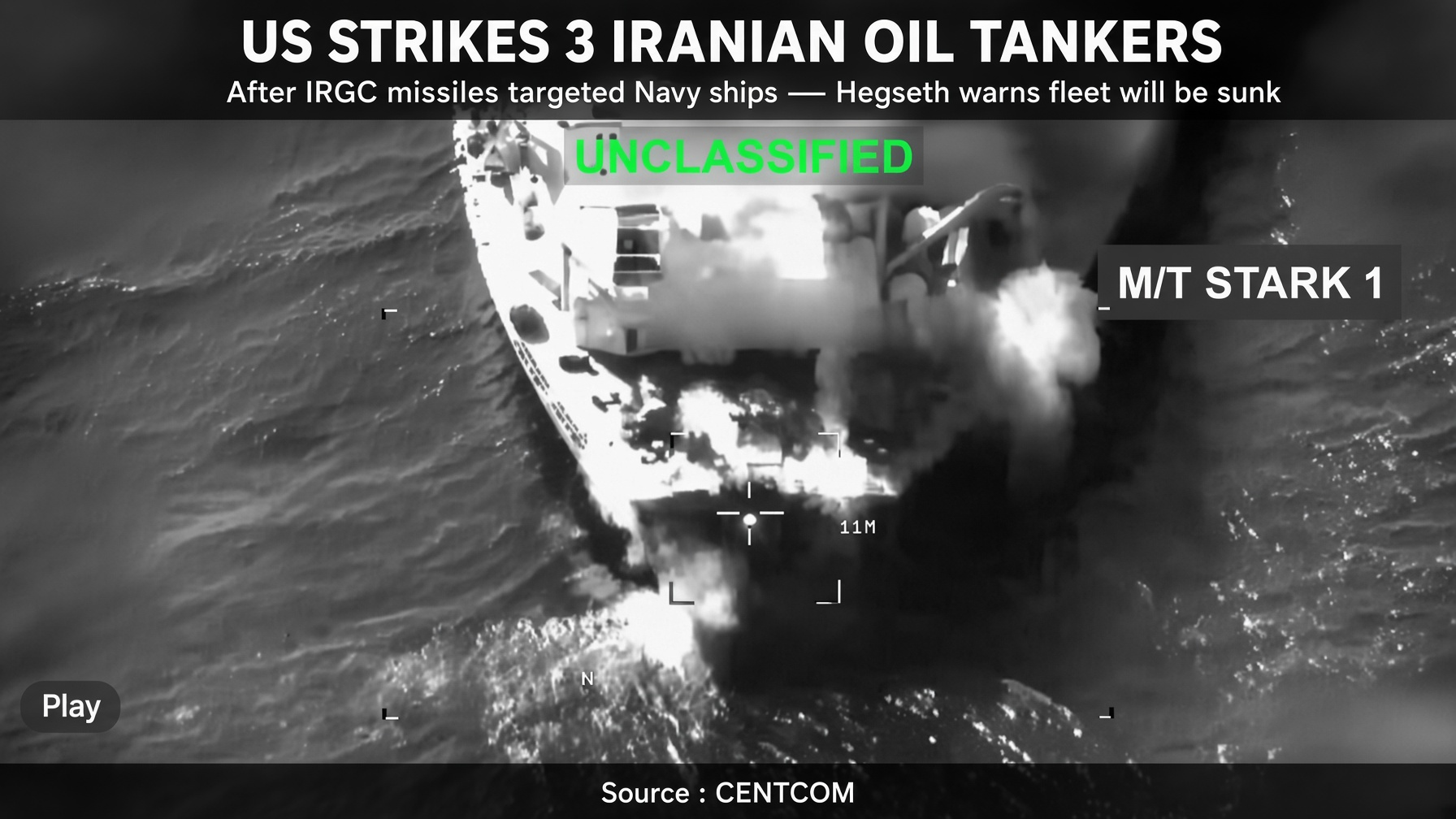
U.S. Central Command said an aircraft carrier and a guided-missile destroyer evaded the missiles while patrolling regional waters and that no American personnel were harmed. In response, U.S. forces “permanently disabled” the M/T Downy off Kharg Island and the M/T Stark 1 near Jask, and “completely destroyed” the unladen M/T Kylo in the Gulf of Oman after directing its crew to abandon ship.
CENTCOM released footage of the strikes, showing explosions and fires on one of the tankers.
Adm. Brad Cooper, the CENTCOM commander, said the tankers belonged to a “multibillion-dollar shadow network” that funds the IRGC and its regional proxies. “If you shoot at two of our ships, we will impose an even higher economic cost — taking out three of yours,” he said. “We will not hesitate to defend American forces, and if necessary, destroy Iran’s limited and exposed oil fleet.”
Defense Secretary Pete Hegseth followed with a sharper public message. “It’s simple: if Iran shoots at U.S. ships, we will destroy (and sink) their oil tankers,” he posted. “All they have to do is not shoot at the U.S. Navy. Iran’s oil tanker fleet is defenseless.” That warning was quickly amplified by accounts covering BRICS and geopolitics.
Iran condemned the strikes as a violation of international law and a continuation of the U.S. naval blockade. State media reported that crews from the hit tankers were evacuated and that the IRGC later targeted six other vessels, including three oil tankers it said were using unauthorized routes through the Strait of Hormuz. The U.S. military has not confirmed those Iranian claims.
Kharg Island handles the bulk of Iran’s oil exports. The latest exchange marks another flare-up in a six-month conflict that has repeatedly disrupted shipping through the Strait of Hormuz, a chokepoint for global energy supplies.
Washington has described the tanker strikes as part of a “tanker-for-tanker” policy meant to raise the economic cost of Iranian attacks on shipping. Tehran says the U.S. campaign amounts to economic warfare and has vowed to defend its commercial vessels. Both sides remain far from any diplomatic off-ramp.
About The Author