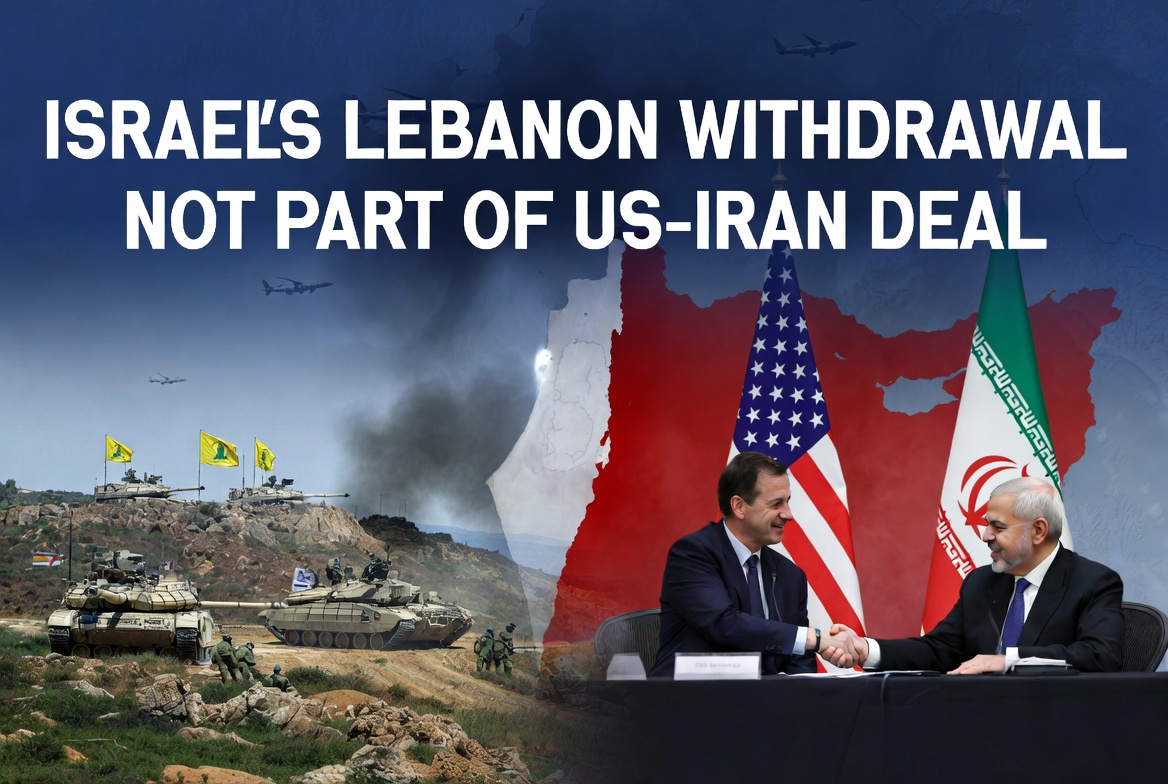
WASHINGTON D.C June 15, 2026 — A senior US official has clarified that Israel’s military withdrawal from southern Lebanon is not included in the preliminary agreement reached between the United States and Iran aimed at de-escalating broader regional hostilities.
The tentative deal, which includes reopening the Strait of Hormuz, extending a fragile ceasefire, and addressing aspects of Iran’s nuclear program, has raised hopes for reduced tensions following months of conflict. However, the exclusion of Lebanon from core bilateral terms highlights significant sticking points, as Iran has previously linked regional de-escalation—including a ceasefire in Lebanon—to any comprehensive understanding with Washington.
Israeli officials have firmly rejected any obligation to pull forces from areas seized in southern Lebanon. Defense Minister Israel Katz stated that Israeli troops will maintain an indefinite presence in “security zones” in Lebanon, as well as in parts of Syria and Gaza, describing them as essential buffers for national security against threats from groups like Hezbollah.
Prime Minister Benjamin Netanyahu reportedly conveyed this position directly to US President Donald Trump, emphasizing that Israel does not consider itself bound by any Lebanon-related clauses in the US-Iran framework. Israeli sources indicated that operations against Hezbollah infrastructure would continue where deemed necessary.
The stance has drawn sharp reactions. Iranian officials and proxies have insisted that Lebanon must be part of any lasting deal, with some warning that the absence of a withdrawal commitment could jeopardize the broader agreement. In Lebanon, where Israeli forces continue to hold positions amid ongoing strikes and displacement, the developments have fueled uncertainty and relief in some areas hoping for calm, even as tensions persist.
Negotiations on Israel’s presence in southern Lebanon are reportedly scheduled for June 22 in Washington, separate from the US-Iran track. The situation underscores the complex, multi-layered nature of the conflict, with Israel operating independently despite not being a direct party to the US-Iran talks.
Analysts warn that without alignment on ground realities in Lebanon, the tentative ceasefire risks remaining fragile, potentially leading to renewed escalation. Markets reacted positively to news of the US-Iran understanding earlier, but ongoing developments could influence stability in energy routes like the Strait of Hormuz.
This story is developing.
About The Author