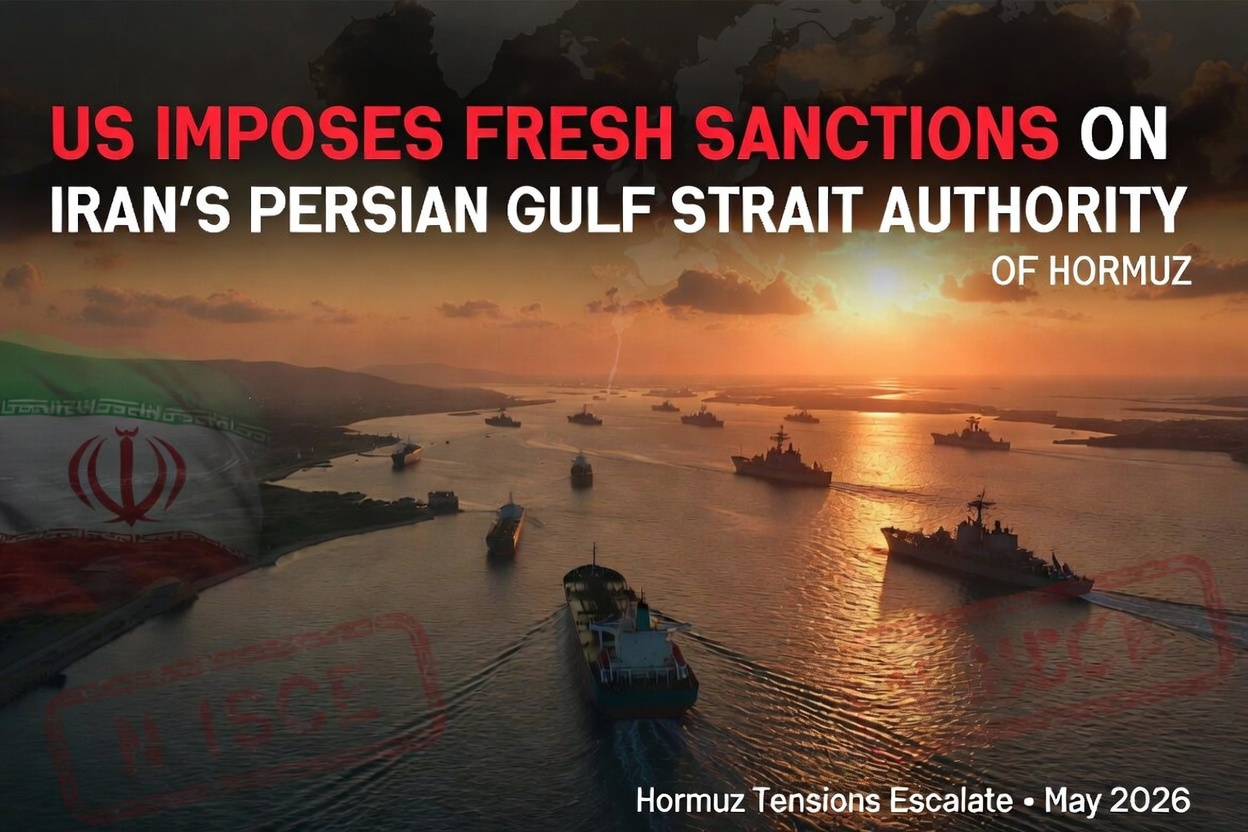
WASHINGTON D.C , May 28, 2026 — The United States has added Iran’s newly established Persian Gulf Strait Authority to its sanctions list, targeting the body accused of coordinating “illegitimate tolls” on vessels transiting the Strait of Hormuz and channeling revenue to the Islamic Revolutionary Guard Corps (IRGC).
The U.S. Treasury Department’s Office of Foreign Assets Control (OFAC) announced the move on Wednesday, placing the authority on the Specially Designated Nationals (SDN) list. This action extends sanctions risks to any international companies, vessels, or entities doing business with it.
Iran created the Persian Gulf Strait Authority on May 18 to manage shipping through the strategic waterway, which handles about one-fifth of global oil trade. Tehran has denied imposing tolls, but U.S. officials allege the body works with the IRGC to direct traffic and extract payments—potentially up to $2 million per ship—from commercial vessels.
This latest escalation comes as part of the Trump administration’s “Economic Fury” campaign, which includes a U.S. naval blockade of Iranian ports since mid-April. The sanctions aim to counter Iran’s efforts to control the strait amid stalled ceasefire talks and fluctuating oil prices.
The Strait of Hormuz has been a flashpoint since Iran restricted access in response to U.S. and allied military actions earlier this year. Negotiators have circulated draft agreements for a ceasefire extension, potential reopening of the strait, and partial sanctions relief, but neither President Trump nor Iran’s Supreme Leader has provided final approval.
Market reactions remain volatile: Oil prices have whipsawed on ceasefire rumors, with Brent crude recently trading near $90–$97 per barrel depending on headline shifts. Shipping and insurance costs have risen, affecting global energy markets.
Iranian officials and supporters have dismissed the sanctions as ineffective after decades of similar measures, arguing they have not altered Tehran’s behavior but instead strengthened its shadow fleet networks. Critics note the human cost, with ripple effects on ordinary Iranians through currency devaluation and economic strain.
U.S. Treasury officials, including Secretary Scott Bessent, have signaled that sanctions will persist until Iran reopens the strait, addresses its nuclear program (including enriched uranium stockpiles), and makes broader concessions.
Third-party nations and shipping firms now face heightened compliance risks. The Treasury has warned that payments to Iran for passage could expose entities to secondary sanctions and cutoff from the U.S. financial system.
As diplomatic efforts continue—reportedly mediated in part by Oman and others—the new sanctions underscore the intertwined military, economic, and maritime dimensions of the U.S.-Iran standoff. Global markets will likely continue monitoring developments closely for any breakthrough or further escalation.
About The Author