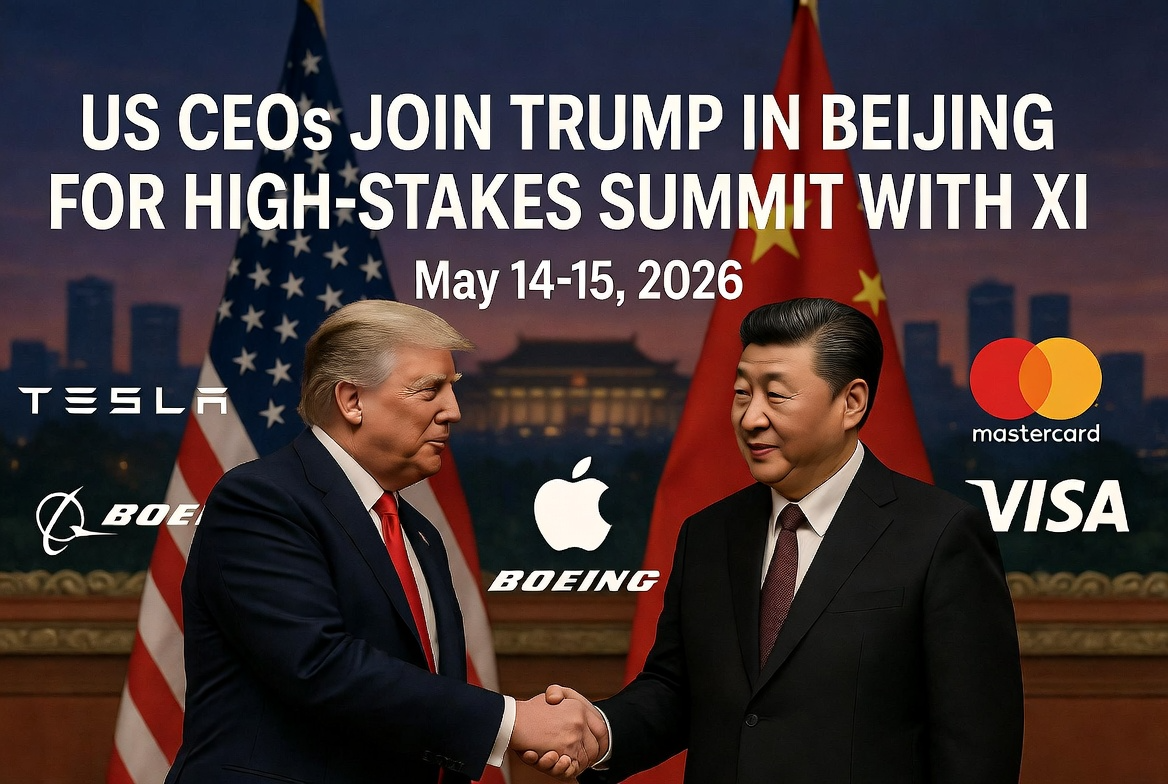
BEIJING/WASHINGTON, May 12, 2026 — President Donald Trump will arrive in China this week with a high-profile delegation of more than a dozen U.S. chief executives, including leaders from Tesla, Apple, Boeing, BlackRock, and major payment networks, for talks with Chinese President Xi Jinping focused on resolving long-standing business hurdles rather than grand trade announcements.
The two-day summit on May 14-15 — part of a state visit running May 13-15 — comes as U.S. companies navigate regulatory scrutiny, supply chain risks, and market access challenges in the world’s second-largest economy. According to a White House official and sources familiar with the planning, the delegation was deliberately scaled back from Trump’s more ceremonial 2017 visit to China, which featured elaborate pageantry and major purchase agreements.
“From Tesla to Apple to Boeing, the U.S. business delegation … consists mainly of companies seeking to resolve business issues with the world’s second-largest economy,” Reuters reported in its coverage of the trip.
Executives were reportedly chosen in part because they have “tangible asks” that could yield concrete outcomes, such as regulatory approvals or improved market access. The emphasis is on company-specific deliverables over broad diplomatic deals.
Key Executives and Priorities
- Tesla CEO Elon Musk: Pushing for Chinese regulatory clearance to expand Full Self-Driving (FSD) technology adoption in China, the world’s largest auto market. Tesla is also seeking approvals for nearly $3 billion in solar manufacturing equipment purchases from Chinese suppliers amid potential export curbs.
- Apple CEO Tim Cook: Representing a company deeply reliant on Chinese manufacturing and sales.
- Boeing CEO Kelly Ortberg: Linked to potential aircraft purchase agreements.
- BlackRock CEO Larry Fink: Attending as his firm faces Beijing’s scrutiny over a $23 billion consortium-led acquisition of ports, including assets near the Panama Canal.
- Payment giants Mastercard and Visa: Aiming to expand in China’s tightly regulated payments market. Mastercard hopes to increase its stake in its local joint venture, while Visa seeks approval for full ownership of a domestic bank-card clearing license.
- Other notable participants: Citigroup CEO Jane Fraser and Goldman Sachs CEO David Solomon (seeking deeper capital markets access, including a wholly owned securities brokerage license for Citi); Illumina CEO Jacob Thaysen (working to rebuild operations after a previous export ban and “unreliable entity” listing); and Meta executives (tackling an order to unwind a $2 billion-plus AI startup acquisition amid tightened scrutiny of U.S. tech investments).
Additional firms mentioned include Coherent (navigating export controls on critical materials for optical chips) and Cargill (potential agricultural purchase agreements).
U.S. firms view the summit less as a venue for flashy announcements and more as a political opening to accelerate ongoing regulatory talks in Beijing, according to people familiar with the preparations.
Geopolitical and Economic Context
Geopolitical strategist Reva Goujon of Rhodium Group noted that many executives are focused on securing reliable supply of critical inputs. “Besides Boeing and Cargill being linked to purchase agreements, the others are mainly there to deliver demands on critical input supply,” Goujon said. “This could help the U.S. administration’s messaging that to even be able to discuss a board of investment, China needs to be a reliable investment partner and not weaponise supply.”
The trip occurs against a backdrop of persistent U.S.-China tensions over technology export controls, biotech security, investment scrutiny, and supply-chain dependencies. Expectations for major new soybean or agricultural purchases remain modest, with analysts anticipating possible incremental farm deals but no blockbuster trade breakthroughs.
Illumina highlighted the trip’s potential in a statement: “This is an opportunity to strengthen relationships and shape the future of precision medicine.”
With U.S. companies deeply intertwined with Chinese markets and manufacturing, the delegation underscores how economic realities continue to shape bilateral engagement despite political rhetoric. Outcomes from the summit remain uncertain just days before the meetings, but the business-heavy contingent signals Washington’s focus on delivering tangible results for American firms.
About The Author