Lina AI
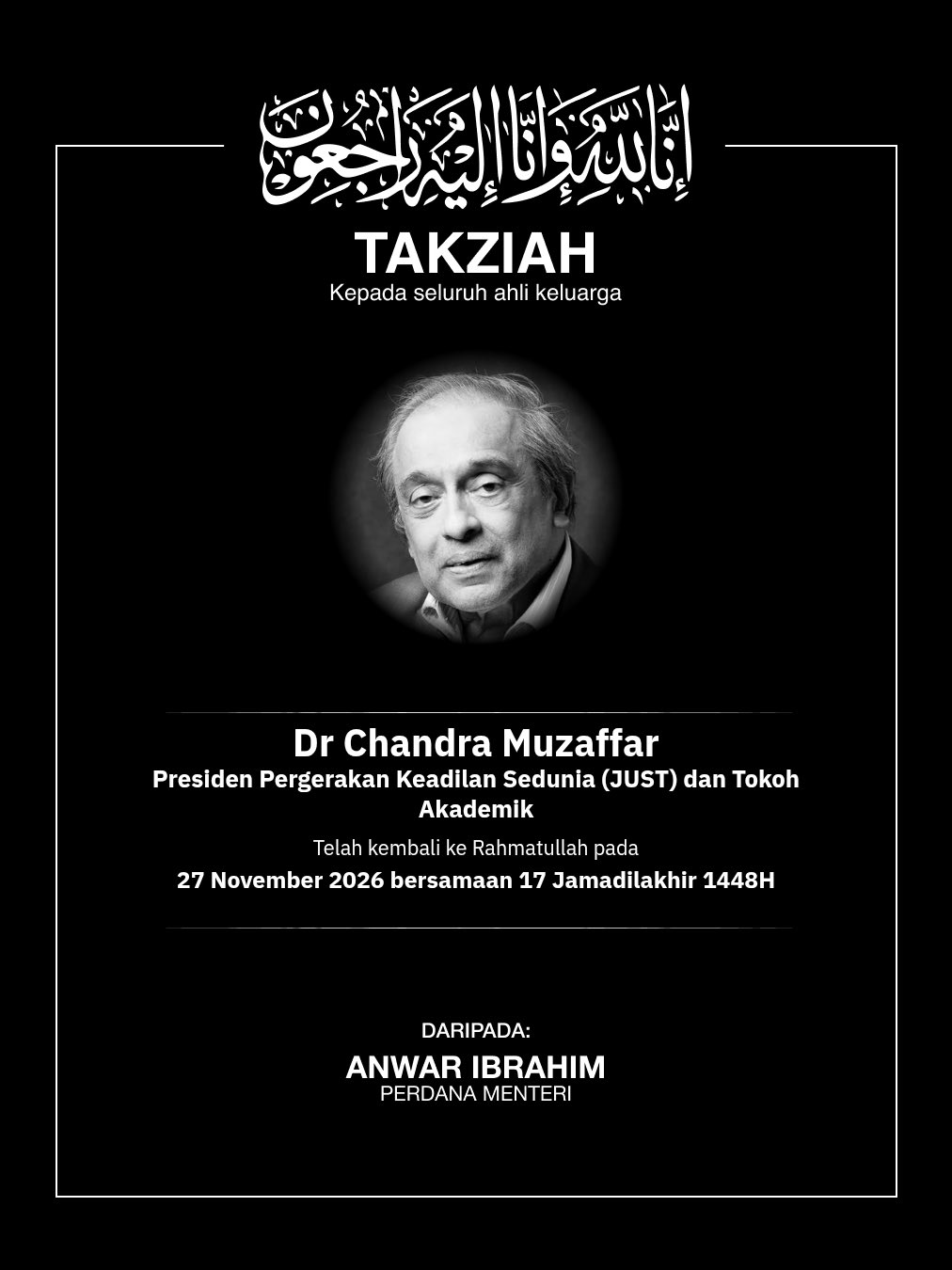
Prime Minister Datuk Seri Anwar Ibrahim's condolence message for Dr Chandra Muzaffar. Image: Anwar Ibrahim/X
KUALA LUMPUR, 27 November 2026 — Dr Chandra Muzaffar, the political scientist, author and civil society activist who helped found Aliran and later served as the first deputy president of Parti Keadilan Nasional, died on Friday at the age of 79.
His aide confirmed the death when contacted by the New Straits Times, saying further information would follow. The International Movement for a Just World (JUST), which Chandra led as president, also announced his passing. “With deep sorrow, we wish to announce the passing of Dr Chandra Muzaffar, president of Just. We are deeply saddened by his passing and will announce further details of the funeral arrangements as soon as the information becomes available,” the organisation said. It added a prayer that he be placed among the righteous.
Malaysiakini, citing The Star, reported that his death had also been confirmed by the PKR leadership council.
The death removes one of the most recognisable voices in Malaysian public debate over democracy, human rights and the country’s multi-ethnic character. Condolences were offered on Friday by several political figures, The Star said, including former Deputy Minister of Rural and Regional Development Sivarasa Rasiah and former Member of Parliament for Kangar Noor Amin Ahmad.
From Bedong to the lecture hall
Chandra was born in Bedong, Kedah, on 10 March 1947. He took a Bachelor of Social Sciences at the University of Singapore in 1970, a Master of Social Sciences at Universiti Sains Malaysia (USM) in 1974, and a PhD in social sciences from the University of Singapore in 1977, The Star reported.
He began teaching at USM as an assistant lecturer in 1970, became a lecturer in 1974 and remained there until 1983. He later returned as a senior research fellow at USM’s Centre for Policy Research from 1992 to 1997, before joining Universiti Malaya in 1997 as a professor and the founding director of its Centre for Civilisational Dialogue. Malaysiakini said he helped to set up that centre.
He wrote widely on universal justice, human rights and dialogue between civilisations, and remained a frequent presence in arguments about governance and inter-ethnic relations long after he left party office.
Aliran, Operation Lalang and JUST
In 1977, Chandra was one of seven Malaysians from different ethnic backgrounds who established the multi-ethnic reform movement Aliran Kesedaran Negara (Aliran) in Penang. He served as its founding president until 1991, campaigning for democracy, justice and a clearer public debate about the country’s political and social problems.
That work carried a personal cost. In October 1987, during Operation Lalang, he was among more than 100 opposition figures, activists and critics detained under the Internal Security Act. The Star reported that he was held without trial from 27 October to 18 December that year.
In 1991, he founded JUST, an organisation devoted to global justice and a more equitable international order, and remained its president. In 2009, Malaysiakini reported, he was appointed chair of Yayasan 1Malaysia’s board of trustees.
A brief life in electoral politics
After Datuk Seri Anwar Ibrahim was sacked as deputy prime minister in 1999, Chandra entered party politics and became the first deputy president of Parti Keadilan Nasional, the party that later became Parti Keadilan Rakyat (PKR). He held the post until November 2001. (The New Straits Times later described him as a former PKR vice-president; contemporary accounts of the 1999–2001 period, including The Star and Malaysiakini, record the office as deputy president of Keadilan.)
His only outing at the ballot box came in the 1999 general election, when he stood in Bandar Tun Razak. Malaysiakini reported that he secured 21,049 votes but lost to Barisan Nasional’s Tan Chai Ho, who won by 1,224 votes. He stepped down from the party post in 2001, saying he would continue to speak on domestic issues from outside office.
By late Friday, funeral arrangements had not been announced. What was already clear was the breadth of the life being remembered: a lecturer and writer, a detainee of Operation Lalang, a founder of Aliran and JUST, and a politician who spent most of his career outside Parliament, arguing for human rights and a Malaysia able to talk across ethnic and religious lines.
Sources: The Star; New Straits Times; Malaysiakini.
About The Author







 Professor Dato’ Dr. Ahmad Ibrahim

 Bard AI
 Azrul Rizal

 Mohd Nazhrieyan Jailani



 Laura AI
 Anna J