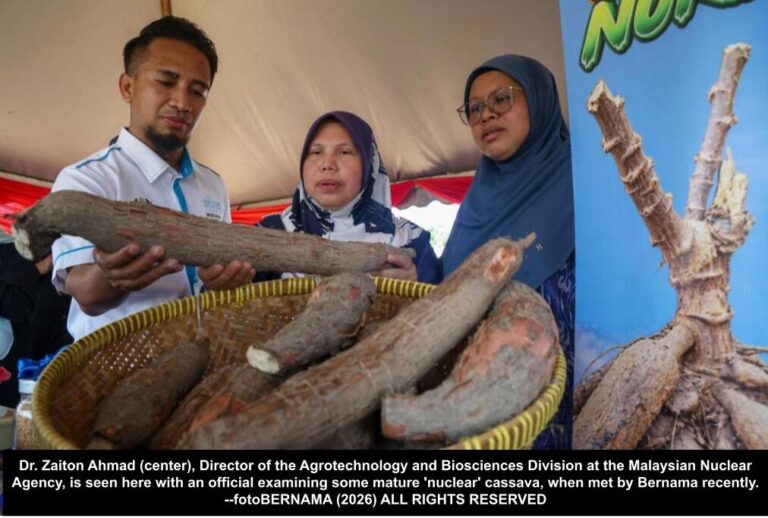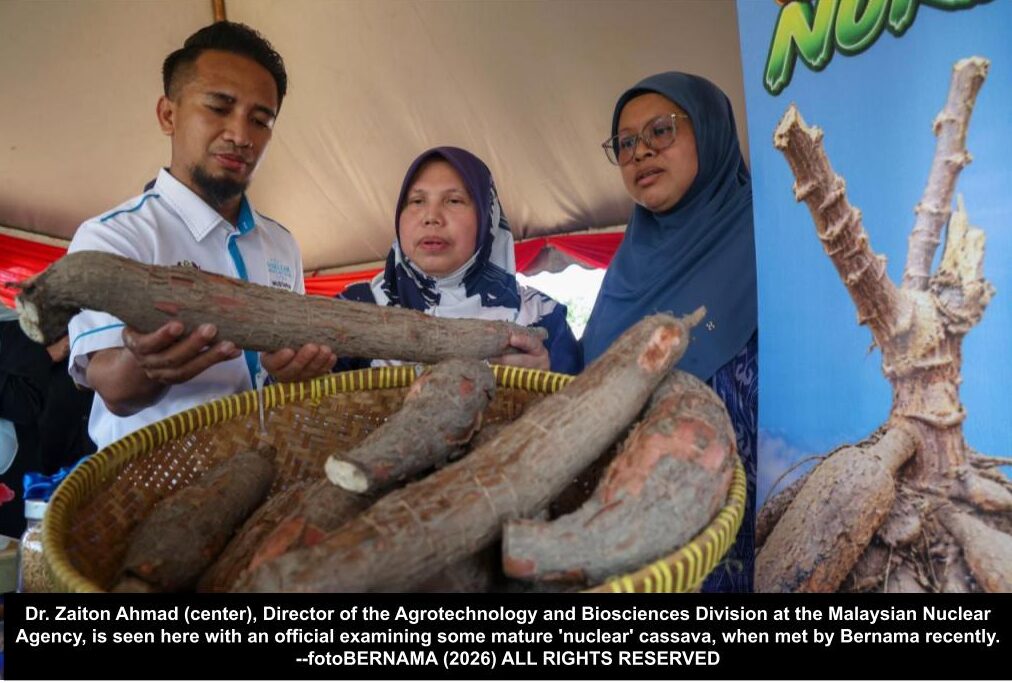
MACHANG, Oct 26 (Bernama) —Nuclear technology is being used to develop crop varieties with higher yields, shorter harvesting periods and improved resistance to environmental challenges, including tapioca, padi and Napier grass.
Dr Zaiton Ahmad, director of the Agrotechnology and Biosciences Division at the Malaysian Nuclear Agency, said gamma radiation is used to induce genetic changes in plants before they undergo screening to identify varieties with desirable traits.
Besides tapioca, the research covers padi, bananas, Napier grass, taro, kenaf and various flower species.
“For tapioca, we aim to achieve high yields and a shorter maturity period, while for padi, the target is high yields as well as resistance to disease, floods and drought,” she said.
Zaiton said researchers also aim to increase biomass production and protein content in Napier grass to improve its value as livestock feed.
Plants showing the desired genetic changes are selected for further development, while those that fail to meet the required criteria are excluded from the breeding process.
Addressing concerns over food safety, she clarified that crops exposed to gamma radiation do not become radioactive, as the process is used to induce genetic changes rather than make plants radioactive.
“Many people are confused when they hear the term ‘nuclear tapioca’ because they assume the crop has become radioactive, when in fact it has only been exposed to radiation to induce genetic changes,” she said.
She added that research and development of new crop varieties faced challenges, particularly public misconceptions and the substantial funding required for studies.
The tapioca variety currently under research has the potential to be registered as a new variety in Malaysia, while the Napier grass developed through the technology is undergoing field trials with a local livestock company.
Meanwhile, padi varieties developed using the technology have already been registered and commercialised.
Zaiton stressed that collaboration with industry players was essential to expanding the use of successful crop varieties and ensuring the benefits reached the wider agricultural sector.
About The Author