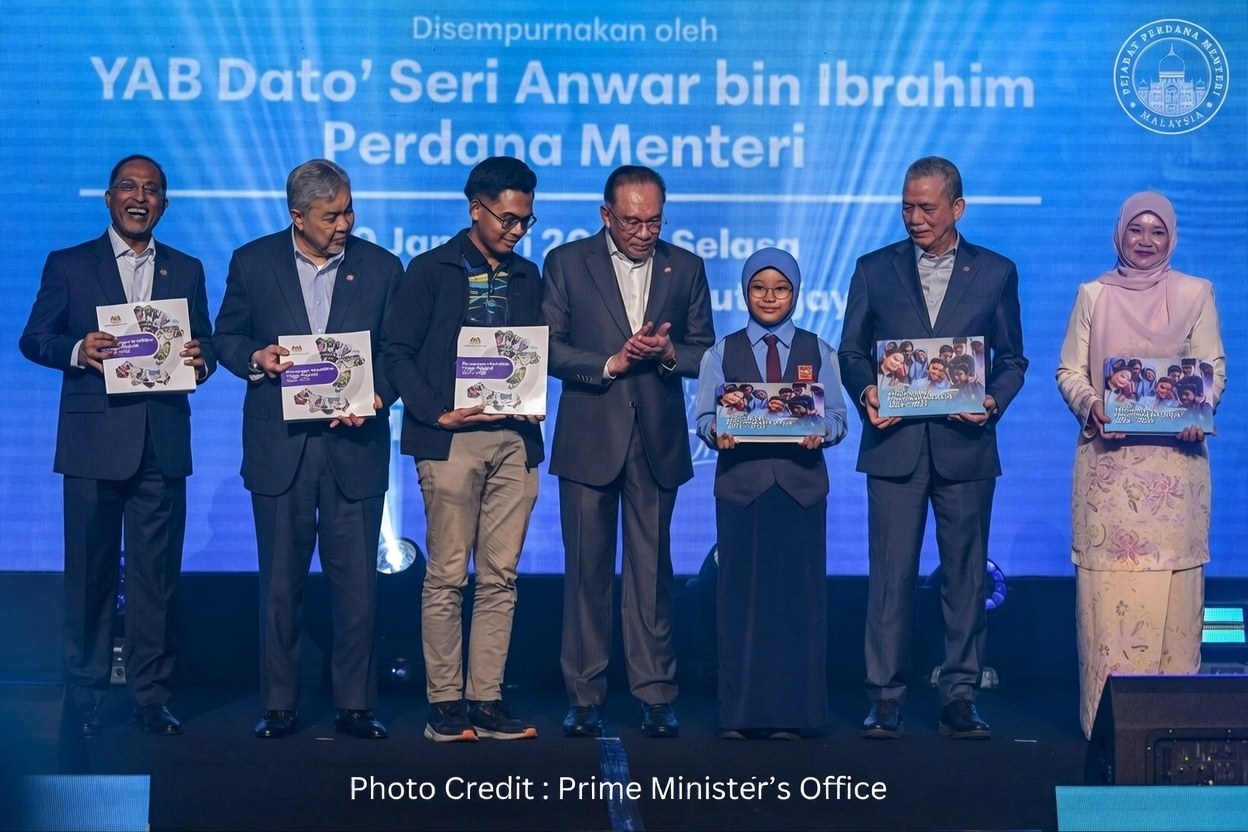
PUTRAJAYA, MALAYSIA January 20, 2026 – PUTRAJAYA – In a landmark move to reshape Malaysia’s education landscape, Prime Minister Dato’ Seri Anwar Ibrahim today launched the National Education Plan (RPN) 2026-2035 at the Putrajaya International Convention Centre (PICC), emphasizing a holistic approach to fostering humane, knowledgeable, and competitive citizens rooted in national values. The plan, jointly spearheaded by the Ministry of Education (MOE) and the Ministry of Higher Education (MOHE), introduces sweeping reforms from preschool to tertiary levels, aiming to address long-standing issues in access, quality, and relevance to global challenges.
The announcement comes as Malaysia celebrates its RM3 trillion trade achievement, with Anwar highlighting the need for education to equip the youth with skills in digital transformation, artificial intelligence, energy transition, and other emerging fields. “Education is not merely about academic achievement or technical excellence; it is a grand effort to shape individuals who are rational, civilized, and possess a humane spirit,” Anwar stated in his post on X following the launch.
Key Reforms in Preschool and Primary Education
One of the most notable changes is the adjustment to entry ages: Starting in 2027, preschool will begin at age five, and Year One of primary school at age six. However, this remains optional, allowing parents to enroll children in Year One at age seven if they deem it more suitable. The preschool system will be fully standardized under the MOE to ensure consistency nationwide.
In primary schools, a new centralized assessment system, the Malaysian Learning Matrix System, will be introduced. Managed by the Examinations Board, it will evaluate Year Four students in four core subjects—Bahasa Melayu, English, Mathematics, and Science—beginning this year (2026). This aims to standardize learning outcomes and identify early interventions.
Secondary and Pre-University Shifts
At the secondary level, Technical and Vocational Education and Training (TVET) programs will be advanced to Form One from the current Form Three, enabling students to explore career pathways earlier. Form Three assessments will cover five subjects starting in 2027, including History. Bahasa Melayu and History will become compulsory in all schools, including those following the Unified Examination Certificate (UEC) system, to strengthen national identity and unity
A significant structural change places pre-university programs—Form Six and matriculation—under the MOHE from 2027, reclassifying these students as part of higher education rather than secondary school pupils. This shift is intended to streamline transitions and enhance academic rigor.
Enhancing Language Mastery and Infrastructure
The plan reaffirms the elevation of Bahasa Melayu as the language of knowledge, thought, and national unity, while bolstering English proficiency to boost global competitiveness. National schools will expand elective language options, including Mandarin for Chinese students, Tamil, or Arabic, with the MOE tasked to provide adequate teachers
Infrastructure upgrades are a priority, with RM1 billion already allocated in 2023 to resolve issues like poor sanitation in schools. A pilot project will upgrade facilities in five primary and five secondary schools per district, focusing on non-elite institutions to ensure equitable improvements.
Higher Education: Inclusivity and Expansion
Higher education reforms focus on accessibility and equity. Free tuition will be provided to all students with disabilities—approximately 3,000 individuals—in public universities, polytechnics, and community colleges, effective immediately. Financial aid via PTPTN will expand to 10,000 students from hardcore poor families, up from 5,800.
Starting this year, all Malaysian university students in public and private institutions must study revised general education subjects on the Federal Constitution and Malaysian History, taught in Bahasa Melayu. Intake capacity in high-demand fields such as AI, Law, and Data Science will increase by 1,500 places this year. Additionally, government-linked companies will collaborate to provide 5,000 new student housing spots.
Commitment to Implementation and Broader Goals
Anwar stressed that the plan’s success hinges on execution, not just documentation. Monthly progress reports will be required from relevant ministers and officials to monitor advancements. The reforms align with the MADANI government’s vision of building a progressive, just, and humane Malaysia, ensuring no child is left behind due to socioeconomic barriers.
Education Minister Fadhlina Sidek echoed this, urging that the blueprint reach grassroots levels, particularly rural schools, for tangible impact. On X, reactions varied, with users like @StratCommX summarizing key points and others expressing support for the inclusive measures.
This comprehensive blueprint replaces previous plans and serves as the primary reference for Malaysia’s education development, positioning the nation to thrive in a rapidly changing world.
About The Author