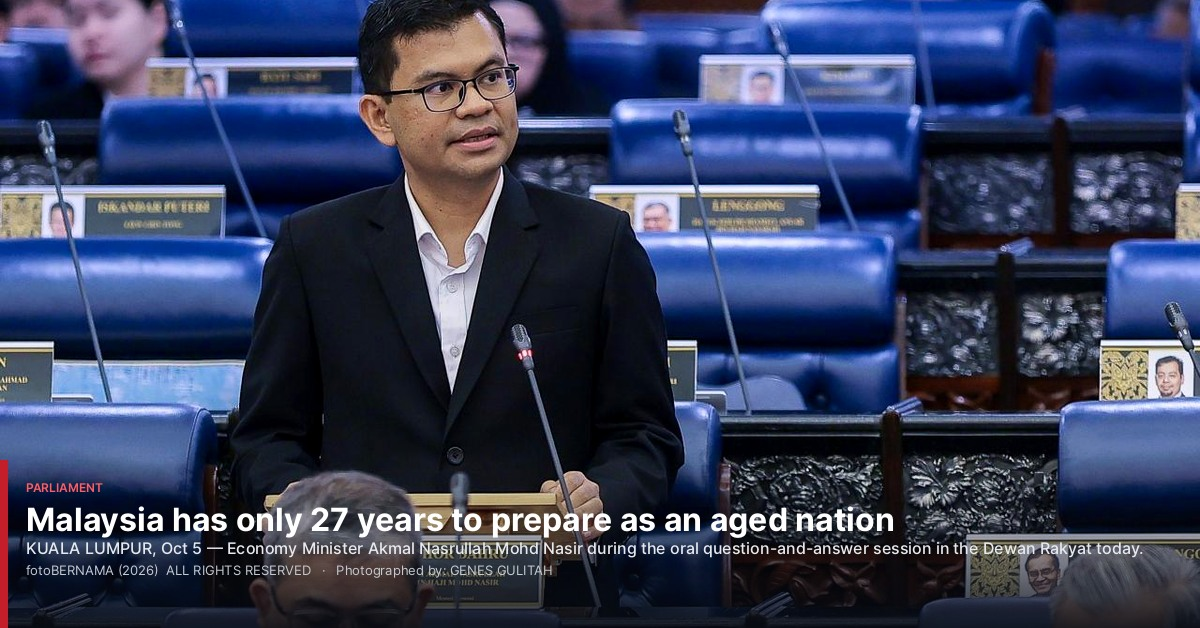
KUALA LUMPUR, Oct 5 2026 — Malaysia has only about 27 years to prepare for aged-nation status by 2048, a transition far shorter than those faced by several developed countries, Economy Minister Akmal Nasrullah Mohd Nasir said.
He said the window leaves the government limited time to strengthen preparedness, compared with 115 years for France, 73 years for Australia and 69 years for the United States.
Malaysia officially became an ageing nation in 2021, when people aged 65 and above made up seven per cent of the population. On current projections, the share is expected to reach 14 per cent by 2048, meeting the threshold for an aged nation, and 20 per cent by 2060, when the country would be classified as super-aged.
“The country’s experience with ageing also faces unique challenges because our income levels are lower compared to developed nations when they underwent the same transitional phase,” he told the Dewan Rakyat during the oral question-and-answer session today.
Akmal Nasrullah was replying to Dr Zaliha Mustafa (PH-Sekijang), who asked for an update on the National Ageing Blueprint (NAB) 2025–2045 and the government’s readiness for an ageing society.
He said the shift brings slowing workforce growth, inadequate retirement savings, and a sharp rise in demand for healthcare and elderly care. The NAB is in the final stage of government review, ahead of a White Paper on Preparation for Becoming an Aged Nation to be tabled in the current Dewan Rakyat sitting.
On a proposal for a district rejuvenation pilot zone in Sekijang, where 10.8 per cent of residents are aged 60 and above, he said the government is willing to consider the project in affected areas. Migration of young people to major cities is speeding ageing in some localities, he said, and urban management as well as recreational and tourism planning for the elderly need to be re-examined.
Replying to Salamiah Mohd Nor (PN-Temerloh) on the role of youth, Akmal Nasrullah said the silver economy has the potential to open business and jobs for young people in elderly care, health technology and digital services. The Ministry of Economy, with the Department of Statistics Malaysia and other agencies, is developing indicators to measure the silver economy’s contribution to gross domestic product.
Source: BERNAMA
About The Author