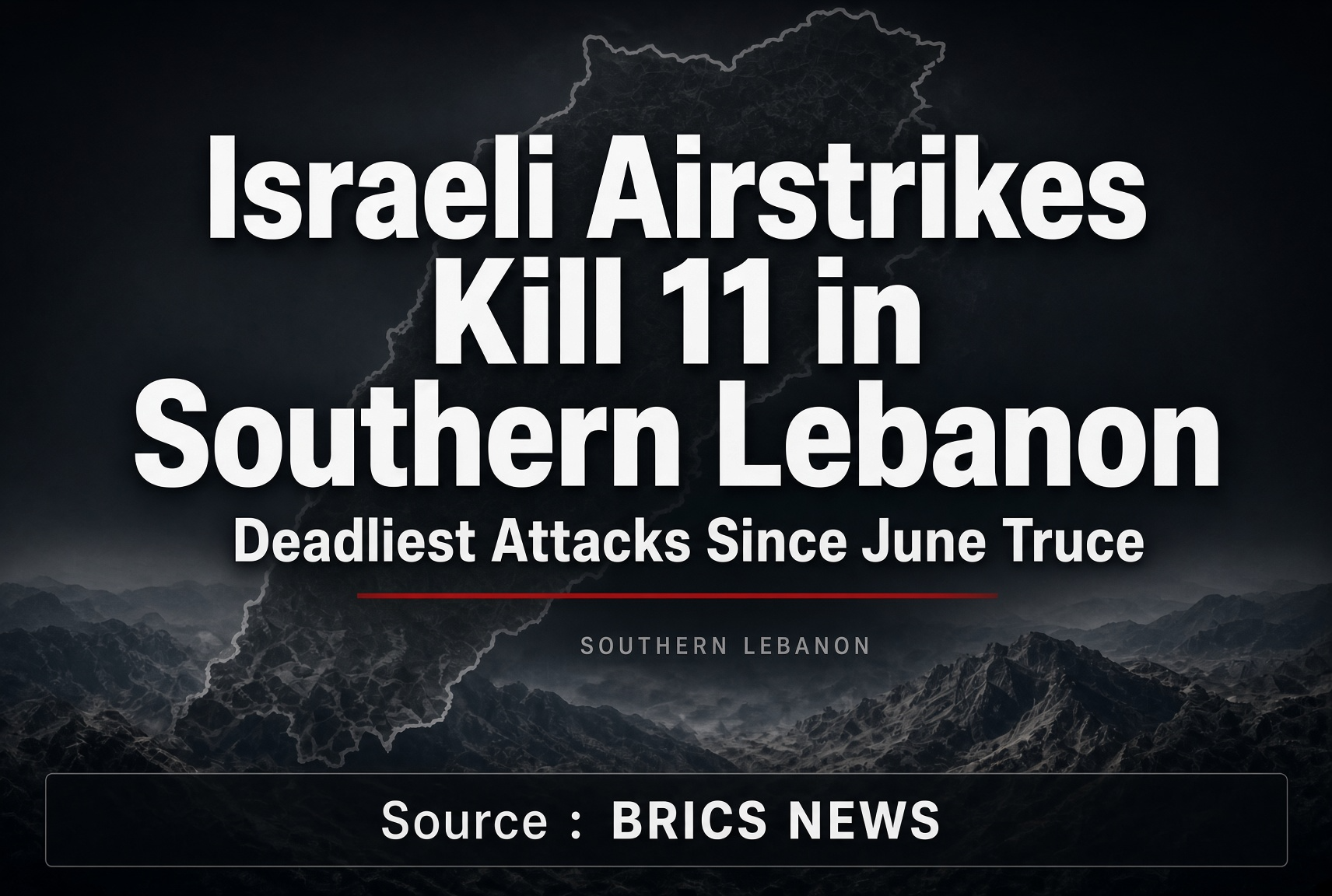
BEIRUT Aug 15, 2026 — Israeli airstrikes hit villages in southern Lebanon on Saturday, August 15, 2026, killing at least 11 people and wounding others, according to Lebanese authorities. The attacks mark one of the deadliest days of violence since a U.S.-mediated framework agreement in June aimed at easing hostilities between Israel and the Iran-backed group Hezbollah.
Lebanon’s Health Ministry and state National News Agency reported that an early-morning strike on a house on the outskirts of the village of Ansar, near Nabatieh and about 70 km (43 miles) south of Beirut, killed seven people. Among the dead were three children and two women; two others were wounded. Lebanese officials said the victims included members of displaced families living in the area.
Hours later, another airstrike struck the town of Deir al-Zahrani, killing four more people and wounding at least nine to 17 others, according to updated ministry figures. Additional Israeli strikes targeted the strategic Ali al-Taher ridge near Nabatieh, along with other sites in the south, including areas near the border. One strike near Ansar was described by Lebanese media as the deepest into the country in two months.
The Israeli Defense Forces (IDF) said the overnight operations targeted Hezbollah infrastructure in response to recent actions by the group against Israeli soldiers, including an attack that seriously wounded three IDF troops near the Ali al-Taher area. The military later stated it had killed Ali Samir al-Haj Hassan, described as a Hezbollah battalion commander in the Radwan Force unit, along with other operatives involved in planning attacks. The IDF said Hassan’s family members, whom it accused the group of using as human shields, were present at the site and were harmed. Israel’s Prime Minister’s Office defended the strike as directed at a legitimate military target.
Lebanese Prime Minister Nawaf Salam condemned the attacks as “extremely dangerous” and said they undermined efforts to stabilize southern Lebanon. “The seven martyrs of the Israeli airstrike on the town of Ansar are not ‘military infrastructure’ and the children and women killed were not military targets,” he wrote on social media, stressing that only the Lebanese state and army have the authority to address any military infrastructure on Lebanese territory. President Joseph Aoun also criticized the strikes.
Hezbollah said the attacks on Lebanon would be “met with what they deserve.” The group has rejected key elements of the June framework agreement, which calls for its eventual disarmament, the gradual withdrawal of Israeli forces from southern Lebanon, and the deployment of the Lebanese army in the border region. Hezbollah chief Naim Qassem has described the deal as an “Israeli order” imposed on Lebanese authorities.
The June 20 truce and subsequent framework have significantly reduced large-scale fighting after months of intense conflict that Lebanese authorities say has killed more than 4,300 people in Lebanon since early March. However, intermittent Israeli strikes and Hezbollah activity have continued, with Saturday’s toll the highest in weeks. Further talks between Israel and Lebanon under U.S. mediation are expected in the coming weeks.
Rescue teams worked through the day to recover bodies and assist the wounded as residents in affected areas reported the sound of warplanes and explosions. The situation remains tense along the Israel-Lebanon border.
About The Author