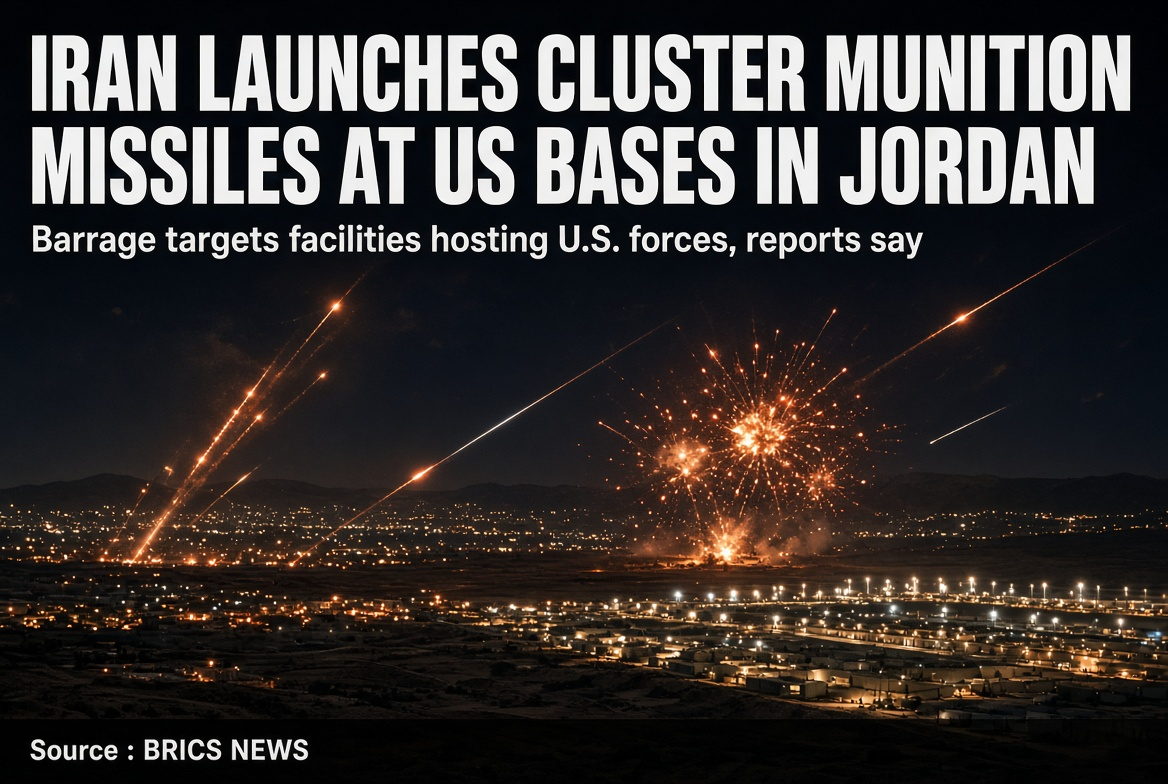
JORDAN Sept 8, 2026 – Social media accounts and regional monitors reported late Tuesday that Iran fired a new barrage of ballistic missiles toward Jordan, with some projectiles described as carrying cluster munitions and aimed at facilities used by U.S. forces.
The account @BRICSinfo posted video of bright aerial bursts over a nighttime cityscape alongside the claim that Iran had launched “cluster munition missiles at US bases in Jordan.” Similar footage circulating on X showed multiple missile launches from Iranian cities including Isfahan and Yazd, followed by interceptor activity lighting up the sky. One report specified that at least two of the missiles carried cluster submunitions.
Jordanian and Syrian air defenses were reported to have engaged incoming projectiles, with some intercepts occurring near the border. Accounts described “an insane number of interceptors” being fired while noting that some missiles still appeared to reach their targets. No official statements from the U.S. military or Jordanian government confirming a new attack or casualties were immediately available.
The incident fits a pattern of tit-for-tat strikes that has defined the 2026 U.S.-Iran conflict. Iran’s Islamic Revolutionary Guard Corps has repeatedly targeted U.S. assets at Jordanian bases such as Muwaffaq Salti (Al-Azraq), King Hussein, Prince Hassan, and Camp Titin in retaliation for American airstrikes on Iranian territory, including operations near the Strait of Hormuz. Earlier exchanges in late August and early September produced competing claims: Tehran asserted heavy damage and casualties, while U.S. and Jordanian officials said most missiles were intercepted and reported no American deaths in the most recent confirmed salvos.
Iran has previously employed ballistic missiles fitted with cluster munition warheads against Israel during the same conflict. Those weapons release smaller bomblets over a wide area and are not banned by Iran, which is not a party to the Convention on Cluster Munitions. Independent verification of the specific munitions used in Tuesday’s reported launches remained pending.
The latest reports come as the wider war continues to strain air defenses across the region and place Jordan in a difficult position as host to several thousand U.S. troops operating from its facilities. Further official details from either side were expected as the situation developed.
About The Author