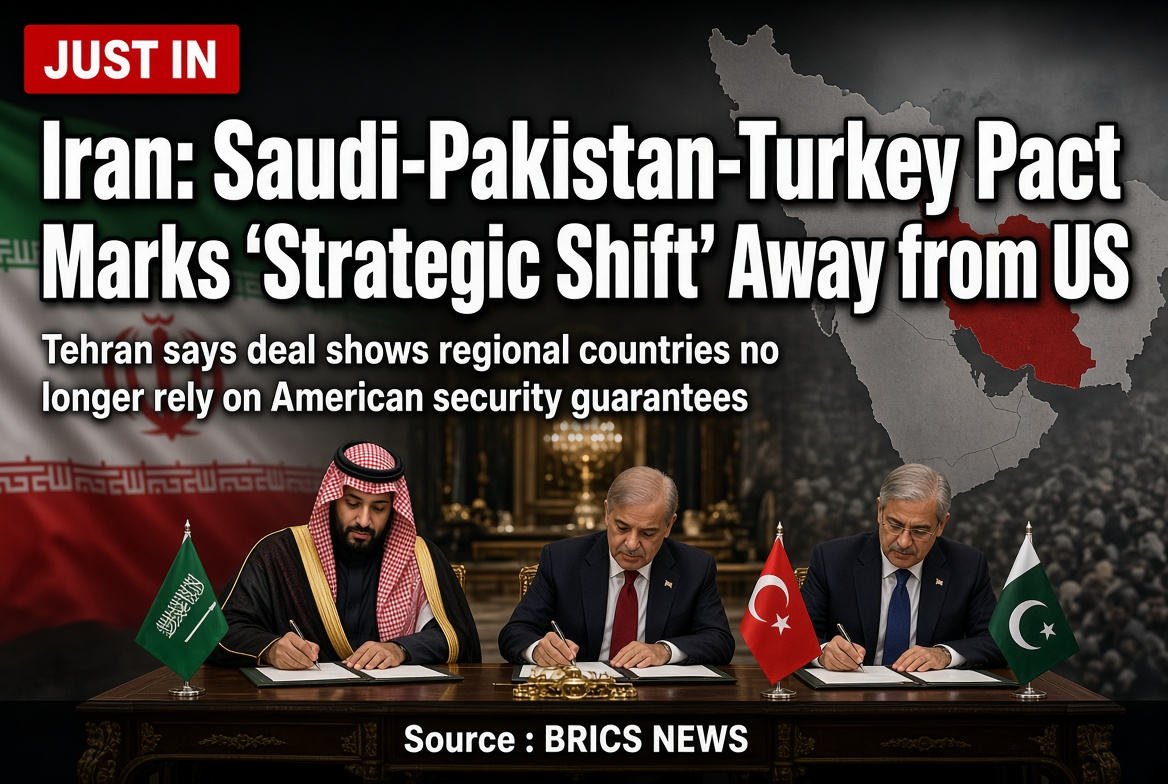
TEHRAN, August 10, 2026 — Iran’s Foreign Ministry on Monday described the newly signed Mecca Joint Defense Agreement between Saudi Arabia, Pakistan, and Turkey as evidence of a fundamental change in how regional countries view the United States as a security provider.
Foreign Ministry spokesman Esmaeil Baqaei told reporters at a weekly press conference that the pact reflects “a sign of a change in the perception” of countries in the region toward the US. “The countries of the region have realized that security is not a commodity that can be bought from false brokers,” he said, adding that regional states “cannot rely on the claim of security provided by the US as in the past.”
The Mecca Joint Defense Agreement was signed on August 7 in the holy city of Mecca by Saudi Crown Prince Mohammed bin Salman, Turkish President Recep Tayyip Erdoğan, and Pakistani Prime Minister Shehbaz Sharif. The deal includes a collective-defense clause under which an armed attack on any one of the three countries is to be regarded as an attack on all three. Officials from the signatory states have described it as a purely defensive arrangement aimed at strengthening collective deterrence and defense cooperation.
Baqaei stressed that Iran sees no reason to view the agreement as directed against Tehran. He pointed to the “deep religious, historical and civilizational ties” Iran maintains with Saudi Arabia, Turkey, and Pakistan, stating there was “no reason to worry that this treaty will be against Iran.”
The Iranian official framed the pact as part of a broader regional move toward greater self-reliance in security matters rather than dependence on external powers. He reiterated Tehran’s long-standing call for regional countries to build trust and cooperation among themselves without foreign interference.
The agreement comes against the backdrop of ongoing regional tensions and conflict involving Iran, the United States, and other actors. Turkish officials have separately emphasized that the pact is defensive in nature and not aimed at any specific country, including Iran.
Iran continues to advocate for inclusive regional security mechanisms based on the geopolitical realities of the Middle East, Baqaei added, while urging neighboring states not to allow their territories to be used for aggression against Iran.
About The Author