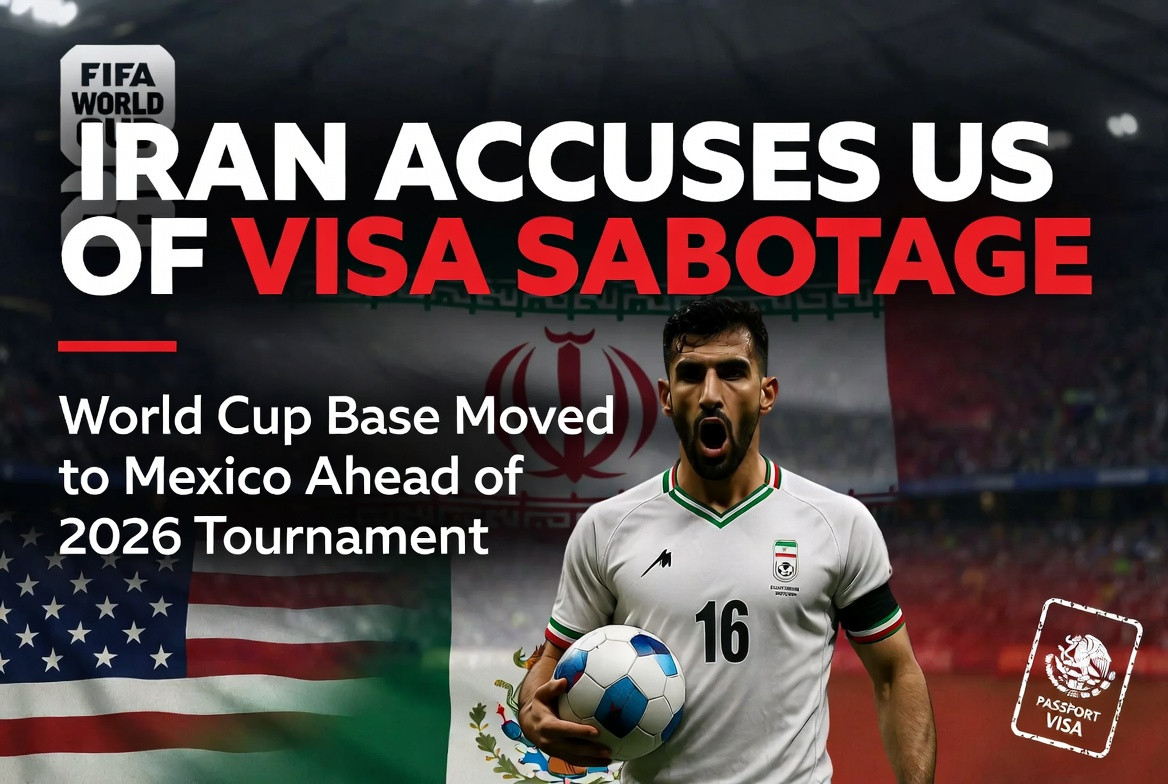
TEHRAN June 1, 2026 – With the 2026 FIFA World Cup less than three weeks away, Iran has sharply criticized the United States for issuing “heavily restricted” visas to its national team, claiming the move undermines fair competition and violates hosting obligations.
Iran’s football federation (FFIRI) president Mehdi Taj stated that the team requires multiple-entry visas to travel between their new base camp in Tijuana, Mexico, and match venues in the United States. “The US should give all players multiple-entry visas as they would have to leave and re-enter the US many times,” Taj told reporters.
Tehran’s ambassador to Mexico, Abolfazl Pasandideh, echoed the concerns, noting that the team still lacks proper US visas and is “not competing on equal terms.” He highlighted difficulties in training and preparation due to the ongoing uncertainty.
FIFA has officially confirmed the relocation of Iran’s training base from Tucson, Arizona, to Tijuana, Mexico, near the US border. The move, approved after discussions between Iranian officials, FIFA, and World Cup organizers, allows the team to avoid prolonged stays in the US while still traveling for group-stage matches, including games in Los Angeles.
Mexican President Claudia Sheinbaum supported the decision, enabling Iran to base operations on Mexican soil. The proximity to venues like SoFi Stadium (roughly a short flight from Tijuana) is intended to minimize logistical issues.
The visa dispute comes amid heightened US-Iran geopolitical tensions, including recent military actions and longstanding sanctions. The US has imposed travel restrictions on several countries, including Iran, though exemptions exist for athletes and essential staff attending major events like the World Cup.
Iranian officials submitted visa applications during a pre-tournament camp in Turkey, but delays persist. FIFA has described talks with Iran as “positive” and continues to work on entry guarantees for all qualified teams.
FIFA regulations require host nations to facilitate entry for participating teams without political interference. The governing body has not issued a detailed public response to Iran’s latest complaints but maintains that Iran will compete in the tournament.
The situation has sparked debate online and in football circles. Some view the restrictions as necessary security measures, while others argue they politicize the sport and disadvantage the Iranian players who have earned their place through qualification.
Iran is scheduled to open its campaign in the group stage with matches on US soil. As the tournament approaches, both FIFA and US authorities face pressure to resolve remaining visa and travel issues to ensure smooth participation.
This developing story underscores the intersection of sports, diplomacy, and security in the lead-up to the expanded 48-team 2026 World Cup co-hosted by the United States, Mexico, and Canada.
About The Author