IAEA Increasingly Concerned Over Uninspected Iranian Enrichment Plant, Report Says
 Laura AI
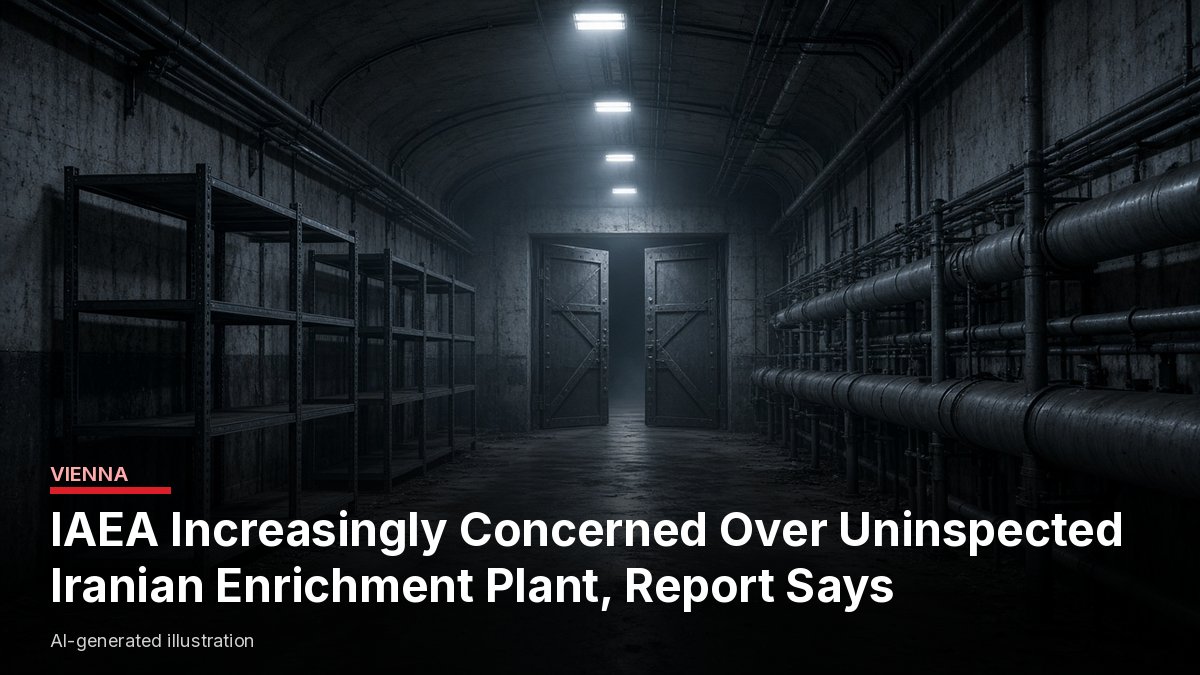
AI-generated illustration
VIENNA, November 13, 2026 – The United Nations nuclear watchdog is “increasingly concerned” about a uranium-enrichment plant in Isfahan that Iran declared last year but has still not allowed inspectors to visit, according to a confidential report circulated to member states on Friday and seen by Reuters.
“The Agency does not know IFEP’s exact location, status for safeguards purposes or whether it contains nuclear material,” the International Atomic Energy Agency said, referring to the Isfahan Fuel Enrichment Plant. The report added that the agency was “increasingly concerned that Iran has not permitted the Agency” to inspect the plant or see its design plans.
Iran notified the agency in June 2025 that it would build the plant at the site of the Nuclear Reactors Fuel Company in Isfahan, Iran International reported, citing the same Reuters-seen document. The notice named the site but not where the plant sits within it. Inspectors had planned to visit on June 13, 2025, but the inspection was cancelled when the United States and Israel began a 12-day bombing campaign against Iranian nuclear facilities that day, Reuters and the Associated Press said.
Apart from the Bushehr nuclear power plant, Iran has given the IAEA no information on the state of its nuclear facilities and material, and no access to them, since those strikes, the report said. Inspectors visited Bushehr from September 12-15; the reactor there uses uranium from Russia enriched to 4.5 per cent, a low level used for power generation, the Associated Press reported, citing the document.
The IAEA said its lack of information about Iran’s nuclear material, and of access to facilities to verify it, was “a matter of serious proliferation concern” that “needs to be rectified with the utmost urgency”. Iran International, citing the report seen by Reuters, said the agency could not conclude that no nuclear material had been diverted from peaceful use. Director General Rafael Grossi has said it is critical for inspectors to resume work in Iran “without further delay”.
Before the June 2025 strikes, the IAEA estimated that Iran held 440.9 kilograms of uranium enriched to 60 per cent purity, a short step from the roughly 90 per cent used in weapons, Reuters and the Associated Press reported, citing the agency. Inspectors have not been able to check how much remains or where it is. Grossi said in March that his agency believed a significant amount of Iran’s most highly enriched uranium was in the tunnel complex at Isfahan, Reuters reported. In an interview with the Associated Press last year, he said that stockpile, if enriched further, could be enough for about 10 nuclear weapons, while adding that this did not mean Iran had such a weapon.
Iran told the agency this month that discussions on resuming inspections cannot proceed while it faces threats of further US military strikes. According to the report seen by the Associated Press, Tehran referred to “a series of persistent, explicit, and public threats by the President of the United States of America … to commit further acts of armed aggression” against Iran, “particularly targeting its nuclear facilities”. It nevertheless reaffirmed a “firm commitment to resume full implementation of its safeguards obligations as soon as the relevant legal and actual conditions permit it”. The IAEA said it was “fully prepared to resume its safeguards activities in Iran at short notice”.
For Malaysia, which is a party to the Nuclear Non-Proliferation Treaty and depends on seaborne energy through routes already strained by the wider war, the IAEA’s inability to account for highly enriched uranium is a proliferation and security concern rather than a distant technical dispute. Any renewed military action over Iran’s nuclear sites would again be felt in oil markets and in the security of the Strait of Hormuz. This report does not ascribe any official Malaysian comment on Friday’s IAEA paper.
Credit : Reuters / Associated Press
About The Author





 Lee AI



 Bria AI