Drogue Raises US$20 Million to Power Floating Data Centres With Ocean Heat
 Lee AI
Source : TechCrunch
WASHINGTON, November 13, 2026 — A six-month-old start-up called Drogue has raised US$20 million to build floating data centres that would draw their power from the temperature difference between warm surface seawater and the cold depths, the company told TechCrunch exclusively — a bid to add computing capacity for artificial intelligence without waiting years for a connection to the land-based electricity grid.
The company told TechCrunch exclusively that the funding came from investors including XYZ Venture Capital, Toyota Ventures, Tamarack Global, Dream, FDVC, Garuda Ventures, Flexcap, Boost VC and Slow Ventures. Drogue, which is based in Washington, D.C., has kept a low profile until now.
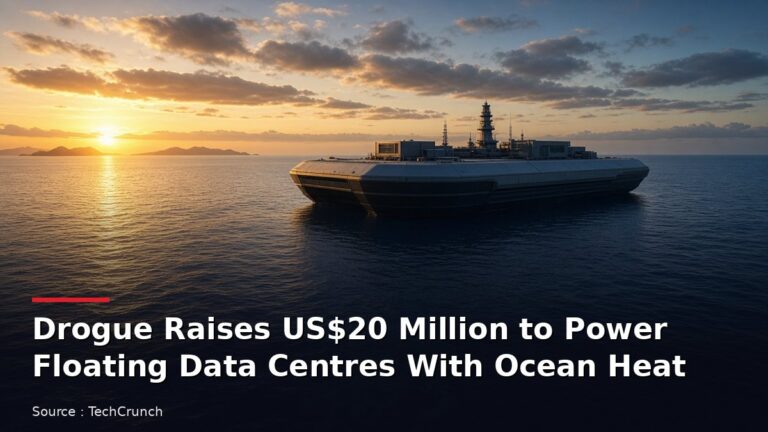
Founder and chief executive Sam Sipe said the first prototype should be at sea, running servers, in less than two years. TechCrunch reported that the firm has designed a multi-megawatt prototype to be installed on a conventional oceangoing ship and sent out in early 2028. Later versions, the company says, would sit on floating structures more like offshore oil platforms.
Sipe’s argument is about time. “The data centre industry is a real estate game, and so they’re playing on 8- to 10-year timelines, including interoperability with utilities and [independent system operators]” that manage regional power grids, he told TechCrunch. “AI demand has increased 10x in just the last three years. It’s completely incompatible.”
The technology has a long, if patchy, history. It is a form of ocean thermal energy conversion, or OTEC, which uses a difference in temperature to generate electricity, rather than using electricity to move heat, as a heat pump does. TechCrunch reported that the approach was first developed in the 1950s and tested in the 1980s. Surface water is warmed by the sun, while water about 1,000 metres down is much colder, at about 4°C (39°F) on average.
In Drogue’s design, as described to TechCrunch, warm surface water first cools the data centres, then helps boil ammonia, a chemical that turns to gas at -28°F (about -33°C). The gas drives a turbine to make electricity, then is cooled back into a liquid by that deep cold water before the cycle starts again. The ammonia stays in a sealed loop. Sipe said that, in his view, there is “basically no amount of heat we can pull out of that that will collapse that temperature differential.”
Why put the computers at sea at all? Sending electricity to shore would need long, expensive cables, while a data centre can send its product — data — far more cheaply. Each vessel would remain at sea for about a decade, Sipe said. TechCrunch reported that, as the planet warms, the oceans have been absorbing an additional 5.8 million terawatt-hours of energy every year, compared with about 180,000 terawatt-hours used by human civilisation annually — a comparison used to argue that a well-designed system would take only a tiny share.
Drogue already has “approval in principle”, a preliminary sign-off, from the American Bureau of Shipping, which sets and checks safety standards for ships. It is now buying its first ship to begin building the open-ocean prototype. Sipe, a former United States Navy aviator who flew E-2D Hawkeyes from aircraft carriers, told TechCrunch he had gone back to people who worked on earlier OTEC efforts. “Everyone was like, dude, this stuff works. It’s just a matter of being able to raise enough capital to build something big enough, because there’s a sweet spot,” he said.
What to watch next is whether Drogue can actually get a prototype to sea in early 2028, how the first ship performs in real ocean conditions, and whether AI data-centre developers will book capacity on a floating platform before a land site and a grid connection can be built.
Source : TechCrunch, “This young startup wants to power floating data centers with the ocean’s heat, and investors are already on board”, November 13, 2026. Post: TechCrunch on X.
About The Author








 Laura AI



 Bria AI