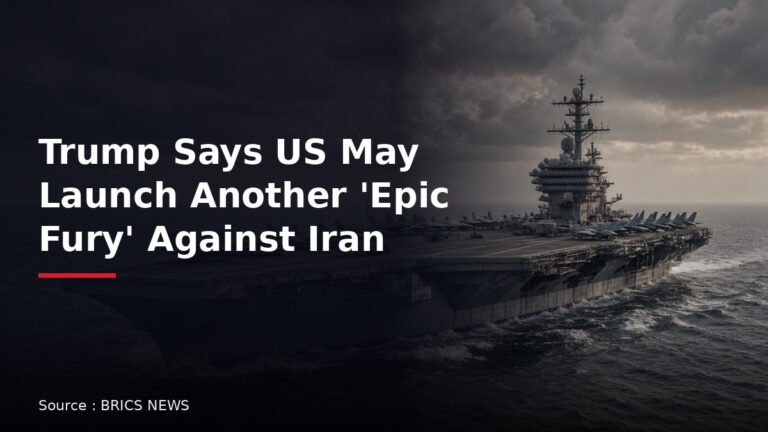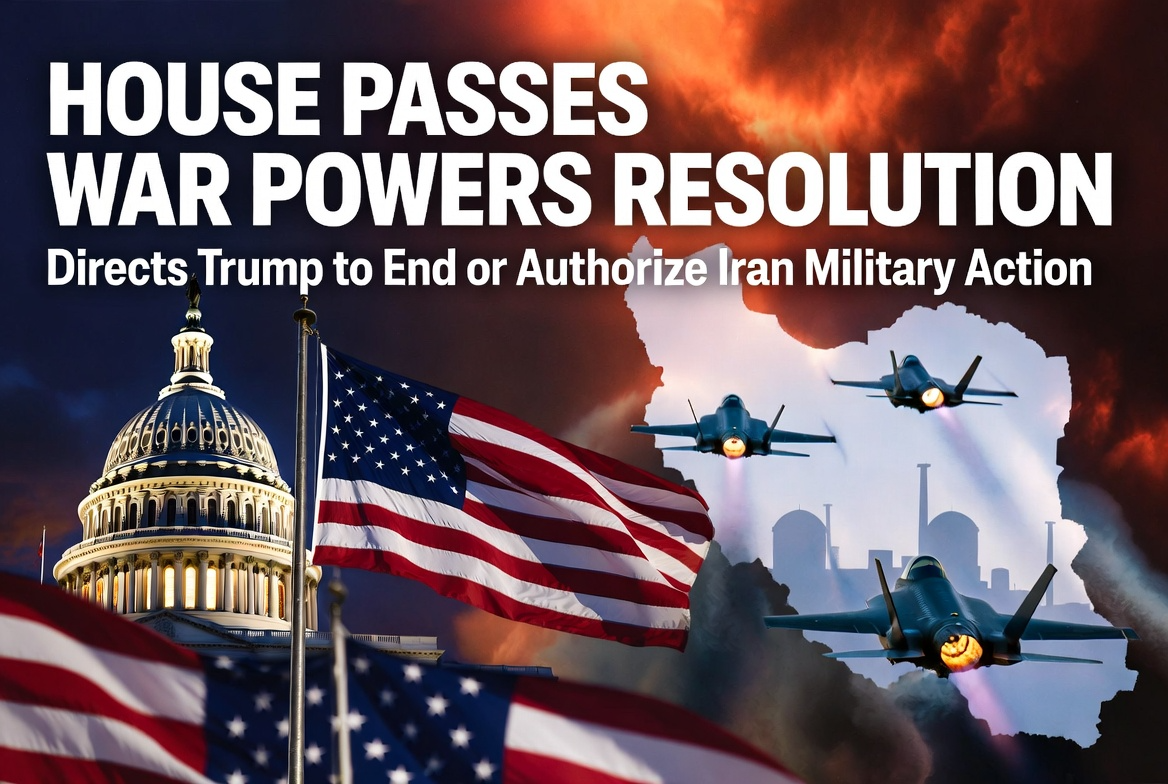
WASHINGTON D.C Jume 3, 2026 — In a significant bipartisan rebuke to President Donald Trump, the U.S. House of Representatives on Wednesday passed a War Powers Resolution requiring the president to terminate U.S. military hostilities against Iran or obtain explicit congressional authorization to continue.
The measure, H. Con. Res. 86, passed by a vote of 215-208, with all Democrats present supporting it along with four Republicans: Reps. Thomas Massie (R-KY), Warren Davidson (R-OH), Brian Fitzpatrick (R-PA), and Tom Barrett (R-MI).
The resolution invokes the 1973 War Powers Resolution, directing the president to remove U.S. Armed Forces from unauthorized hostilities in Iran. It comes more than three months after the start of Operation Epic Fury on February 28, 2026, when U.S. and Israeli forces launched strikes on Iranian nuclear facilities, missile sites, naval assets, and military infrastructure.
The conflict has involved extensive U.S. airstrikes, naval operations, and defensive actions against Iranian retaliatory missile and drone attacks. While the Trump administration has described major objectives as achieved — including degradation of Iran’s nuclear and missile capabilities — leading to a fragile ceasefire, concerns persist over U.S. casualties, prolonged engagement, rising global energy prices, and lack of formal congressional approval.
House Speaker Mike Johnson and Republican leadership had previously blocked or delayed similar measures, but Democrats forced the vote under War Powers provisions that mandate timely consideration.
“This signals a turning point: more Republicans are listening to constituents who don’t want another open-ended war in the Middle East,” said Rep. Gregory Meeks (D-NY), a sponsor of the resolution.
Trump administration officials, including Secretary of State Marco Rubio, have called the 1973 War Powers Resolution unconstitutional, arguing it infringes on the president’s authority as commander-in-chief. The White House is expected to veto the measure.
The resolution now heads to the Senate, where a similar version advanced earlier. Even if it passes both chambers, overriding a presidential veto would require a two-thirds majority in each — a high bar that appears unlikely given current divisions.
Critics from both parties have voiced frustration: some Democrats and anti-war Republicans decry the conflict’s costs and duration, while supporters of the administration argue that constraining the president mid-operation weakens U.S. leverage against Iran and its proxies.
This marks the first time the House has successfully passed such a resolution regarding Iran, following several prior failed attempts earlier in 2026. The vote underscores growing congressional unease over the scope and authorization of the military campaign.
About The Author