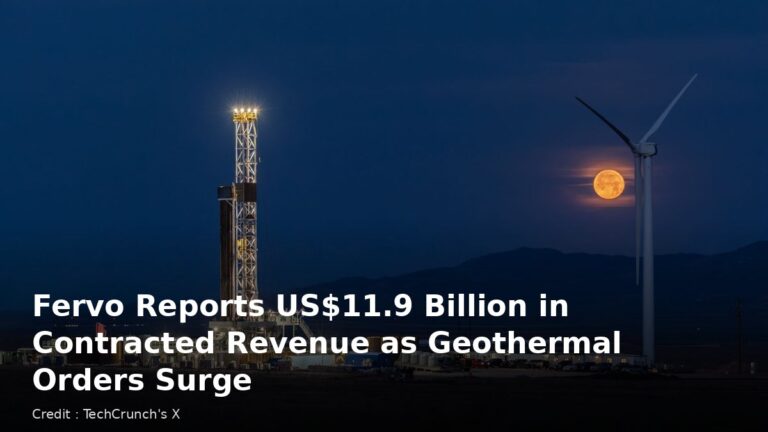
Credit : TechCrunch's X
CAPE STATION, Utah, November 9, 2026 – Geothermal developer Fervo Energy says the value of power contracts it has signed has climbed to US$11.9 billion, up from US$7.2 billion a quarter earlier, as technology companies search for new sources of electricity to run their artificial intelligence data centres. The figure was disclosed in the company’s third-quarter 2026 results, released on Monday, and was first highlighted by TechCrunch.
The jump is largely down to a September agreement with Google. Under the 15-year, take-or-pay contract, Fervo will supply about 396 megawatts from its Cape Station site in Utah, with first power expected in mid-2028. Take-or-pay means Google is committed to paying for the electricity whether or not it uses it. Fervo has also committed to offering Google an option to expand the deal by roughly 600 megawatts, which would take the total to almost one gigawatt. The company says it now holds 1,054 megawatts of binding power purchase agreements.
The Google project, previously described only as later phases of Cape Station, is now being called Cape Google 400. Chief executive and co-founder Tim Latimer told investors on the earnings call that it will be connected to the grid, which lets Google draw power from the arrangement and sell it on to other customers if it is not yet ready to use it. “We built Cape Station on our schedule. Google can develop a potential data centre on their schedule, and neither party is waiting on the other,” he said, according to TechCrunch’s account of the call.
Fervo also reported progress on the ground. The first 33-megawatt unit, which the company calls a GeoBlock, declared commercial operation on September 30, ahead of its contractual date. Two further GeoBlocks are on track to reach commercial operation by January 1, 2027, which would complete the first phase of Cape Station at around 100 megawatts. GeoBlocks are groups of wells linked together and sized to match the demand of a typical data-centre hall, so customers can bring capacity online in stages as each block is finished.
A new independent study has also changed the picture for the site itself. Fervo says Cape Station could support about 8.4 gigawatts of capacity, nearly double the earlier estimate of about 4.3 gigawatts. The study was completed by the consulting firm DeGolyer and MacNaughton. Fervo’s newer wells are deeper and hotter, and each is capable of about 15 megawatts of gross power.
The financial results show a company still in its early stages. Fervo reported a third-quarter operating loss of US$43.7 million, but ended the quarter with US$1.9 billion in cash and cash equivalents against US$301.6 million in debt. Quarterly net income was US$11.7 million, helped by interest income and a tax benefit from credits earned as the first-phase assets entered service.
Costs will be the key test. Fervo says the first phase of Cape Station works out at about US$7,000 per kilowatt of capacity, while the Google project is expected to cost about US$5,500 per kilowatt. The company’s long-term goal is US$3,000 per kilowatt. TechCrunch notes that, with subsidies, the current figure is roughly comparable to a new gas-fired plant, although still about twice what natural gas costs today, and that hyperscalers may not always be as indifferent to price as they are now.
The results come as large technology firms race to secure round-the-clock power for AI. Unlike solar and wind, geothermal can run continuously, and Fervo’s phased, block-by-block construction is pitched as a faster alternative to very large nuclear or gas plants. Whether the company can keep hitting its schedules and bring costs down will determine if the new orders turn into steady revenue.
This story is based on Fervo Energy’s third-quarter 2026 results and its earnings call, as reported by TechCrunch.
About The Author