AI-generated illustration
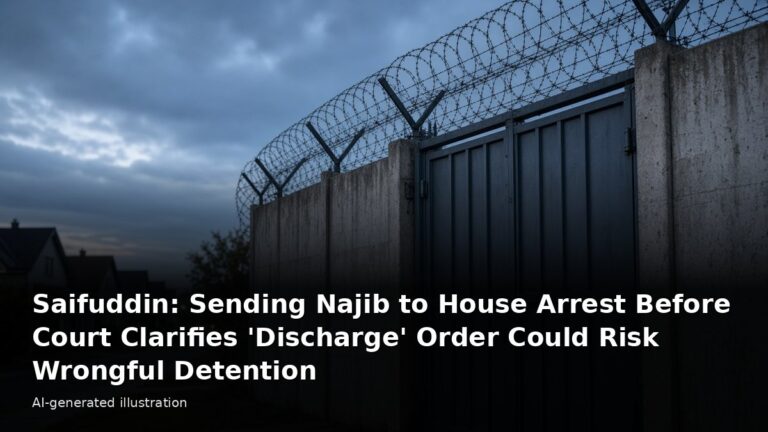
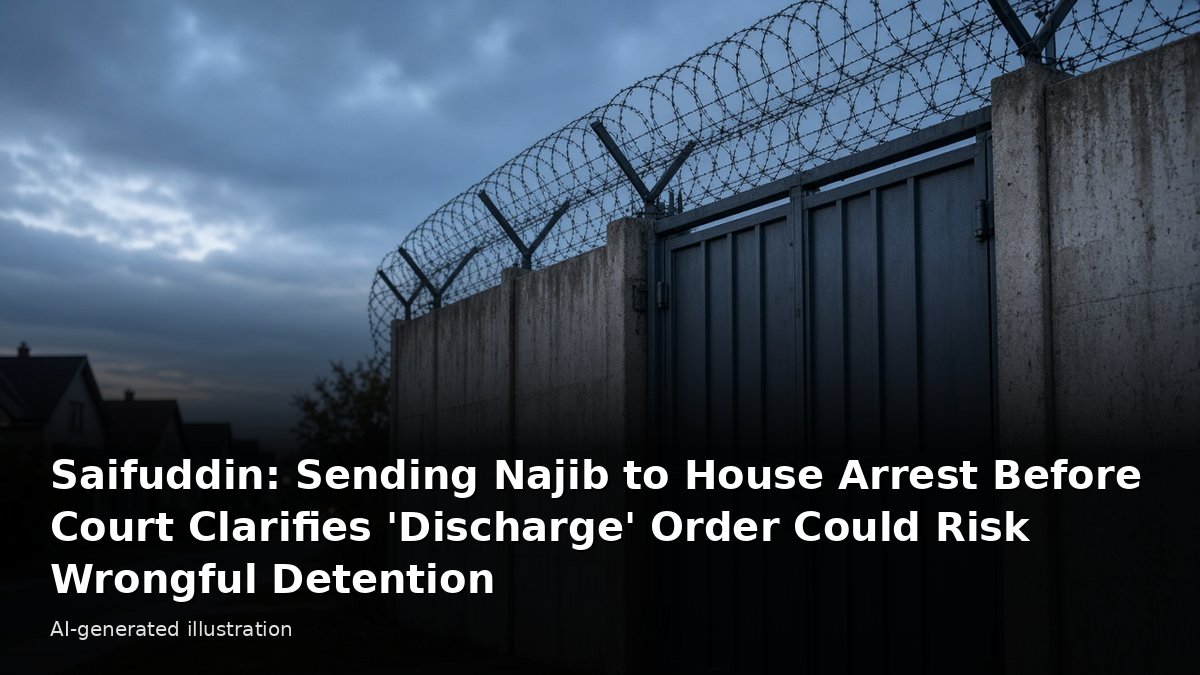
MELAKA, November 10 – Home Minister Datuk Seri Saifuddin Nasution Ismail has said that moving Datuk Seri Najib Razak to house arrest before the courts clarify the meaning of a High Court “Order of Discharge” could expose the authorities to a claim of wrongful detention.
Speaking to reporters in Melaka on November 9, Saifuddin said the issue arose from two differing interpretations: the Pardons Board’s decision that Najib serve the remainder of his sentence under house arrest, and a court order of discharge which could mean he must be released from prison custody, The Star and the New Straits Times reported.
“If the court says it means release, then the Prisons Department must release Datuk Seri Najib under that order. But if, instead, we send him to house arrest, it could become wrongful detention and so on. It could happen,” he said.
“House arrest and release are different”
Saifuddin explained that under house arrest, Najib would still be serving the remainder of his sentence, with the Prisons Department keeping authority over him at a gazetted residence instead of Kajang Prison. If the order’s use of the word “discharge” amounted to a full release, however, the department would no longer have that authority.
“How are we to act when the order of discharge states ‘discharge’, while the Pardons Board says house arrest? House arrest and release are different,” he said.
Sinar Harian quoted him as saying (translated from Malay) that the ministry needed certainty on the matter before taking any action, so as to avoid legal implications. “That is why the court should decide, because there are differences in understanding,” he said (translated from Malay).
Ministry says it respects Pardons Board decision
Saifuddin stressed that the Home Ministry was not opposing the Pardons Board’s decision or His Majesty the Yang di-Pertuan Agong’s exercise of his constitutional powers. He said the ministry had received the Pardons Board secretary’s letter and would comply with the decision.
“There is not one sentence, one comma or one matter that we have changed. We respect and comply with the Pardons Board’s decision,” he said, adding that the ministry, as the implementing agency, had to act within the law.
He said the Attorney General had been asked for an opinion and that the matter would be brought before the courts. “When there are two interpretations, the court is the best platform. The Home Ministry will comply with and respect the court’s decision,” he said. According to The Vibes, he added that he did not know who would start the proceedings or when a decision would be made.
Background
Najib paid the RM50 million fine in his SRC International case at the Kuala Lumpur High Court on November 6, a condition of the conditional pardon granted on September 18 that allows him to serve the rest of his sentence under house arrest until August 23, 2028. The transfer from Kajang Prison was deferred after the Attorney General’s Chambers said it needed judicial clarification on the effect of the High Court’s discharge order, including its implications for the start of Najib’s separate 1MDB sentence.
Istana Negara said on November 7 that the conditional pardon order was clear, explicit and unambiguous, and that any argument disputing it would amount to defying the King’s decree. Najib’s lawyers have said there is nothing in the court order that needs interpreting and have called for his immediate transfer to house arrest.
Sources: The Star, New Straits Times, Sinar Harian, The Vibes.
About The Author