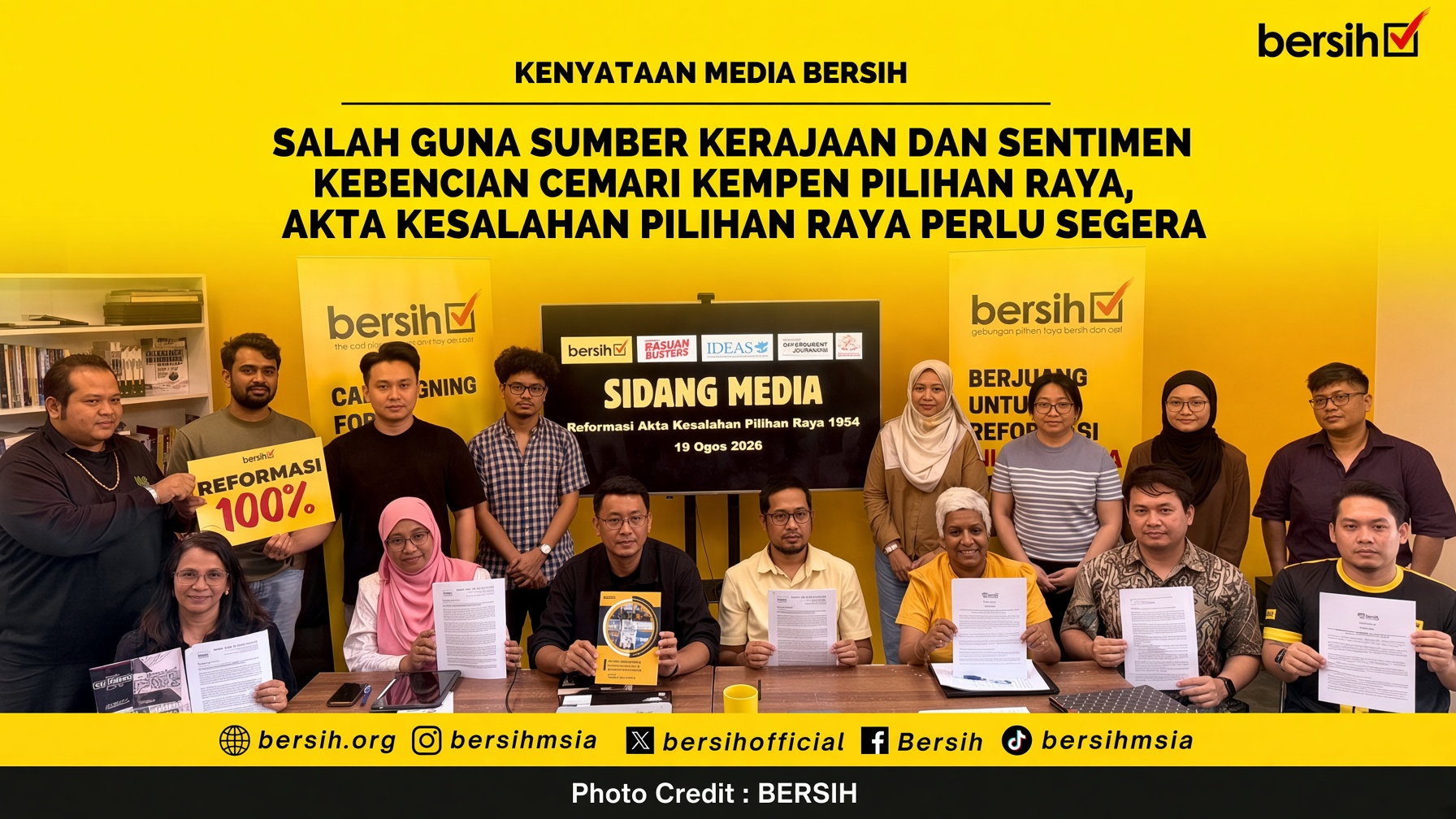
PETALING JAYA, 19 August 2026 — The Coalition for Clean and Fair Elections (BERSIH) today urged the government to immediately amend the long-outdated Elections Offences Act 1954 before the 16th General Election (PRU-16), warning that misuse of public resources and rising hate sentiments are contaminating election campaigns.
In a media statement released following a press conference at its office, BERSIH said monitoring of recent by-elections and state elections in Sabah, Johor and Negeri Sembilan revealed a clear pattern of government machinery and public funds being used to give an unfair advantage to ruling party candidates.
“Pindaan terhadap Akta Kesalahan Pilihan Raya yang telah lama tidak dikemaskini berdasarkan konteks semasa, perlu dilakukan dengan segera sebelum PRU ke-16 berlangsung bagi memperkukuhkan penjalanan pilihan raya agar proses kempen menjadi lebih bersih, bebas dan adil,” the statement read.
BERSIH’s monitors documented 72 instances of alleged misuse of federal and state government resources and programmes during the recent state polls — 34 in Sabah, 18 in Johor and 20 in Negeri Sembilan. These included welfare programmes such as Jualan Rahmah and Jualan Agro MADANI being turned into campaign platforms, announcements of new projects and benefits, free health checks, dental scaling, food events, cash aid and lucky draws, often with ruling party candidates present, party logos displayed and calls for votes made.
Specific examples cited included programmes organised by the Ministry of Housing and Local Government under Nga Kor Ming, the Ministry of Rural and Regional Development under Ahmad Zahid Hamidi, and others, as well as directives reportedly given to civil servants and students to attend certain events. BERSIH noted that some activities could already fall under existing provisions on treating (Section 8) and bribery (Section 10) of the Act.
The coalition stressed that while government programmes benefiting the people are important, they must not become “veiled campaigns” that create an uneven playing field. Such programmes should be suspended during the election period and resumed only after results are announced.
Beyond resource misuse, BERSIH expressed serious concern over the increasing use of racial and religious sentiments in campaigns, including on social media, as well as the exploitation of artificial intelligence to generate or manipulate images, videos, audio and text. It also criticised attempts to drag the institution of the monarchy into partisan politics, particularly during the Negeri Sembilan state election.
“Sudah tiba masanya Malaysia bergerak ke arah demokrasi yang lebih sihat, matang dan progresif,” the statement concluded.
BERSIH called on the Election Commission (SPR) and the government under Prime Minister Anwar Ibrahim to strengthen the Act by:
- Making the misuse of government resources and machinery during the election period a clear offence;
- Requiring independent audits of candidates’ and parties’ election expenses before submission to the SPR;
- Introducing stronger mechanisms and guidelines against excessive racial politics and digital manipulation; and
- Expanding the SPR’s powers to issue compounds for election offences.
The reform demand is also backed by the Cross-Party Parliamentary Group of Malaysia (KPPRM) on Integrity, Governance and Anti-Corruption.
BERSIH, which has advocated for clean elections since 2006, said the current Act no longer reflects present-day realities and that timely reforms are essential to restore public confidence in the electoral process.
About The Author