Credit : Datuk Seri Anwar's X
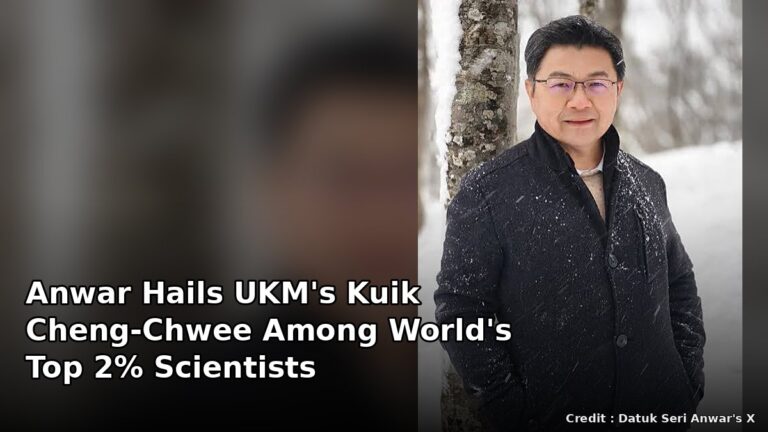
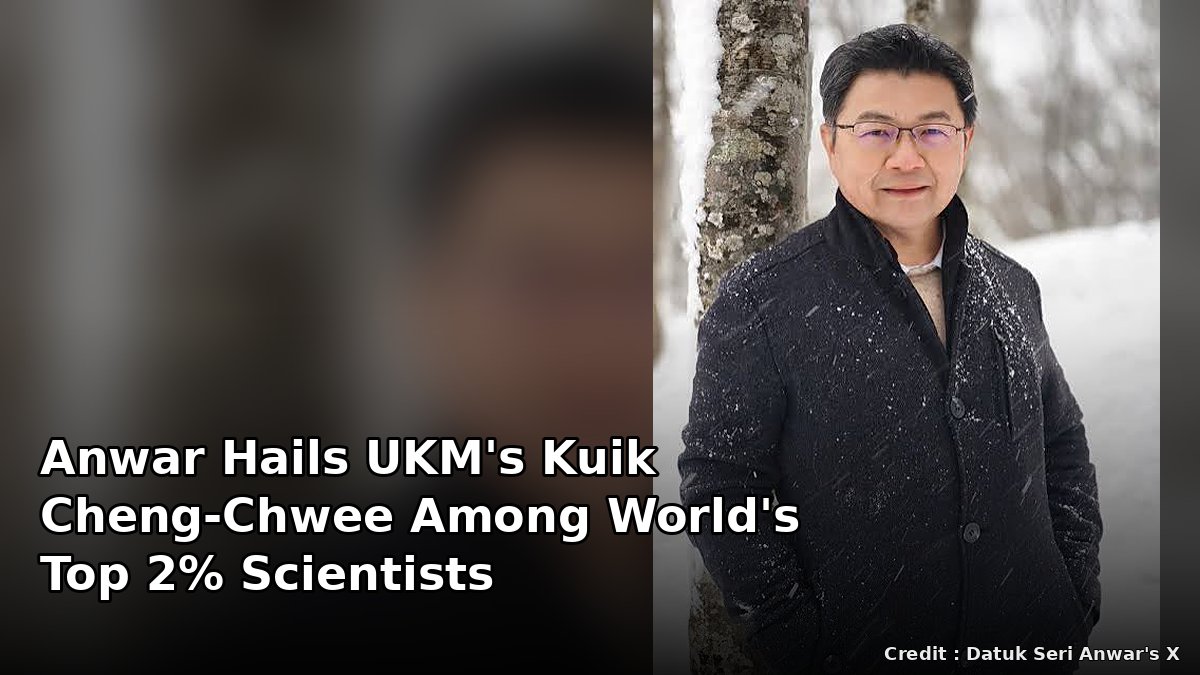
PUTRAJAYA, October 21, 2026– Prime Minister Datuk Seri Anwar Ibrahim has congratulated Universiti Kebangsaan Malaysia (UKM) international relations scholar Professor Dr. Kuik Cheng-Chwee on being named among the world’s top 2 per cent of scientists for 2026, saying the recognition brings credit to Malaysia on the international stage.
In a post shared on X on Wednesday morning, Anwar extended his congratulations to Kuik, who is a Principal Fellow at UKM’s Institute of Malaysian and International Studies (IKMAS), for his success in being listed among the top 2 per cent of scientists in the world this year.
“This recognition not only reflects his excellence and contribution to the field of knowledge, but also brings honour to Malaysia’s name at the international level,” Anwar wrote.
“May this success continue to enliven the culture of knowledge, strengthen the tradition of research and serve as an inspiration to the generation of scholars to contribute to the progress of the nation,” he added, tagging the post with #MalaysiaMADANI and #YakinMADANI.
A leading voice on hedging and Asian security
Kuik is Professor of International Relations at IKMAS and is concurrently a Nonresident Senior Fellow at the Foreign Policy Institute of Johns Hopkins University’s School of Advanced International Studies (SAIS) in Washington, according to his UKM profile. He was previously a postdoctoral fellow at the University of Oxford’s Department of Politics and International Relations and at the Princeton-Harvard China and the World Program.
His research focuses on how smaller and non-great-power states position themselves between major powers, Southeast Asian international relations and Asian security. He is best known for his work on “hedging”, the strategy by which states such as Malaysia avoid taking sides outright in great-power rivalry. He is the author of Theorizing Hedging: Explaining Shifts and Variations in Alignment Choices (Cambridge University Press, 2026), co-author with David Lampton and Selina Ho of Rivers of Iron: Railroads and Chinese Power in Southeast Asia (2020), and co-editor with Alice Ba and Sueo Sudo of Institutionalizing East Asia (2016).
His essay “The Essence of Hedging”, on how Malaysia and Singapore responded to a rising China, won the Michael Leifer Memorial Prize from the ISEAS–Yusof Ishak Institute. Closer to home, Kuik served as Head of the Writing Team from 2019 to 2020 for Malaysia’s inaugural Defence White Paper. He sits on the editorial boards of several international journals, including Contemporary Southeast Asia and the Australian Journal of International Affairs, and holds an M.Litt. from the University of St Andrews and a PhD from Johns Hopkins University.
The 2026 listing extends a run of recognition: his UKM profile notes that he was named in Stanford University’s list of the World’s Top 2% Scientists in the subfield of International Relations for 2023, 2024 and 2025.
About the list
The World’s Top 2% Scientists list is compiled by researchers at Stanford University in collaboration with publisher Elsevier. It ranks scientists across standardised fields and subfields using citation-based indicators drawn from Elsevier’s Scopus database, with separate rankings for career-long impact and for impact in a single year. The 2026 edition was released on October 7, 2026, based on Scopus data as of August 1, 2026, according to Xiamen University Malaysia.
Malaysia has 941 researchers on the 2026 single-year list, up from 880 in 2025, according to an analysis by the tracking site TopSciNet, which places UKM second among Malaysian institutions with 86 listed scientists, behind Universiti Malaya. Several other Malaysian universities have announced their own entries in recent days, including UCSI University with 21 researchers, Xiamen University Malaysia with 13 and Curtin University Malaysia with seven.
About The Author