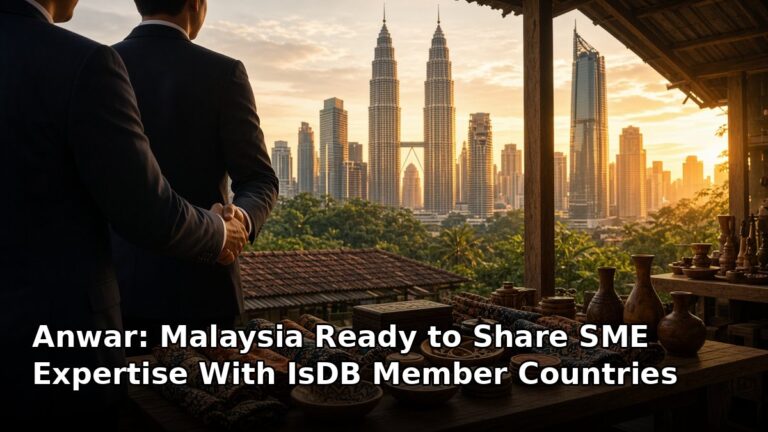
KUALA LUMPUR, October 20 – Prime Minister Datuk Seri Anwar Ibrahim says Malaysia is ready to share its expertise and widen international development cooperation, after meeting Islamic Development Bank (IsDB) Group Chairman Dr Muhammad Sulaiman Al Jasser in Kuala Lumpur on Tuesday.
In a post on X on Tuesday afternoon, accompanied by four photographs of the meeting, Anwar said the discussion held at midday reflected “continued confidence in Malaysia’s development direction and governance.”
“Malaysia is recognised for its experience in empowering micro, small and medium enterprises (MSMEs), strengthening economic resilience and creating job opportunities. This expertise and experience can potentially be leveraged by IsDB member countries,” he wrote.
“I also stressed Malaysia’s readiness to share its expertise and expand development cooperation at the international level. In this regard, I welcome efforts to strengthen the IsDB Centre of Excellence in Kuala Lumpur as a hub for sharing knowledge and expertise,” the Prime Minister added.
“God willing, this close cooperation will broaden Malaysia’s role as a credible development partner, while bringing the expertise of our people to the world stage,” said Anwar, who tagged the post #MalaysiaMadani and #YakinMADANI. The post can be viewed at https://x.com/anwaribrahim/status/2112469566773395711.
In a statement issued the same day, the IsDB said Anwar, who is also Finance Minister and Malaysia’s IsDB Governor, met Al Jasser to reaffirm the longstanding strategic partnership between Malaysia and the IsDB Group. The meeting was also attended by Minister of Finance II Senator Datuk Seri Amir Hamzah Azizan and Treasury Secretary-General Tan Sri Johan Mahmood Merican, who is also an IsDB Executive Director.
According to the bank, the talks focused on the upcoming Malaysia–IsDB Group Country Engagement Framework for 2027 to 2029, which is aimed at supporting Malaysia’s development priorities while drawing on the country’s expertise in Islamic finance, institutional development and private sector engagement to deliver development impact across IsDB member countries. Both sides also explored ways to strengthen support for small and medium-sized enterprises, promote entrepreneurship and job creation, and expand private sector development.
The IsDB said Al Jasser commended Malaysia’s leadership as a global hub for Islamic finance and highlighted the strategic role of the IsDB Group Kuala Lumpur Centre of Excellence in strengthening institutional cooperation, facilitating knowledge sharing and advancing Reverse Linkage initiatives, the bank’s technical cooperation programme for transferring Malaysia’s successful development solutions to other member countries. The meeting ended with a shared commitment to deepen South-South cooperation and mobilise innovative financing.
Al Jasser was on an official visit to Malaysia from October 19 to October 20, 2026, which the IsDB said would also include engagements with the Ministry of Finance and Bank Negara Malaysia on Islamic economics and finance, financial inclusion, regulatory cooperation and talent development. The visit followed his trip to Bangkok, where he led the IsDB delegation to the 2026 World Bank–IMF Annual Meetings from October 12 to October 19, and earlier stops in Brunei on October 6 and Indonesia on October 8.
Malaysia’s relationship with the Jeddah-based multilateral lender dates back to 1975. The IsDB opened its regional office in Kuala Lumpur in the 1990s, and on March 25, 2021, the government and the bank signed an agreement transforming it into a Centre of Excellence focused on Islamic finance, the halal industry, science, technology and innovation, Reverse Linkage and resource mobilisation.
According to the IsDB, Malaysia is a pioneer member country in its Reverse Linkage programme, with several cooperation projects between Malaysia and other member countries implemented since 2014. The centre, based at Menara Wawasan on Jalan Sultan Ismail, focuses on value-creation activities with an emphasis on generating investment opportunities for the private sector.
About The Author