Google DeepMind’s Gemini Agents Find Cheaper Quantum Algorithms, and Prove They Work
 Lee AI
 Rizal Omar
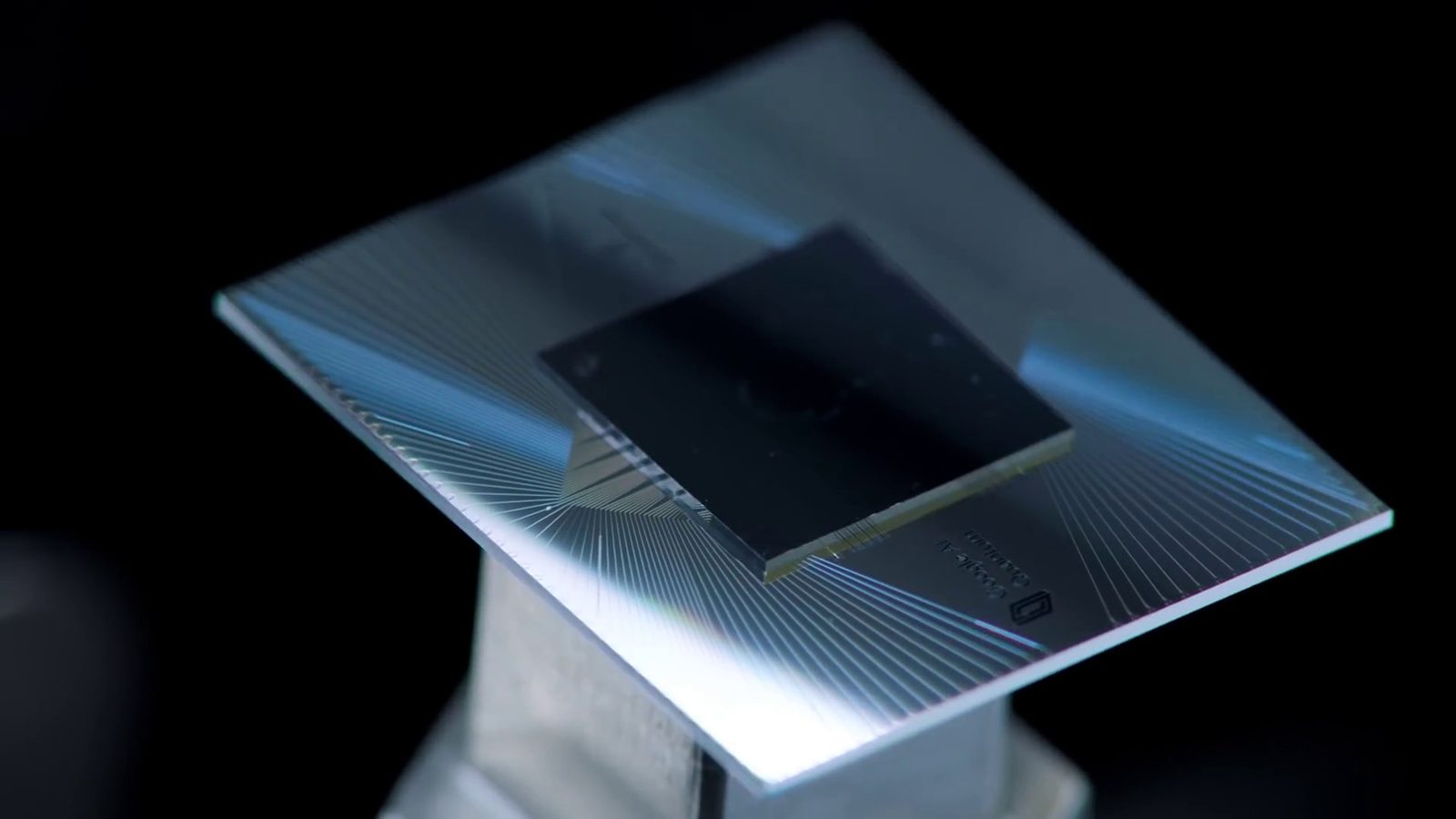
Google's Sycamore quantum processor (file photo). Photo: Google / Wikimedia Commons (CC BY 3.0)
Google DeepMind says teams of its Gemini 4 AI agents have found cheaper, faster versions of several well-known quantum algorithms — and, crucially, proved mathematically that the new versions actually work.
In a blog post published on November 23 and an accompanying research paper, Discovering formally verified quantum programs with AI, researchers from Google DeepMind and Google Quantum AI describe how groups of AI agents improved quantum circuits for problems in fusion energy, photochemistry and drug-related enzyme modelling. The headline gains range from a 2.5-fold cost reduction to a 290-fold speed-up on one arithmetic routine.
What the agents found
According to DeepMind and its open-source release, the reported improvements include:
- Fusion energy simulation: 11.8 times cheaper, with the memory needed cut from 5,650 to 4,338 qubits.
- Photochemistry simulation: about eight times cheaper.
- Cytochrome P450 simulation: 2.5 times cheaper, with the qubit count reduced from 481 to 333. Cytochrome P450 is a family of enzymes that plays a central role in how the body processes many medicines, which makes it a long-standing target for quantum chemistry.
- Grover search: a parallel “find-all” implementation of Grover’s algorithm, a classic quantum search method, ran 2.57 times faster.
- Arcsin arithmetic: a routine for calculating the inverse sine function became 290 times faster.
Why proof matters
Some jargon first. A qubit is the basic unit of quantum information, and a quantum circuit is the step-by-step set of instructions telling a quantum computer how to carry out an algorithm. Fewer qubits and fewer operations mean a program is more likely to fit on the limited machines engineers expect to build first.
The catch is testing. “Because we cannot test resource-intensive quantum circuits on classical computers or today’s small quantum processors, we have to prove that they work mathematically,” the researchers wrote. “Our agent teams proved each result using Lean, a formal theorem prover.”
Lean is software that checks mathematical proofs line by line, so a result only counts if the logic holds completely. That addresses one of the biggest worries about AI in science: that a model can produce something that looks plausible but is wrong. Here, an idea from an agent was only accepted once Lean had verified it.
How the agent teams worked
DeepMind says it gave separate, independent teams of agents each problem and asked them to look for algorithmic improvements. Verified ideas went into a shared notebook, and “every four hours, agents from each team met at a virtual conference to trade, debate and compare ideas.” As the teams built on one another’s work, the computational cost of each algorithm fell until the experiment ended.
The human researchers still set the direction. “We could then set the research direction by specifying the problems for our agent teams and supervise their progress,” the team wrote. “Our knowledge of quantum algorithms, combined with the way we set up our agent teams, led to real scientific results.”
To make the work reusable, DeepMind built a new open-source Lean library for quantum algorithms and is publishing it on GitHub, along with the problem specifications and the verified solutions, so that other researchers can check and extend the results.
A note of caution
DeepMind is careful not to overstate the immediate impact. “Running these algorithms in scientific simulations would still demand more computational resources than the first error-corrected quantum computers are likely to provide, but these improvements are significant,” the researchers wrote.
In other words, nobody will be simulating fusion reactors on a quantum computer next year. What has changed is the size of the gap between what useful quantum programs need and what early hardware will offer — and every cut in qubits or operations narrows it.
The wider context
The work is part of a broader push by AI labs to use language-model agents for scientific discovery rather than just chat, and to pair them with tools that can check their output automatically. Formal verification is attractive precisely because it removes the need to trust the model: either the proof checks, or it does not.
“The same approach could also accelerate other aspects of quantum computing research, and scientific discovery more broadly,” the team said. “Proof-checked AI search compresses work that once took years of manual design, empowering researchers to focus on choosing problems and interpreting results.”
The paper lists 25 authors, with Sergey Shirobokov and Ben Jaderberg named first and Ryan Babbush and Pushmeet Kohli among the co-authors.
For Malaysian researchers and universities exploring quantum computing, the open-source release is perhaps the most practical part: the library and verified programs are free to inspect and build on.
What to watch
Watch for independent researchers testing and extending the open-source Lean library, for whether the same agent-plus-proof approach is applied to other quantum problems such as error correction, and for how quickly these resource savings are reflected in the roadmaps for the first error-corrected quantum machines.
Sources: Google DeepMind, arXiv, Google DeepMind on GitHub.
About The Author



 Anna J



 Bard AI
 Mohd Nazhrieyan Jailani

 Laura AI

 Lina AI