NATO Sends AWACS Early-Warning Aircraft to Poland After Three Russian Missiles Land on Alliance Soil
 Laura AI
 Anna J
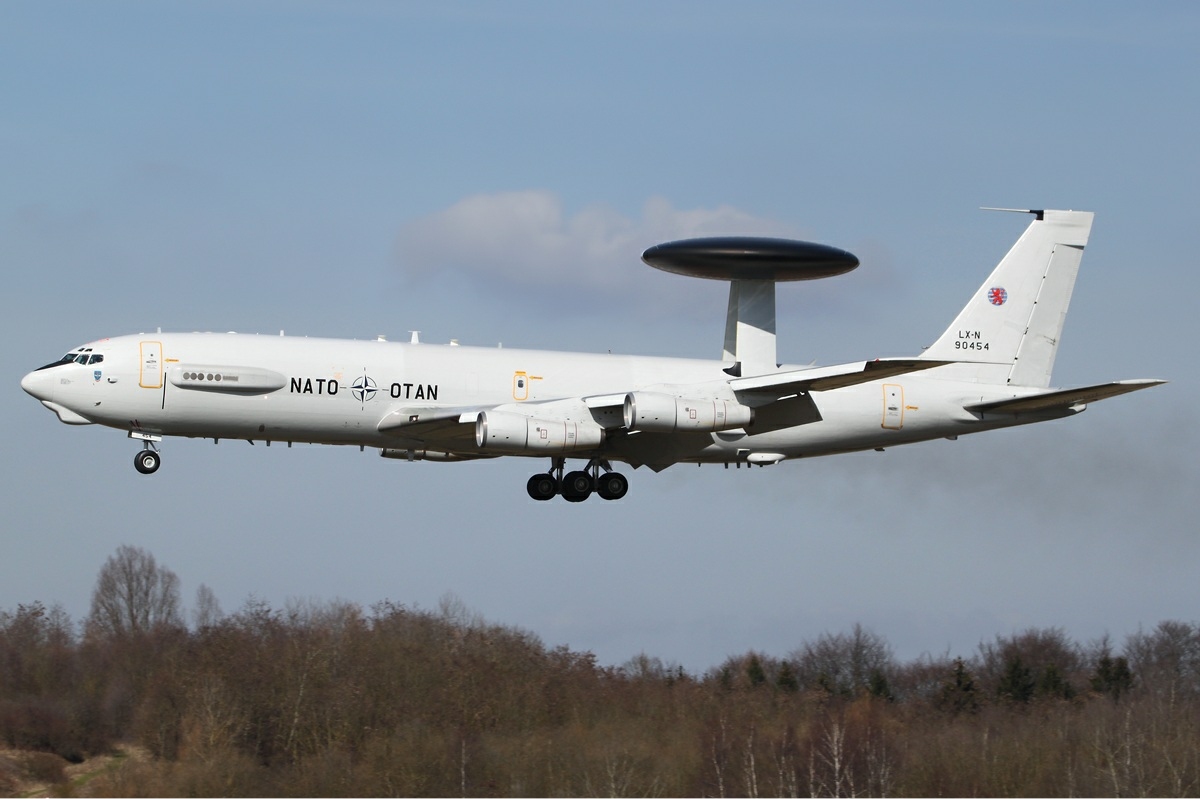
A NATO E-3A AWACS early-warning aircraft, file photo. Photo: Peter Bakema / Wikimedia Commons (GFDL 1.2)
NATO will deploy an AWACS early-warning surveillance aircraft to Poland after three Russian cruise missiles came down on Polish territory, marking the alliance’s most concrete response so far to an incident that has deepened fears that Russia’s war in Ukraine could spill across NATO’s eastern border.
The decision was announced on Monday, 23 November, by Poland’s Deputy Defence Minister Paweł Zalewski after a meeting of allies in Brussels. A NATO spokesperson later confirmed that the Supreme Allied Commander Europe (SACEUR), General Alexus Grynkewich, had authorised the forward deployment of the aircraft, Reuters reported.
What happened
According to Polish prosecutors, three Russian Kh-101 missiles landed in Poland on Friday, 20 November, during a Russian attack on western Ukraine. Polish public broadcaster Polskie Radio, citing the Polish Press Agency (PAP) and tvn24.pl, reported that three objects crossed into south-eastern Poland, and that debris was later found at three sites in the Lublin and Podkarpackie regions and identified as Kh-101 cruise missiles.
The Kh-101 is an air-launched cruise missile that Russia has used repeatedly in long-range strikes on Ukrainian cities and infrastructure. Its appearance on the soil of a NATO member is what turned a familiar pattern of Russian bombardment into a matter for the alliance as a whole.
“Deeper operational awareness”
“An AWACS early-warning aircraft will be made available to Poland,” Mr Zalewski told reporters after the Brussels meeting. “This is a very good system that gives us even deeper … operational awareness which allows us to respond better to this kind of threat.”
AWACS, short for Airborne Warning and Control System, is a modified airliner carrying a large rotating radar dome above its fuselage. It can watch a wide swathe of airspace from high altitude and pass targeting information to fighter jets and ground-based air defences, which makes it particularly useful for detecting low-flying cruise missiles that can be hard to pick up with ground radar alone.
The NATO spokesperson said SACEUR was “now examining the deployment of additional assets as he continues to assess our deterrence and defence posture in Poland”, according to Reuters.
Mr Zalewski said the North Atlantic Council, the alliance’s main decision-making body, had confirmed the decision at Monday’s meeting. He credited Defence Minister Władysław Kosiniak-Kamysz and his close working ties with General Grynkewich for securing the move, Polskie Radio reported. Warsaw had asked allies for additional aircraft to strengthen its defences.
Allies’ positions
Mr Zalewski said ambassadors had expressed “full solidarity” with Poland and regarded the incident as part of a wider Russian escalation against NATO. He said none of the allies doubted that Moscow’s actions were intentional. Asked how Monday’s decisions would protect Poland from another attack, he said Russia was prepared to accept much higher risk, including continuing such actions. “They are escalating in Ukraine, but they will escalate against NATO,” he told reporters.
NATO Secretary General Mark Rutte, speaking in Berlin on Monday, struck a more cautious note on intent. He called the incursion a “dangerous incident” coming from Russia, but said it had to be established “by authorities” whether it was deliberate, Polskie Radio reported.
German Chancellor Friedrich Merz said Russia “must immediately stop these dangerous provocations”, adding that Poland could count on Berlin’s “full solidarity” and that NATO would defend alliance territory if necessary.
Mr Kosiniak-Kamysz wrote on X that allied early-warning aircraft were already helping to protect Polish skies, describing them as a significant addition to ground-based air defences, Poland’s F-16 fighters and allied jets. He said Poland was seeking further support.
Poland’s Foreign Ministry said Russia’s ambassador would be summoned once certain procedures, including work by the military and security services, had been completed. Moscow’s response to the specific findings had not been reported in the sources reviewed for this article.
Why it matters to Malaysia
Events on NATO’s eastern flank can feel distant from Kuala Lumpur, but any widening of the war in Ukraine carries real consequences for Malaysia and its neighbours. A direct clash between Russia and NATO would unsettle global energy, grain and shipping markets, which feed through into fuel, food and freight costs for Malaysian households and businesses. Europe is also a major trading partner and a destination for thousands of Malaysian students and workers, so a sharper security crisis on the continent is something Malaysian families and exporters will be watching closely.
What happens next
Mr Zalewski said NATO foreign ministers would meet next week to consider further Polish proposals, and that some countries had already said they were ready to provide other reconnaissance assets. Polish investigators are continuing their work on the missile debris, and the summoning of Russia’s ambassador is expected once that process is complete. Whether the alliance moves beyond surveillance to additional air-defence deployments will be the key question for the days ahead.
Sources: Reuters; Polskie Radio, citing PAP and tvn24.pl.
About The Author











 Lee AI
 Rizal Omar


 Bria AI


 Bard AI
 Azrul Rizal

 Mohd Nazhrieyan Jailani