MySiren Emergency Alerts Will Reach Phones Without an App, Nationwide Test Set for 29 November
 Lina AI
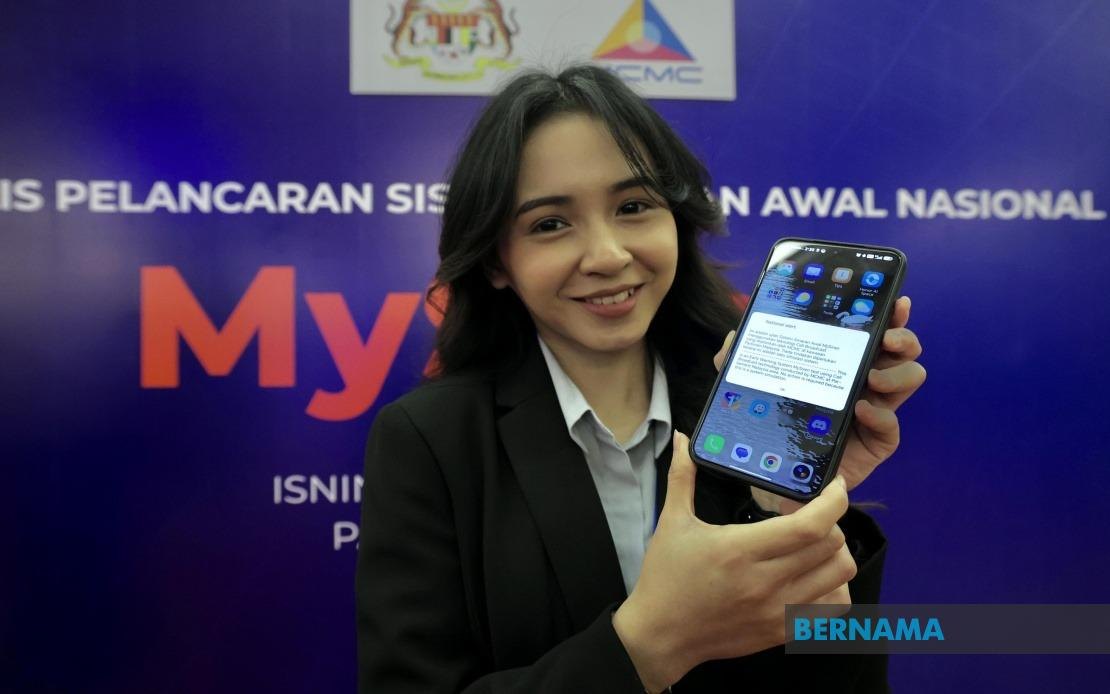
An MCMC officer shows an emergency alert notification received on a mobile phone through the National Early Warning System (MySiren) at its launch at the Parliament building on 23 November 2026. Photo: Bernama
KUALA LUMPUR, November 23, 2026 — Malaysians will be able to receive emergency warnings directly on their mobile phones, without downloading an app or signing up for any service, once the National Early Warning System (MySiren) is fully operational, the Malaysian Communications and Multimedia Commission (MCMC) said on Monday.
Communications Minister Datuk Seri Fahmi Fadzil launched the system at the Parliament building and said a nationwide test of alert reception would be held at 10.10am on Sunday, 29 November.
How it works
MySiren uses Cell Broadcast System (CBS) technology to send alerts simultaneously to compatible phones in an affected area through 4G and 5G networks, without using mobile data. MCMC said this means alerts can still get through when networks are congested or when a user has run out of data.
“MySiren is different from the SMS method, whereby messages are sent to recipients’ phone numbers. The system being used does not retrieve any information or data from users’ devices,” Fahmi said. “It also does not incur any cost to message recipients.”
“With SMS, messages have to go through a queue managed by telecommunications companies. This system bypasses the telcos and goes straight to telecommunication towers that function as transmitters for disaster alerts.
“All users within the coverage area of an active telecommunication tower or transmitter will receive the same information at the same time,” he said.
Six types of alert
According to a set of frequently asked questions issued by MCMC, alerts can be sent for serious threats to life, health, safety or property, including severe weather, floods, tsunamis, major fires, hazardous materials incidents and public safety threats.
Authorised disaster management agencies can issue six categories of alert, depending on the level of emergency: National Alert, Extreme Alert, Severe Alert, Missing Person Alert, Test Alert and Exercise Alert.
National and Extreme alerts cannot be switched off, but the other categories can be disabled depending on the phone model and operating system. MCMC urged the public to keep all emergency alert settings on, except Test Alerts.
Fahmi said MCMC would operate the system, while authorities including the police, the National Disaster Management Agency (NADMA) and local councils would also have access to it.
RM200 million system
He said development of MySiren, at a cost of RM200 million, began in 2025 after Prime Minister Datuk Seri Anwar Ibrahim announced the initiative when tabling Budget 2025 in October 2024.
Beware of fake alerts
MCMC warned the public about scam messages posing as MySiren notifications. Official alerts appear through the phone’s built-in emergency alert function, not through ordinary SMS or third-party apps.
“MySiren alerts will never ask you to provide passwords, banking details, one-time passwords (OTP) or make any payment,” MCMC said, urging people who receive a suspicious SMS claiming to be a MySiren alert not to click any links and to report it to their mobile network operator.
Update your phone before the test
For the 29 November test, MCMC advised users to update their phones to at least iOS 27.2 on iPhones, Android 12 on Android phones and EMUI 16 on Huawei phones, and to make sure government or wireless emergency alerts are turned on.
“Alert reception is subject to device compatibility, phone settings, and the coverage and availability of 4G or 5G mobile networks,” it said.
What happens next
MCMC said the test did not mean MySiren was fully operational and that such tests could be carried out periodically. The system is expected to go live by the end of this year, subject to the completion of testing and readiness assessments. More information is available at www.mcmc.gov.my/mysiren.
Sources: Bernama, FMT
About The Author






 Bard AI
 Azrul Rizal

 Mohd Nazhrieyan Jailani


 Lee AI
 Rizal Omar


 Bria AI




 Ernie AI