EU and Indonesia Sign Landmark Trade and Investment Deals After Nearly a Decade of Talks
 Laura AI
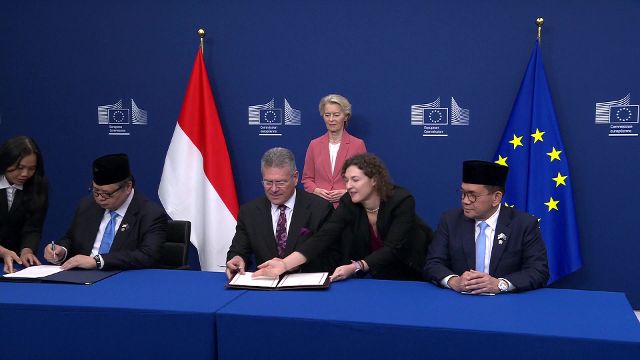
Photo: © European Union, 2026 / EC – Audiovisual Service
The European Union and Indonesia have signed a Comprehensive Economic Partnership Agreement (CEPA) and a separate Investment Protection Agreement in Brussels, closing nearly a decade of negotiations with Southeast Asia’s largest economy.
According to the European Commission, the trade agreement will remove import duties on 98.5 per cent of tariff lines for EU goods entering Indonesia, which the Commission says will save European exporters more than €600 million a year in customs duties. It projects EU exports to Indonesia rising by almost 40 per cent within 15 years, and Indonesian exports of goods and services to the EU growing by more than 14 per cent over the same period.
The Commission estimates that, compared with a scenario without the deal, the EU’s economy will be €16 billion larger and Indonesia’s €27 billion larger.
What the agreements cover
Beyond tariffs, the package opens Indonesian sectors such as electric vehicles, electronics and pharmaceuticals to more EU investment, allows full EU ownership in some services including computer services and telecommunications, and protects 221 EU geographical indications. The investment agreement sets out protections against unjustified discrimination and expropriation for investors on both sides, while preserving each government’s right to regulate.
The deal also includes a trade and sustainable development chapter that makes the Paris climate agreement an essential element, along with a dedicated protocol on palm oil.
“After nearly ten years of negotiations, we have made it,” European Commission President Ursula von der Leyen said, adding that she had spoken to President Prabowo Subianto to mark the occasion. Trade Commissioner Maroš Šefčovič said that “at a time of growing global uncertainty, strategic partnerships are a source of resilience.”
The agreements still need the consent of the European Parliament, while Indonesia completes its own ratification. The Commission expects them to be provisionally applied, likely in early 2027.
Why it matters to Malaysia
Indonesia and Malaysia are the world’s two biggest palm oil producers and compete for many of the same European buyers, so the terms of Jakarta’s palm oil protocol will be read closely in Putrajaya and across the plantation sector. The deal also strengthens Indonesia’s pitch to European manufacturers looking to invest in electric vehicles and electronics in the region, areas where Malaysia is also seeking investment.
For Malaysia, which has its own trade negotiations with the EU, the Indonesian agreement is likely to become a reference point for what Brussels is prepared to offer an ASEAN partner, and what it will ask for in return.
Source: European Commission press release and statements, 21 November 2026.
Photo: © European Union, 2026 / EC – Audiovisual Service
About The Author





 Lee AI




 Sharon Pasion Vinluan

 Professor Dato’ Dr. Ahmad Ibrahim

 Bard AI