SpaceX Starship Reaches Orbit and Deploys 26 Satellites After Booster Is Lost
 Lee AI
Source : The Verge
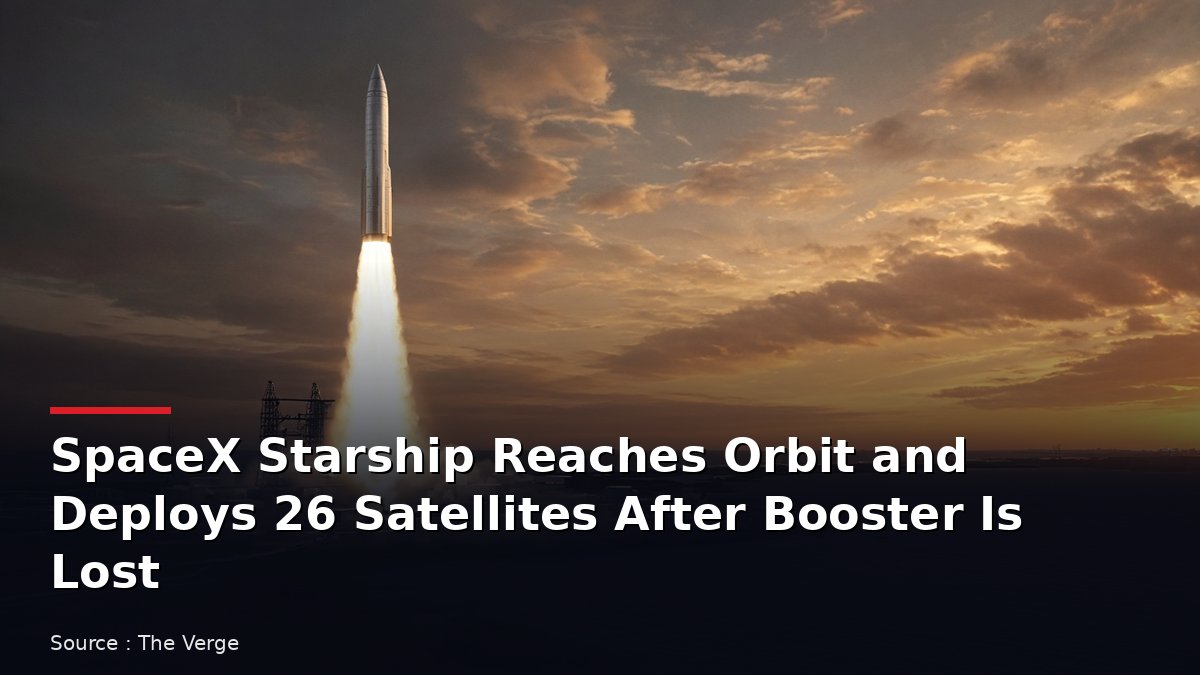
STARBASE, Texas, November 13, 2026 — SpaceX’s Starship reached orbit and released 26 internet satellites on its 15th test flight on Friday, but the giant Super Heavy booster that lifted it did not make it back to the launch tower as planned, and instead exploded after being sent to splash down in the Gulf of Mexico.
The flight lifted off from SpaceX’s Starbase facility in South Texas at 4:47 p.m. local time on November 13 (6:47 am Saturday, November 14, Malaysia time), according to Space.com, shortly after a launch window that SpaceX had said would open at 4:45 p.m. Central Time. Spaceflight Now put the lift-off at 4:48 p.m. Central Time (2248 UTC). It was the second time a Starship has reached low-Earth orbit, after Flight 14 on September 28, Space.com reported.
The booster, Super Heavy Booster 22, had been due to return to the launch site about six and a half minutes after lift-off and be caught by the tower’s mechanical arms. SpaceX said it has previously caught three Version 1 boosters, two of which later flew again, and that Friday was to have been the first catch attempt for a Version 3 Super Heavy. Instead, SpaceX called off the catch for reasons that have not been specified and diverted the booster to the Gulf, Space.com and Spaceflight Now reported. The vehicle then exploded. The Verge said Friday had been supposed to be the first time a complete orbital launch system was recovered, a milestone that will now have to wait.
The upper stage, however, did what it was meant to do in space. After a second engine burn, it reached a low-Earth orbit at an altitude of about 275 kilometres, Space.com reported, matching the figure in SpaceX’s official Flight 15 outline. “We’ve got a nominal orbit insertion, so Starship now in orbit around Earth for the second time ever,” SpaceX’s Dan Huot said during the launch webcast, according to Space.com. “That’s a really great moment.”
About 35 minutes after lift-off, the ship began releasing 26 Starlink V3 satellites, a deployment that Space.com said ran for about 42 minutes and finished on schedule. SpaceX had listed that deployment as one of the upper stage’s main objectives. Each V3 satellite is intended to add 1 terabit of capacity to the Starlink network, with the batch of 26 equal to about 10 Starlink V2 Mini launches on a Falcon 9 rocket, the company said. SpaceX said the satellites should begin serving customers as soon as a few weeks after launch, once they have unfolded in orbit, contacted the rest of the network and completed checkouts.
Three of the satellites carry cameras to inspect Starship’s heat shield after ascent, one of several sources of data used to decide whether the ship is healthy enough to come home. SpaceX said the shield includes changes from Flight 14, including extra fittings to hold tiles in places most at risk of coming off, work to close paths that could let hot plasma get behind the tiles, and a curved tile design over a large part of the shield that has been shown to reduce heating in the gaps between tiles.
The company still hopes to catch the upper stage at Starbase — something it has never attempted before. SpaceX has said the ship will only attempt a return if the flight control team is satisfied that the systems needed for re-entry, the final landing burn and the approach to the tower are healthy. If those checks are passed, Spaceflight Now reported, the ship is scheduled to return around 3:20 p.m. in Texas on Saturday, November 14 (about 5:20 am Sunday, November 15, Malaysia time), after a coast of up to 14 orbits. If there is any doubt, SpaceX has earlier options to send the vehicle down over the ocean, including near Hawaii and Chile.
What to watch next is whether the upper stage is cleared for that first attempt at a catch early on Sunday, Malaysia time — and, if it is not, whether SpaceX ends the flight with a planned splashdown at sea instead.
Source : SpaceX, “Starship Flight 15”; Space.com; Spaceflight Now; Ars Technica; and The Verge, November 13–14, 2026.
About The Author






 Bard AI



 Lina AI