Source : Anthony Albanese
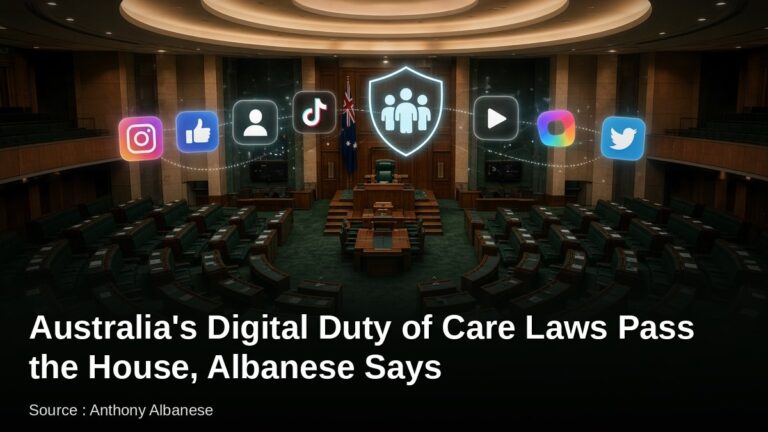
CANBERRA, October 28 — Australia’s sweeping new online safety laws, which would place a legal “digital duty of care” on technology companies, have passed the House of Representatives, Prime Minister Anthony Albanese announced on Wednesday.
“NEWS: Our laws to hold digital platforms to account have passed the House,” Mr Albanese said in a post on X on October 28.
Parliamentary records show the Online Safety Amendment (Digital Duty of Care) Bill 2026 cleared its second reading, consideration in detail and third reading in the lower house on October 28. Fifteen government amendments and eight crossbench amendments were agreed to before the vote. The bill now moves to the Senate, where its passage is not yet guaranteed.
The legislation would require online services, including social media platforms, online games and artificial intelligence chatbots, to carry out risk assessments of their services and put systems in place to stop risky features from causing harm. Adults would be given meaningful choice about what appears in their feeds, while users under 18 would have to be protected from content and features considered harmful to young people.
Speaking in the House chamber on October 27, Mr Albanese said the bill “puts a positive obligation on Big Tech to provide a safe online environment where Australians are protected from seriously harmful and illegal content”. He said it would set safety standards for digital services “just like we do for motor cars and food and children’s toys”.
According to the Prime Minister, platforms would have to shield under-18s from content that promotes eating disorders, hostility towards women and gender equality, pornography, material that glorifies crime or dangerous stunts, and content that causes serious distress, including abuse and bullying. He said the bill would also protect young people from addictive features that keep them up late, and would ban so-called “nudify” apps. “This is sensible reform,” Mr Albanese told the House, urging members of both chambers to “examine your conscience”.
The bill was introduced on October 15 by Communications Minister Anika Wells, who told parliament that Australia’s existing online safety framework had left regulators “playing whack-a-mole”. She said the duty of care was designed to move “the safety net upstream” to the companies that design online products. If the bill passes and receives royal assent, a 12-month transition period will apply before the new obligations take effect, with the eSafety Commissioner determining the level of obligation for lower-risk services.
The road through the Senate remains uncertain. The Coalition opposition has said it will vote against the bill, with Liberal communications spokeswoman Sarah Henderson describing it as “dangerously vague” and “fatally flawed”, according to Australian Associated Press (AAP). The government is therefore expected to need support from the Greens and the crossbench to pass it in the upper house.
To win over the Greens and answer concerns about political censorship, the government has already dropped a proposed power for the communications minister to define new online harms, leaving that to parliament instead. The Greens, led on the issue by communications spokeswoman Senator Sarah Hanson-Young, are pushing for higher penalties and for Australians to be given the right to sue technology companies for harm. Ms Wells has said she is open to considering both changes.
The bill has been referred to the Senate Environment and Communications Legislation Committee, which is due to report by November 20, 2026. More than a dozen democracy and advocacy groups have urged parliament to pass the legislation, AAP reported.
The reform builds on Australia’s ban on social media accounts for under-16s, which was introduced in December 2025. AAP reported that Facebook, Instagram, TikTok, Snapchat and YouTube already face a legal battle with the eSafety Commissioner over allegedly failing to properly enforce that age limit.
Source: Anthony Albanese’s X
About The Author