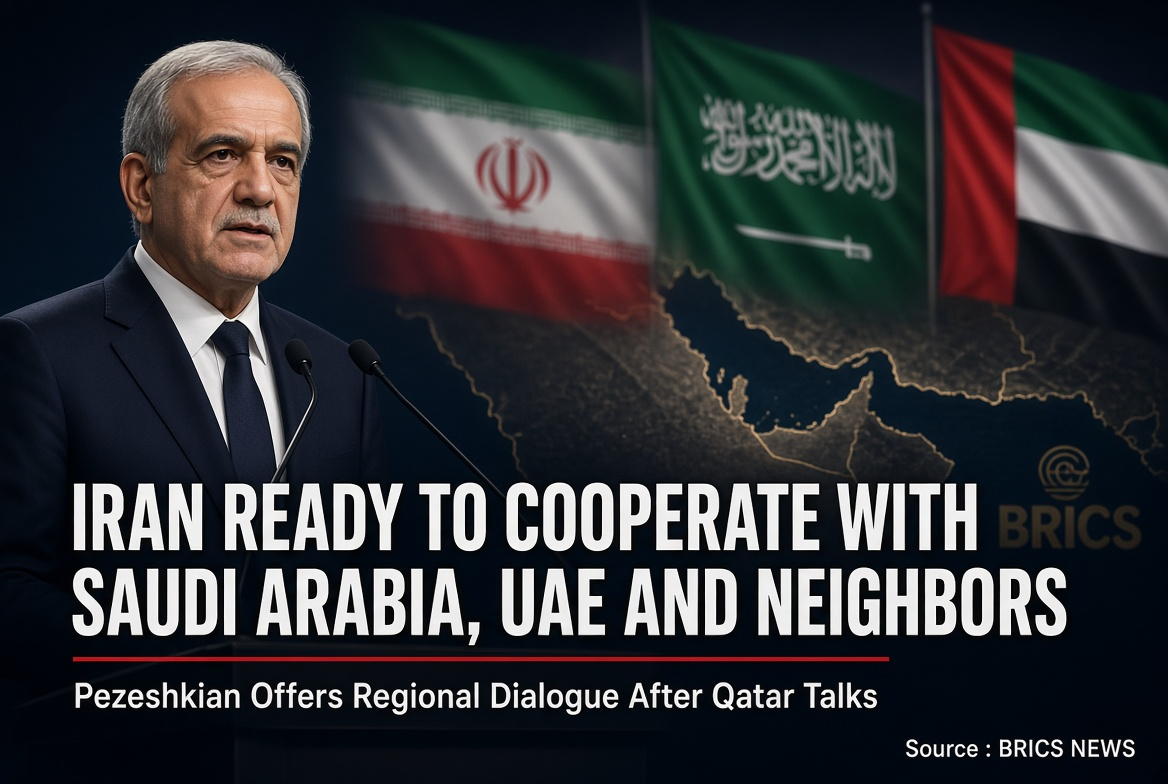
TEHRAN Aug 28, 2026 – Iranian President Masoud Pezeshkian said Iran is prepared to work with Saudi Arabia, the United Arab Emirates and other regional countries to build mutual understanding and expand ties, according to a report circulating Friday from the BRICS-focused account @BRICSinfo.
The statement comes a day after Pezeshkian met Qatari Prime Minister and Foreign Minister Sheikh Mohammed bin Abdulrahman Al Thani in Tehran and addressed the 40th International Islamic Unity Conference. In both settings he combined an offer of dialogue with a firm insistence that Iran’s legal rights must be recognized and that Tehran will not yield to pressure.
“All the legal rights of the Iranian people must be recognized,” Pezeshkian said during the Qatar meeting. “The Islamic Republic of Iran demands nothing beyond its legal rights and will not surrender to pressure or bullying.” He added that Iran “has not, does not, and will not seek war, but it will not submit to bullying either.”
He told the Qatari official that recent “painful” or “bitter” incidents between the two countries should not prevent a return to cooperation, describing Iran and Qatar as “friendly and brotherly nations” whose differences can be resolved through understanding. Joint projects planned before the latest round of regional fighting had been delayed, he said.
At the Islamic Unity Conference, Pezeshkian framed the same message more broadly. “Defending Iran does not mean hostility toward Muslim nations or neighboring countries,” he said. “No Islamic country should allow its territory to be used as a launchpad for aggression against another Islamic country. No Islamic country should seek its own security through the insecurity of its neighbors.”
He proposed three steps for Muslim states: a mutual security and non-aggression pact based on respect for territorial integrity; a permanent mediation mechanism under the Organization of Islamic Cooperation; and a practical network of economic, scientific and technological cooperation so that more trade and investment stays inside the Islamic world.
The remarks fit a pattern Pezeshkian has followed since taking office: outreach to Gulf capitals, emphasis on dialogue over open-ended conflict, and repeated calls for regional countries to manage their own security without external “guardianship.” Iran restored diplomatic relations with Saudi Arabia in 2023 and has maintained contacts with Riyadh and Abu Dhabi even during periods of high tension.
@BRICSinfo presented the latest comments as a sign of Iran’s effort to deepen its place in the BRICS grouping while lowering tensions across the Gulf. Reduced friction among Iran, Saudi Arabia and the UAE would ease pressure on energy routes and support a wider, if still fragile, push for regional stability. Whether the public offer produces new working groups, visits or concrete economic deals will depend on how Riyadh, Abu Dhabi and other capitals respond in the coming weeks.
About The Author