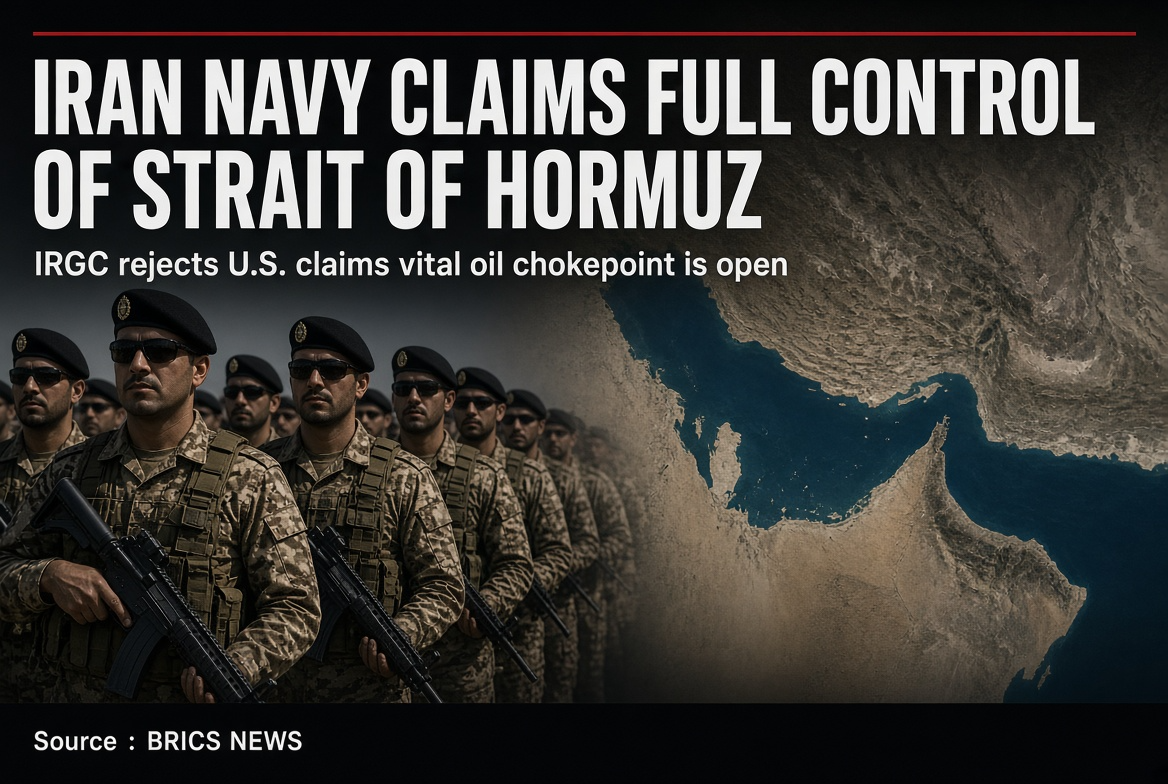
TEHRAN Aug 28, 2026 – Iran’s Islamic Revolutionary Guard Corps (IRGC) Navy said Friday it maintains “full control” over the Strait of Hormuz and dismissed U.S. assertions that the vital oil chokepoint is open, calling those statements an attempt to manage oil prices and conceal American setbacks.
In a statement reported by Reuters, the IRGC Navy said restrictions on passage would remain in place until U.S. military actions against Iran end and related commitments are implemented. The declaration was accompanied by images of Iranian personnel in formation and a satellite view of the waterway, circulating widely on social media including via the account @BRICSinfo.
The claim comes more than six months into a high-intensity conflict that began with U.S. and Israeli strikes on Iran in late February 2026. A June memorandum of understanding (MoU) between Washington and Tehran briefly raised hopes of restoring commercial traffic, with Iran tasked in the document with facilitating safe passage and consulting Oman and other Gulf states on future administration of the strait. That arrangement largely unraveled amid renewed incidents and competing assertions of authority.
IRGC officials have repeatedly argued that no vessel may transit without Iranian permission and management. Spokesman Hossein Mohebbi said this week that “enemy” warships remain at least 400 kilometers from the strait and that even the route near Oman falls under Iranian control. He added that Iran and Oman have discussed shares of the waterway and its revenues, and that the strait could reopen within an agreed framework if the United States returns to the June MoU. Otherwise, he said, it “will not be opened under any circumstance.”
The Strait of Hormuz is one of the world’s most important energy arteries. Before the war, roughly one-fifth of seaborne oil and significant volumes of LNG passed through it, with more than 100 vessels transiting daily. Traffic has since collapsed to a small fraction of normal levels. Many remaining movements involve “dark” transits with AIS transponders switched off, Iranian- or China-linked ships using the northern corridor near Iranian islands, limited U.S.-facilitated escorts, or ship-to-ship transfers outside the most dangerous stretches. War-risk insurance costs have soared, and mines, drones, missiles, and fast-attack craft have kept most commercial operators at a distance.
U.S. officials, including President Donald Trump, have asserted that mines have been cleared from international waters and that American forces have escorted hundreds of vessels. Maritime tracking and industry reports present a more mixed picture: weekly tanker and gas-carrier movements have shown some recent upticks from post-MoU lows, but volumes remain far below pre-war norms, mine-danger warnings persist in some assessments, and incidents—including strikes on tankers—have continued.
Iran has used its geography, islands, land-based missiles, drones, mines, and small-boat swarms to impose costs even after heavy damage to its conventional navy. Analysts describe the result less as total physical occupation of the waterway than as the ability to raise risk, dictate preferred routes, and extract leverage in talks with Oman and others. Tehran has floated institutional arrangements such as a Persian Gulf Strait Authority and, at times, fees or permits, while rejecting a return to the pre-war status of an open international strait.
Negotiations with Oman over a temporary joint corridor and demining continue, according to recent joint statements. Those talks sit alongside broader diplomatic pressure, sanctions, and the threat of renewed military action. For now, Iran’s latest assertion of exclusive management underscores how the strait remains both a bargaining chip and a flashpoint six months into the war.
About The Author