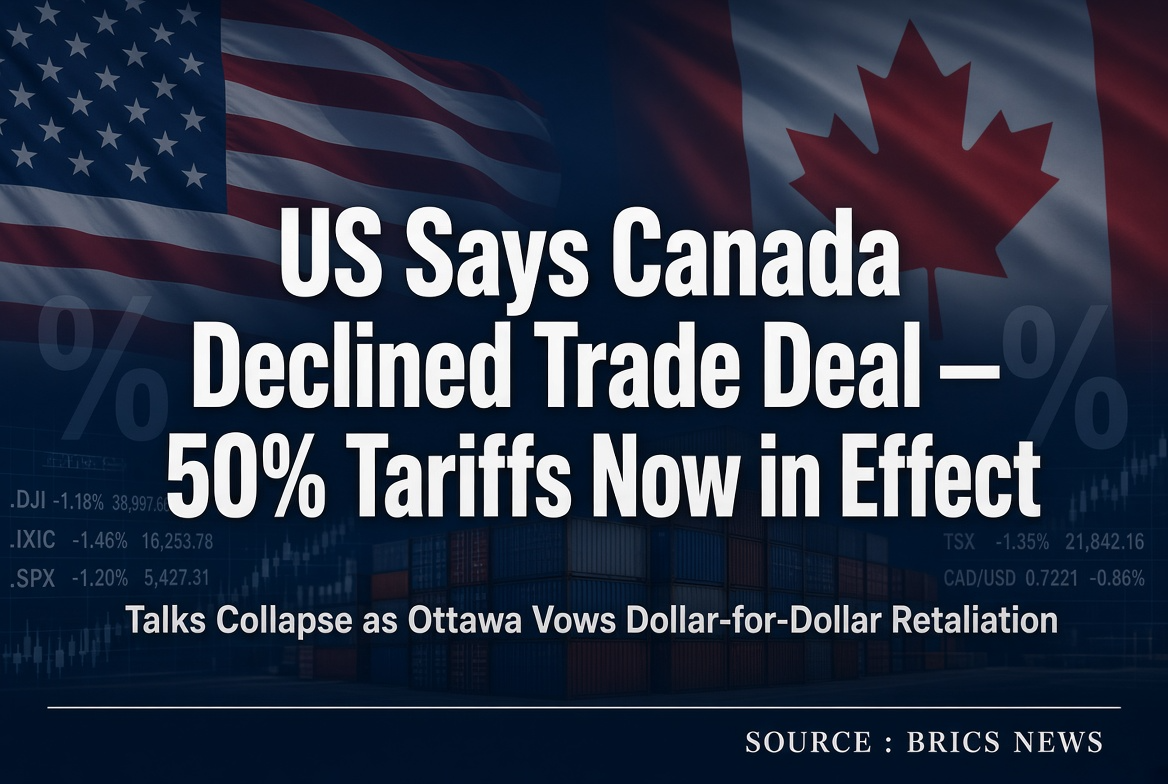
WASHINGTON D.C AUg 21, 2026 — The United States has imposed 50% tariffs on roughly $20–28 billion worth of Canadian goods after last-minute trade negotiations between the two countries collapsed late Friday, U.S. officials said.
U.S. Trade Representative Jamieson Greer announced that Canada “declined to finalize the trade deal under the terms agreed earlier this week,” describing it as a “missed opportunity for Canada.” Greer said new Canadian demands and walk-backs of prior commitments “upended the careful balance” reached during days of intensive talks in Washington.
The tariffs, which took effect just after midnight Saturday (August 22, 2026), apply to a range of products including plywood, cement, wine, dairy, clothing, hockey sticks, and other goods—representing about 5% of Canada’s annual exports to the United States.
Canadian Prime Minister Mark Carney responded by suspending negotiations and ordering Canadian negotiators to return to Ottawa. In a statement, Carney said progress made in recent weeks “has not been enough to meet our objectives for Canadians.” He accused the U.S. side of introducing “last-minute changes” that were “unfair, uneconomic, and called into question the reliability of any deal.”
Carney pledged that Canada “will match those tariffs dollar for dollar to protect our workers and businesses.” He also announced that additional support measures for affected Canadian industries and workers would be introduced in the coming days, building on nearly $25 billion in aid provided over the past 18 months.
The breakdown ends a temporary extension of the original tariff deadline, which President Donald Trump had pushed back by several days amid reports of substantial progress. Earlier discussions had reportedly centered on reducing U.S. tariffs on Canadian steel and aluminum from 50% to 25% and on autos from 25% to 15%, in exchange for Canada rolling back certain retaliatory measures, including provincial bans on U.S. alcohol sales and other restrictions.
The failure to reach an agreement marks a further escalation in the ongoing U.S.-Canada trade dispute, which has strained the world’s largest bilateral trading relationship amid longstanding frictions over dairy market access, steel, lumber, autos, and reciprocal tariffs. Both sides have accused the other of bad faith in the final hours of talks.
Officials indicated no new negotiations are currently scheduled. Markets and industry groups on both sides of the border are expected to closely monitor the economic fallout in the days ahead.
About The Author