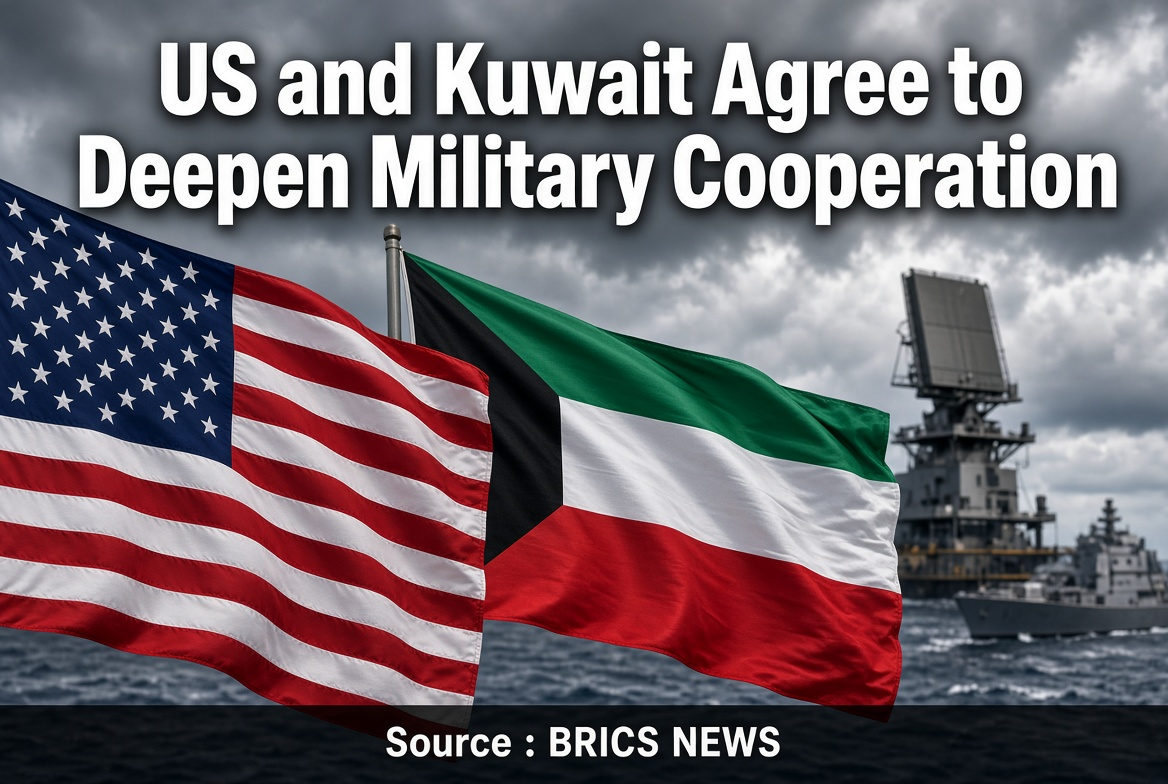
WASHINGTON D.C August 21, 2026 — The United States and Kuwait have agreed to deepen their military cooperation and integration, focusing on countering drones, strengthening air and missile defenses, and expanding maritime security, the Pentagon announced on Friday.
Senior officials from both countries held the 16th U.S.-Kuwait Joint Military Commission at the Pentagon on August 19-20. The talks were co-chaired by Deputy Assistant Secretary of War for Near East and Central Asia Michael P. DiMino IV and Kuwait’s Chief of the General Staff Lieutenant General Khaled al-Shriaan. Representatives from U.S. Central Command, the Joint Staff, the State Department, and the Maryland National Guard also took part.
The delegations formalized new operational roadmaps aimed at strengthening Kuwait’s defense capabilities and improving interoperability with U.S. forces. Officials emphasized their commitment to a “strong, reciprocal, and enduring defense partnership.”
Discussions centered on regional security challenges. Both sides highlighted the growing threat from unmanned aircraft systems (UAS), noting how the proliferation of drones has transformed modern warfare and increased the need for deeper military integration. They also agreed to expand cooperation on maritime security and enhance regional integrated air and missile defense architectures.
Kuwait is moving forward with a pending $1.98 billion acquisition of Anduril counter-small UAS systems. This forms part of a broader effort to expand foreign military sales and modernize Kuwait’s armed forces. Officials also discussed streamlining arms transfer processes under the America First Arms Transfer Strategy.
In a separate announcement, DiMino confirmed Kuwait’s formal acceptance into the U.S. State Partnership Program. The Gulf nation will be paired with the Maryland National Guard to support long-term military-to-military cooperation.
Kuwait, a major non-NATO ally of the United States, hosts thousands of American troops and remains a key element of Washington’s military posture in the region. The latest agreement builds on decades of defense partnership between the two countries.
About The Author