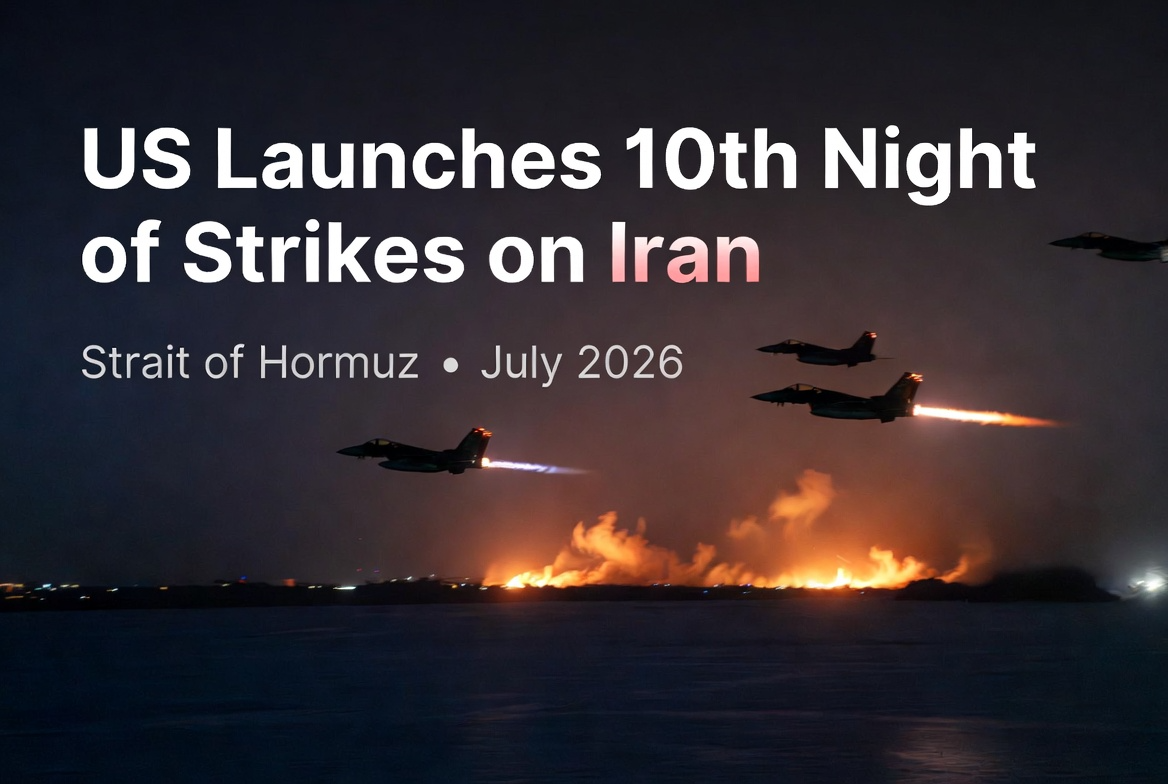
WASHINGTON July 20, 2026 – The United States military conducted another wave of airstrikes against Iranian targets late Monday, marking the 10th consecutive night of operations aimed at weakening Tehran’s ability to threaten commercial shipping through the Strait of Hormuz, according to U.S. Central Command (CENTCOM).
CENTCOM announced that U.S. forces began the latest round of strikes on Monday afternoon (local time), targeting Iranian military command centers, air defense systems, coastal surveillance sites, maritime capabilities, missile and drone launch sites, and communications networks. The stated goal is to further degrade Iran’s capacity to attack vessels transiting the critical waterway, which handles a significant portion of global oil shipments.
The strikes come amid escalating tit-for-tat exchanges between the U.S. and Iran. Iranian forces have carried out attacks on U.S. and allied positions in the region, including a recent strike on a base in Jordan that killed American service members. U.S. President Donald Trump stated that the operations were conducted “in honor” of the fallen troops, saying, “We hit them very hard again tonight.”
Iranian state media reported explosions in several locations, including southern areas near the Strait of Hormuz such as Bandar Abbas, Sirik, and Qeshm Island, as well as other cities. Tehran has retaliated by targeting U.S.-linked assets in neighboring countries including Kuwait, Jordan, and Bahrain.
This latest round continues a pattern of nightly U.S. strikes that began intensifying in mid-July after an interim understanding between the two sides collapsed. The U.S. maintains that the operations are necessary to keep the Strait of Hormuz open for international shipping. Iran views the waterway as a strategic pressure point and has warned against any attempts to restrict its use.
British maritime authorities have also reported recent incidents involving commercial vessels in the area.
The situation remains fluid, with both sides exchanging strikes while diplomatic channels, including mediation efforts involving regional players, continue in the background.
About The Author