Source : @Variety
SINGAPORE — Hong Kong-born filmmaker Peter Chan Ho-sun has said he will probably use artificial intelligence in his filmmaking but “definitely not AIGC”, or AI-generated content, and insisted that the two-hour feature film will hold its ground against the rise of short-form and vertical dramas, at least in his lifetime.
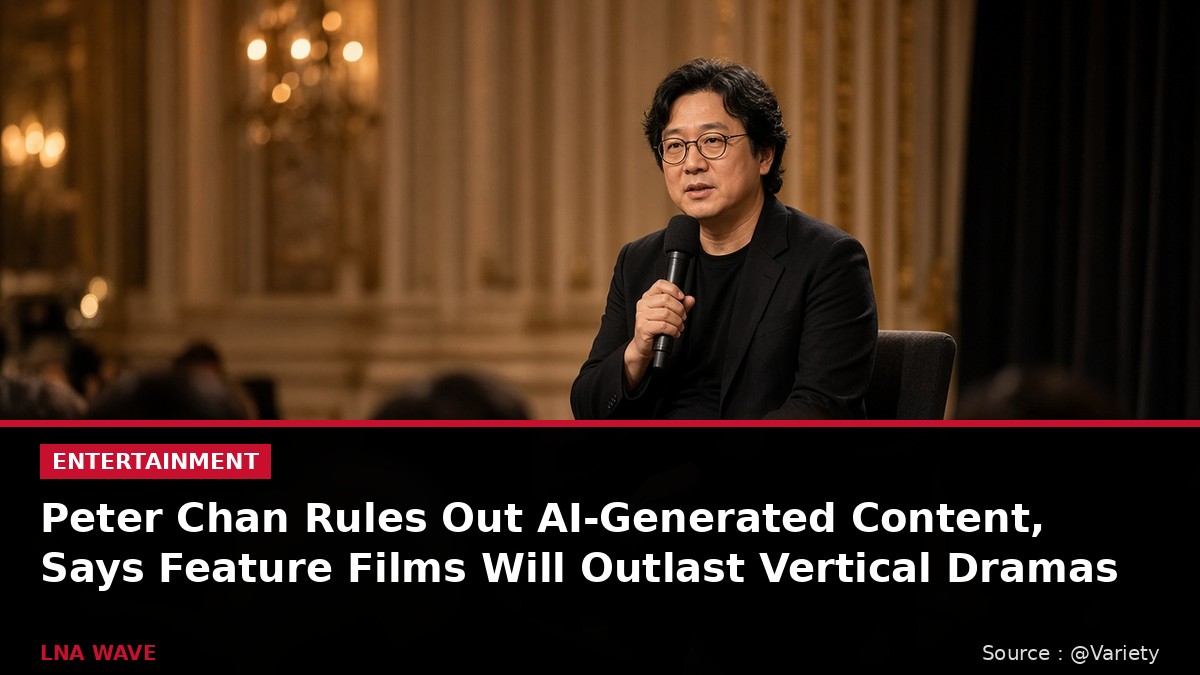
The director of “Comrades: Almost a Love Story” and “The Warlords” was speaking at an In Conversation event at the Singapore International Film Festival, held in the Grand Ballroom at Marina Bay Sands, Variety reported on Thursday (Oct 22).
Asked by an audience member whether he had ever doubted his decision to enter the film industry, Chan offered a frank assessment for aspiring filmmakers. “This is probably the toughest time for film, but do I believe this medium is going to be lost and gone to short-form entertainment? No,” he said.
Chan said he would treat AI as a technique, in the way the industry already uses CGI and special effects, noting that CGI has relied on AI for years without calling it that. “Anything that helps me make movies, I welcome. But they won’t know art. Movies are still made by people,” he said.
He argued that audiences were moving in two opposite directions at once. Younger viewers with shrinking attention spans are turning to short and vertical dramas, he said, while others are listening to podcasts that run for hours, citing Christopher Nolan’s round of podcast appearances to explain his purist approach to making “Oppenheimer”. “So there are two completely opposite ends of the spectrum that are surviving and thriving simultaneously. So I believe that movie will be around for a long, long time,” Chan said.
His latest film, “The Road Not Taken”, premiered in Toronto. It follows a couple in the middle of divorce proceedings when the wife, who has early-onset Alzheimer’s, no longer remembers the divorce and drifts back in her mind to when they fell in love in their 20s. “My new movie is about Alzheimer’s, but it’s really not just about Alzheimer’s. It’s about a broken family that has all sorts of problems a family could have,” he said. The English title comes from the Robert Frost poem Chan calls his life motto, while the Chinese title, “Ming Tian Hui Geng Hao”, translates as “Tomorrow Will Be Better”.
This year marks the 30th anniversary of “Comrades”, which Chan made at 34 as his seventh feature. He said the film, which he believes barely recouped its investment, went on to influence filmmakers in mainland China, South Korea and Southeast Asia. “That movie gave me a lease of movie life for the next 30 years, until now,” he said, adding that 90 per cent of people remember him for that single film.
Reflecting on his career, Chan described his DreamWorks film “The Love Letter” as a difficult experience, saying he struggled with a corporate system in which it was unclear who called the shots and with a reliance on test screenings that he likened to today’s algorithms. He later founded the pan-Asian company Applause Pictures, whose output included “The Eye” franchise and the “Three” horror omnibus films, before moving into mainland Chinese cinema with the 2005 musical “Perhaps Love”.
Asked how he navigates censorship in mainland China, Chan said limitations of budget, stars, studios or censorship tend to push filmmakers to be more creative. “Making every movie is answering some sort of life questions that I have at that stage, in point of my life,” he said. “So in a way, I’ve been making the same movie in my mind in the last 36 years.”
The original Variety post can be viewed on X: https://x.com/Variety/status/2113427166314553500.
About The Author