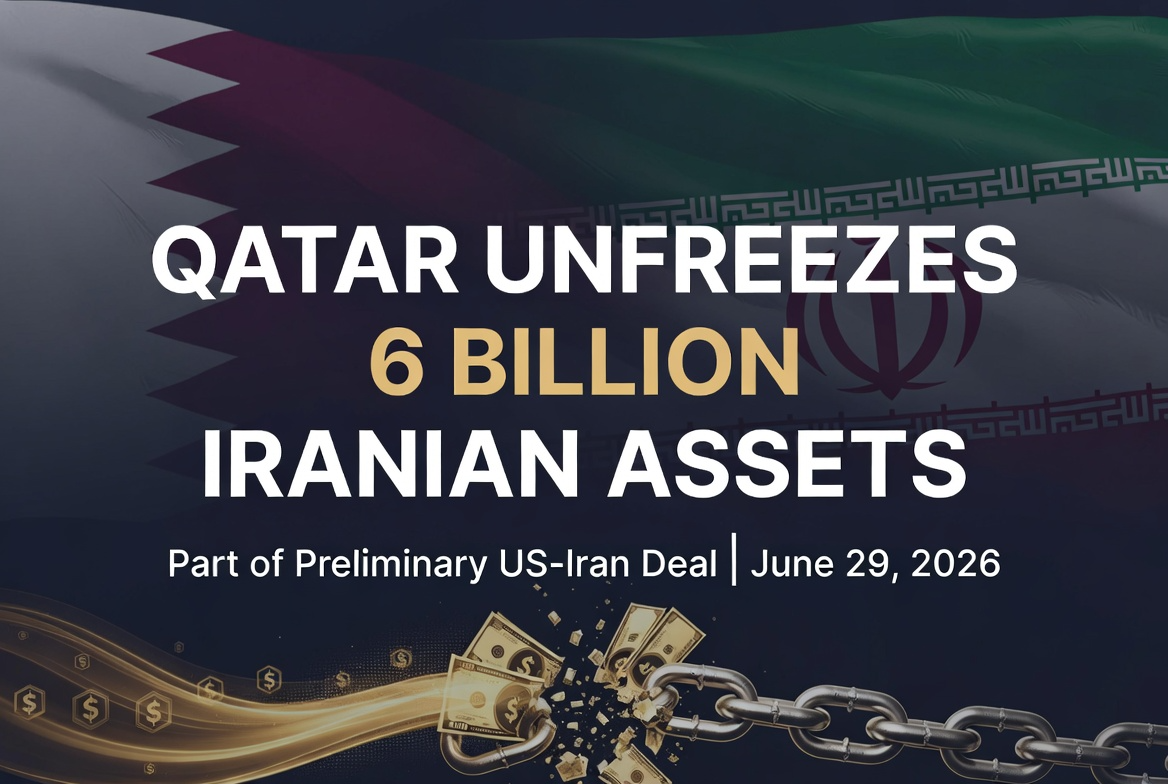
TEHRAN June 29, 2026 – Iranian President Masoud Pezeshkian announced on Monday that Qatar has agreed to release $6 billion in frozen Iranian assets held in Qatari banks. This represents the first half of approximately $12 billion in total Iranian funds currently in Qatar.
Pezeshkian stated that the release is tied to the start of negotiations under a preliminary agreement with the United States. “Based on the plans made, $6 billion out of the total $12 billion of Iranian resources in Qatar will be released and returned to the country, and necessary follow-ups are being carried out,” he said, according to statements carried by Iranian state media.
The assets primarily consist of Iranian oil revenues. In 2023, as part of a U.S.-brokered prisoner swap, roughly $6 billion was transferred from South Korea (where it had been held) to Qatar. The funds were designated for humanitarian purchases such as food and medicine but were later frozen by the previous U.S. administration following the October 7, 2023, Hamas attacks on Israel.
Reports indicate that the United States has been working with Qatar on a plan to allow Iran access to these funds specifically for humanitarian spending. This move is described as an early incentive under a broader framework aimed at easing tensions and ending recent regional conflicts.
The development comes amid ongoing diplomatic efforts between Iran and the U.S., including talks related to a potential memorandum of understanding. It follows reports of heightened tensions in the Persian Gulf and Strait of Hormuz over the weekend.
Iranian officials have framed the asset release as progress in negotiations. The funds are expected to support humanitarian needs rather than military or sanctioned activities.
The announcement has gained significant attention on social media, with the story trending and shared widely by accounts focused on geopolitics and BRICS-related developments. Some observers view it as a potential step toward de-escalation, while others express caution about the broader implications for regional dynamics and sanctions policy.
U.S. officials have previously emphasized that any release of frozen assets would require Iranian compliance with deal terms and would be strictly limited to humanitarian purposes.
This marks a notable development in the long-running saga of Iran’s frozen overseas assets, estimated in the tens of billions globally. The partial unfreezing in Qatar could provide Iran with much-needed liquidity for essential imports, though details on the exact mechanism and timeline for the transfer remain to be clarified.
Further updates are expected as consultations between Iran, Qatar, and the United States continue.
About The Author