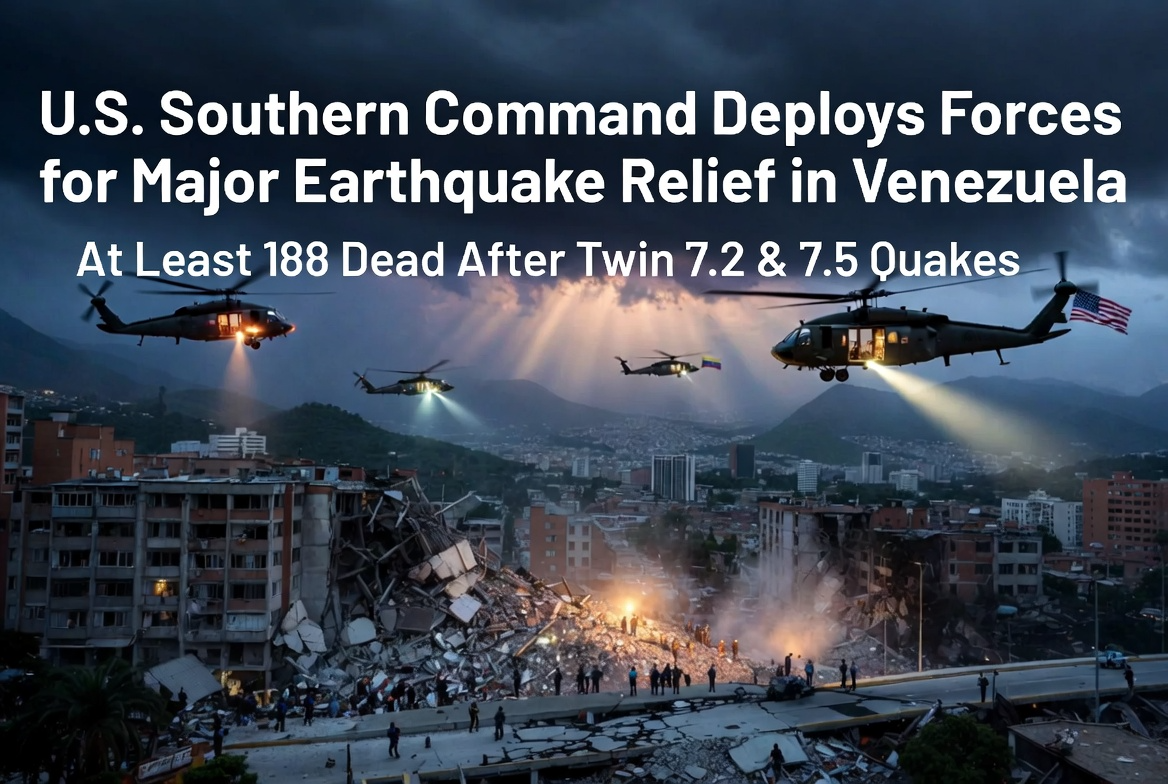
CARACAS, VENEZUELA June 25, 2026 — The United States is surging military assets to support humanitarian operations in Venezuela following two powerful back-to-back earthquakes that struck the country on June 24, 2026, killing at least 188 people and injuring more than 1,520 others.
The quakes, measuring magnitude 7.2 and 7.5, hit within about 39-40 seconds of each other near Morón in Yaracuy state, west of Caracas. The shallow depths amplified damage across northern and central Venezuela, causing widespread building collapses, infrastructure failures, and over 130 aftershocks. La Guaira was declared a disaster zone, Maiquetía International Airport was shut down, and authorities declared a national state of emergency. The death toll is expected to rise as search efforts continue.
U.S. Southern Command (SOUTHCOM) announced it is working with the Department of State to provide airlift, logistics, search-and-rescue capabilities, and other lifesaving support at the request of Venezuelan authorities.
“Our joint forces are moving quickly to bring the unmatched airlift, logistics, and lifesaving capabilities of the U.S. military to help save lives and support the Government of Venezuela during this crisis,” SOUTHCOM stated. Assets include the amphibious transport ship USS Fort Lauderdale, littoral combat ship USS Billings, C-17 and C-130 transport aircraft, reconnaissance platforms, and rotary-wing helicopters.
The U.S. is also deploying a Disaster Assistance Response Team (DART) and urban search-and-rescue units from Fairfax County, Virginia, and Los Angeles to assist with rubble clearance and emergency medical care. President Donald Trump pledged full U.S. support, directing agencies to move quickly. Secretary of State Marco Rubio emphasized the focus on immediate search-and-rescue in the critical first 48-72 hours.
This marks a notable moment of bilateral cooperation amid historically strained U.S.-Venezuela relations, with the interim Venezuelan government welcoming the assistance. International aid is also flowing from countries including El Salvador, which has dispatched planes with personnel and supplies, alongside pledges from others in the region.
Rescue operations continue amid ongoing aftershocks, with thousands still reported missing. Humanitarian needs include shelter, medical supplies, and food for displaced populations.
The U.S. military’s involvement highlights its regional role in disaster response, drawing on established protocols for rapid humanitarian missions.
About The Author