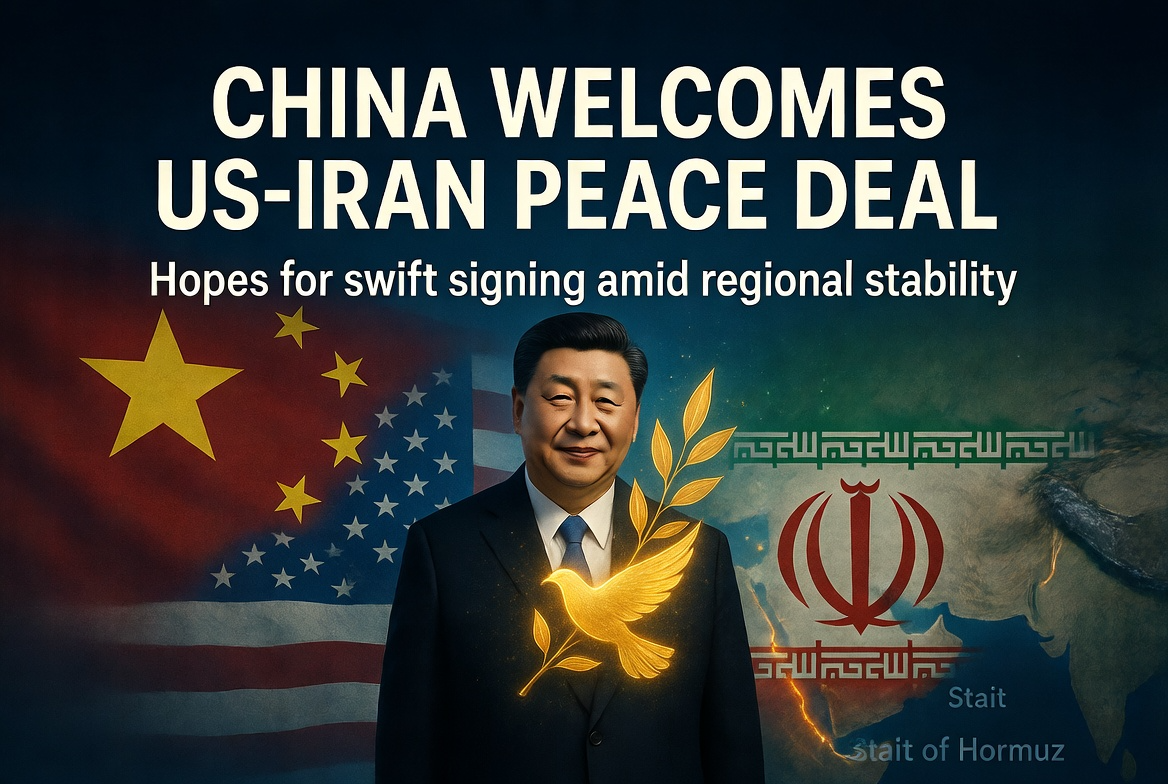
BEIJING June 15, 2026 — China has expressed support for the recently announced peace agreement between the United States and Iran, stating that it hopes the deal will be formally signed as planned.
A spokesperson for China’s Foreign Ministry welcomed the framework agreement, which aims to end months of conflict, reopen the Strait of Hormuz to international shipping, and provide a pathway for sanctions relief and reconstruction support. “We hope the agreement is signed as planned,” the statement read, according to reports circulating on social media and geopolitical accounts.
The development comes after Pakistani Prime Minister Shehbaz Sharif announced that the US and Iran had reached a memorandum of understanding following intensive mediation efforts. US President Donald Trump confirmed the deal, with an official signing ceremony scheduled for June 19 in Switzerland. Key elements of the reported 14-point draft include:
- An immediate and permanent ceasefire across all fronts, including Lebanon.
- Reopening of the Strait of Hormuz within 30 days and lifting of the US naval blockade.
- Suspension of certain oil-related sanctions and release of frozen Iranian assets.
- US commitments on non-interference and phased military withdrawals from surrounding areas.
- $300 billion in reconstruction funding pledges and 60 days of further negotiations on Iran’s nuclear program.
China, a major importer of Iranian crude oil, stands to benefit significantly from restored stability in the Persian Gulf. Reliable energy flows through the Strait of Hormuz — which carries about one-fifth of global oil supply — align with Beijing’s energy security priorities. Analysts note that China’s position reflects pragmatic economic interests amid its broader geopolitical competition with the US.
Images circulating alongside the announcement: Chinese President Xi Jinping and a symbolic merged US-Iran flag.
The announcement has drawn positive responses from multiple world leaders, including those from the EU, Britain, France, Germany, Italy, Australia, and Qatar. Oil prices have fallen sharply on expectations of resumed shipments, while Asian stock markets rallied.
However, challenges remain. Israel has signaled it will not withdraw from certain security zones in Lebanon, Syria, and Gaza, raising questions about full regional de-escalation. Skeptics also point to Iran’s missile program and proxy networks as potential sticking points excluded from initial talks.
This interim deal marks a significant diplomatic breakthrough in a conflict that disrupted global energy markets earlier in 2026. Implementation and follow-through negotiations will be closely watched in the coming weeks.
About The Author