KUALA LUMPUR, June 10 — Human Rights Watch has said Colombian private military contractors were deployed to Sudan to support the Rapid Support Forces during the war in Darfur, including in the period surrounding the group’s capture of El Fasher, the capital of North Darfur, in October 2025.
In an 83-page report titled From Bogotá to El Fasher: The UAE’s Role in the Deployment of Colombian Fighters and Other Backing to the Rapid Support Forces in Sudan, the rights group said the contractors fought alongside the Rapid Support Forces, known as the RSF, which has been battling the Sudanese Armed Forces since April 2023.
Human Rights Watch said it found evidence that private military contractors were present in El Fasher when the RSF took control of the city after an 18-month siege. The organisation said the city witnessed widespread killings, sexual violence, starvation and attacks on vulnerable civilians during and after the takeover.
The report comes amid growing international concern over Sudan’s humanitarian crisis, which has displaced millions of people and left large parts of the population facing acute hunger. In Malaysia, where official and public attention to conflicts in the Muslim world and the Global South often focuses on civilian protection and international law, the findings add a new dimension to debate over foreign involvement in internal wars.
Human Rights Watch said the Colombian contractors were apparently hired by Global Security Services Group, an Abu Dhabi-based security company, before being sent to Sudan in support of the RSF. The organisation said some contractors transited through facilities in the United Arab Emirates before reaching Sudan, including a base in Ghiyathi and an apparent facility in Al Wathba, both in Abu Dhabi emirate.
The UAE has repeatedly denied providing military support to any party in Sudan’s conflict. Abu Dhabi has said its assistance is humanitarian and that it supports efforts to secure a ceasefire, protect civilians and ensure accountability.
Human Rights Watch said its conclusions were based on interviews with two Colombian private military contractors who were deployed to Sudan, one former employee of Global Security Services Group, eight residents of El Fasher and seven other sources, including former Colombian military officers.
The organisation said it also reviewed corporate records and official documents, and verified and geolocated photographs and videos posted online, including material published by the contractors themselves. According to the report, some of the verified material showed contractors fighting alongside the RSF in Sudan and training in facilities in the UAE.
One contractor told Human Rights Watch that when he arrived in the UAE, his passport was not stamped. He said he and other contractors were then transferred to the Ghiyathi base, where he said he received training from Emirati nationals. The organisation said it also identified four other contractors who made stopovers in the UAE before being deployed to Sudan, based on verified photos and videos.
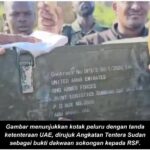
According to the report, the first public evidence of Colombian fighters in Sudan appeared in November 2024, when videos posted on social media showed a convoy intercepted by the Joint Forces of the Armed Movements, a coalition of armed groups allied with the Sudanese Armed Forces.
The convoy had entered Sudan from Libya, and documents recovered from it included Colombian identity papers. Human Rights Watch said the Colombians were found with Bulgarian-made 81mm shells, which France 24 reported had been diverted from UAE armed forces stocks.
The rights group said the shells were among military equipment that appeared to have reached the RSF in violation of end-user agreements, based on research by Human Rights Watch, Amnesty International and France 24.
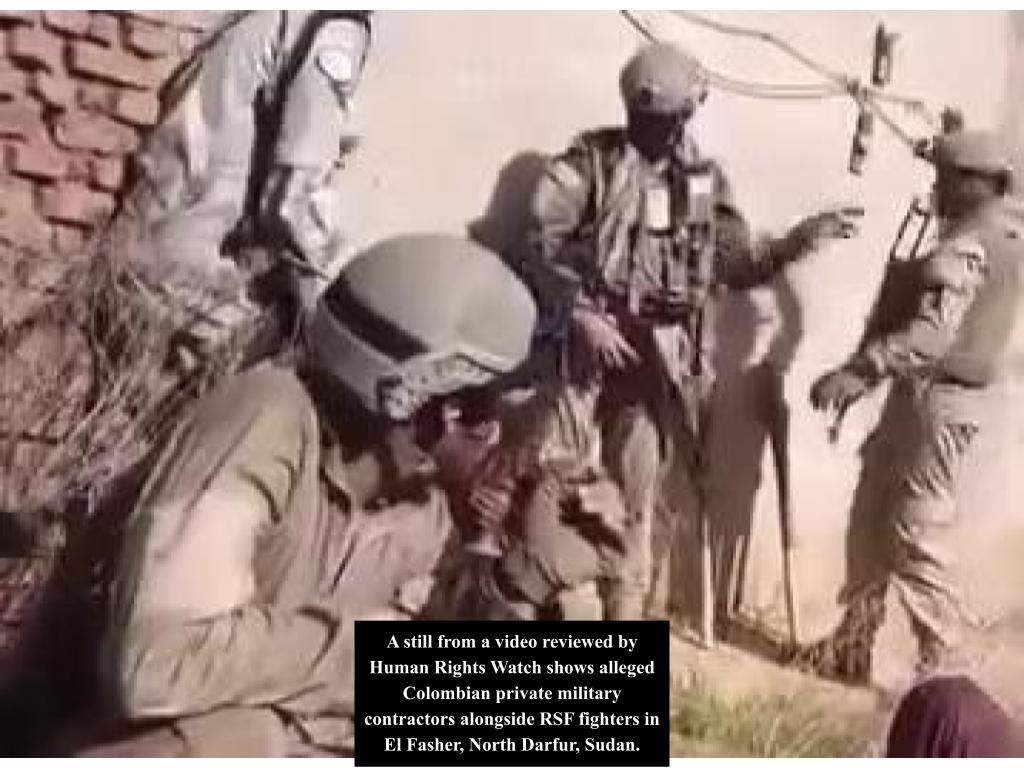
The report said Human Rights Watch verified and geolocated videos showing foreign private military contractors, apparently Colombian and Spanish-speaking, fighting in El Fasher during the RSF’s capture of the city in late 2025.
Six witnesses told the organisation they saw foreign fighters at locations where mass killings attributed to the RSF took place. The witnesses said the men wore helmets, body armour and kneepads, equipment similar to that seen in videos reviewed by Human Rights Watch.
The organisation also said one Colombian contractor reported training RSF recruits at camps around Nyala, the RSF’s main base in South Darfur, around April 2025. The contractor said many of the recruits were “young children.” Human Rights Watch said international law prohibits the recruitment or use of children in armed conflict.
The report said Global Security Services Group was founded in 2016 by Ahmed Mohammed al-Humairi, secretary general of the UAE Presidential Court, according to a 2025 report by The Sentry, an investigative nongovernmental organisation. Human Rights Watch said al-Humairi later transferred his shares in the company to Mohamed Hamdan al-Zaabi, a longtime business partner.
Human Rights Watch said the company had described itself as the first private security company in the UAE to receive an armed security licence. Until recently, the report said, it had also advertised key Emirati ministries as clients and described itself as the only armed private security services provider for the UAE government.
The rights group said it wrote to Global Security Services Group, the UAE authorities and others mentioned in connection with the apparent recruitment and deployment of contractors or other military support to the RSF, but did not receive a response.
Human Rights Watch called on the UN Security Council to ask its Panel of Experts on Sudan to investigate the company and its leadership over their apparent role in supporting the RSF, including whether any actions violated the 2004 UN arms embargo on Darfur.
It also urged governments and regional bodies to support investigations into companies and individuals that may have assisted the transfer of fighters or military equipment to Darfur, with possible targeted sanctions if credible evidence is established.
The Sudan conflict has become a major test for international efforts to protect civilians in wars involving armed groups, foreign support networks and private military actors. The issue is also relevant to Malaysia’s wider diplomatic emphasis on humanitarian accountability, peaceful conflict resolution and respect for international law.
Human Rights Watch said any external support to armed groups accused of serious abuses, including fighters, weapons, equipment or training, risks prolonging the conflict and worsening civilian suffering.
About The Author