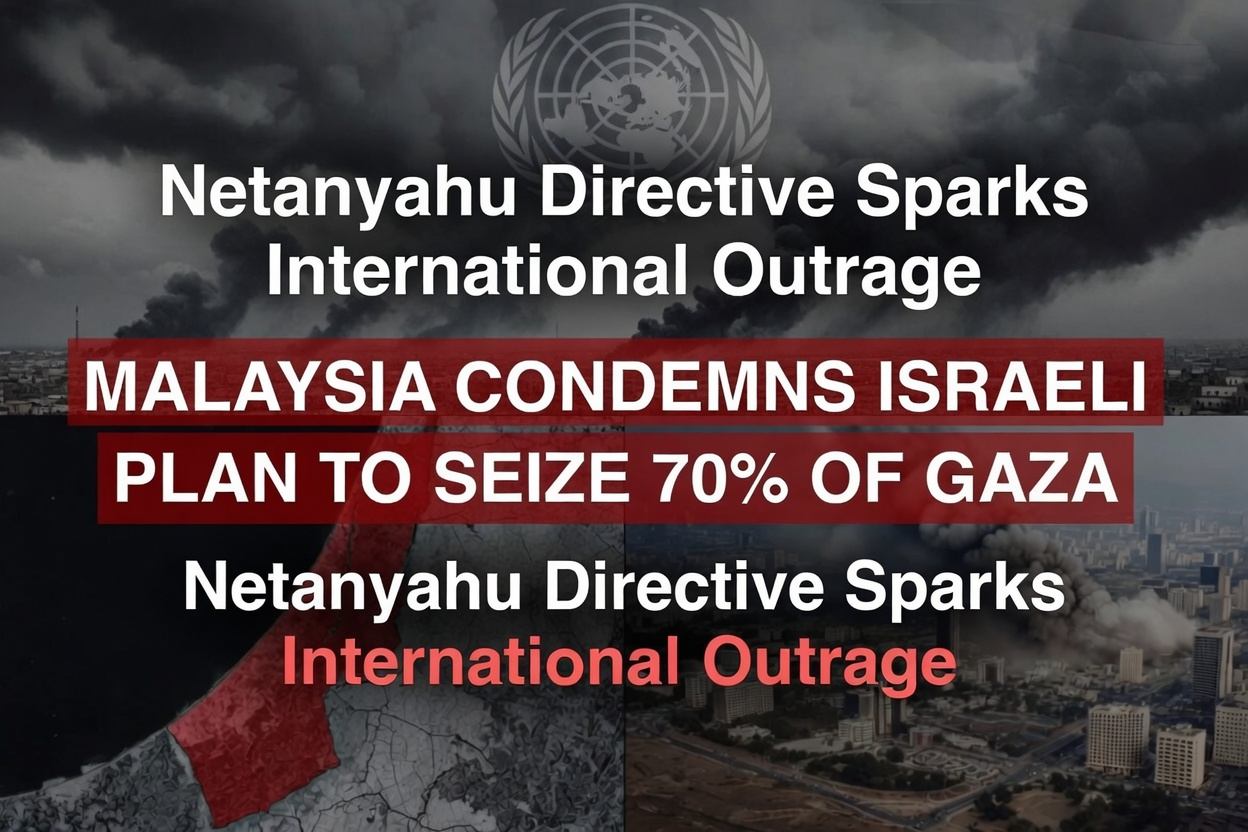
KUALA LUMPUR, May 31, 2026 — Malaysia has issued a strong condemnation of the Zionist Israeli regime’s plan to expand military control over 70% of the Palestinian territory of Gaza, describing the move as illegal, politically unacceptable, and a blatant violation of international law.
In an official press release issued by the Ministry of Foreign Affairs (Wisma Putra), Malaysia rejected the directive announced by Israeli Prime Minister Benjamin Netanyahu on May 28, 2026. Netanyahu stated that Israeli forces, already controlling around 60% of Gaza, would push to seize an additional 10% of the territory in a step-by-step manner.
The Malaysian statement reads: “Malaysia condemns in the strongest terms the recently announced plan by the Zionist Israeli regime to seize and expand its control over 70 per cent of the Gaza Strip.” It further labels the action as yet another egregious violation of the UN Charter and numerous UN Security Council and General Assembly resolutions.
Malaysia reiterated that Gaza remains an integral part of Palestinian territory and urged the international community and the United Nations to unequivocally reject the plan. The ministry warned that any attempt to alter Gaza’s territorial reality would further undermine prospects for peace and justice in the region.
This latest development comes amid a fragile ceasefire that took effect in October 2025. Netanyahu’s directive has raised concerns about potential humanitarian deterioration, as it could squeeze Gaza’s population of over 2 million into an even smaller area.
Malaysia has long maintained a consistent foreign policy position in support of Palestinian self-determination and an independent Palestinian state based on pre-1967 borders with East Jerusalem as its capital.
The full press release, including bilingual Malay and English versions, was shared via Wisma Putra’s official channels, accompanied by a short animated video highlighting the statement.
This condemnation aligns with Malaysia’s longstanding advocacy for a just and lasting solution to the Israeli-Palestinian conflict through international law and multilateral diplomacy.
About The Author