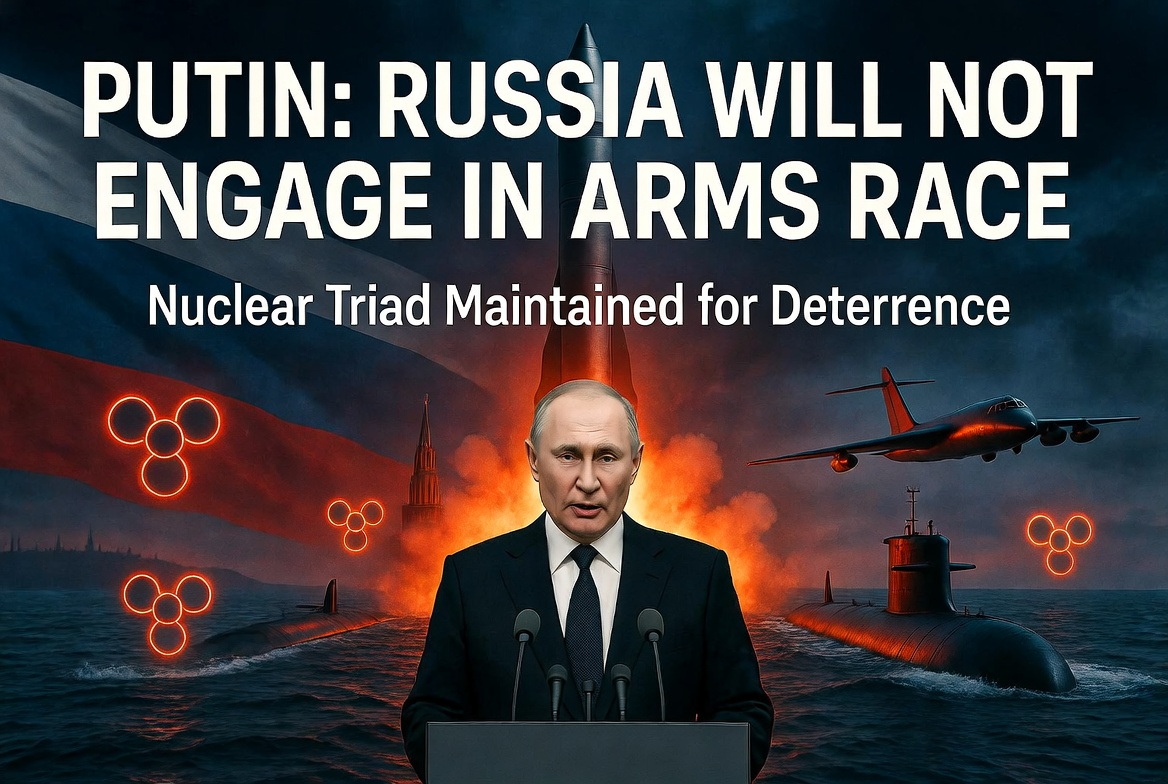
MOSCOW, May 21, 2026 — Russian President Vladimir Putin stated that Russia is not seeking an arms race with any country and will keep its nuclear forces at the level necessary for strategic deterrence.
Speaking during a meeting with military officials and Belarusian counterparts following joint exercises, Putin emphasized restraint amid the absence of binding nuclear arms control agreements.
“We are not planning to engage in any arms race,” Putin said. “Our nuclear triad will remain on the scale that is required.”
The remarks come months after the New START Treaty — the last major U.S.-Russia nuclear arms control agreement — expired on February 5, 2026. The pact had capped deployed strategic nuclear warheads at 1,550 for each side, along with limits on delivery systems. Its end marked the first time in decades that the world’s two largest nuclear arsenals operate without formal numerical restrictions.
Russia has previously indicated it would continue observing voluntary limits for a period if the U.S. reciprocated, while stressing that its force posture would respond to the broader security environment, including NATO expansion and Western military support for Ukraine.
Context of Ongoing Modernization
Putin’s comments align with earlier statements this year in which he described the development and strengthening of Russia’s nuclear triad — comprising land-based intercontinental ballistic missiles, submarine-launched ballistic missiles, and strategic bombers — as an “absolute priority” for national security.
Moscow continues to modernize its nuclear forces, deploying new systems and conducting tests, while conducting joint military drills with allies like Belarus. Officials frame these efforts as necessary for maintaining parity and deterrence rather than escalation.
Broader Implications
The expiration of New START has raised international concerns about a potential renewed arms race, though both Washington and Moscow have signaled openness to future talks. Analysts note that while voluntary restraint is currently in place, the lack of verification mechanisms and inspections increases risks of miscalculation.
Russia’s position, as articulated by Putin, projects a preference for strategic stability through sufficient deterrence capabilities without entering a costly, open-ended competition.
The full video of Putin’s remarks, shared widely on social media, shows him addressing participants in recent Russia-Belarus military exercises.
This development occurs against the backdrop of heightened global tensions, with ongoing conflicts and great-power competition influencing nuclear policy decisions worldwide.
About The Author