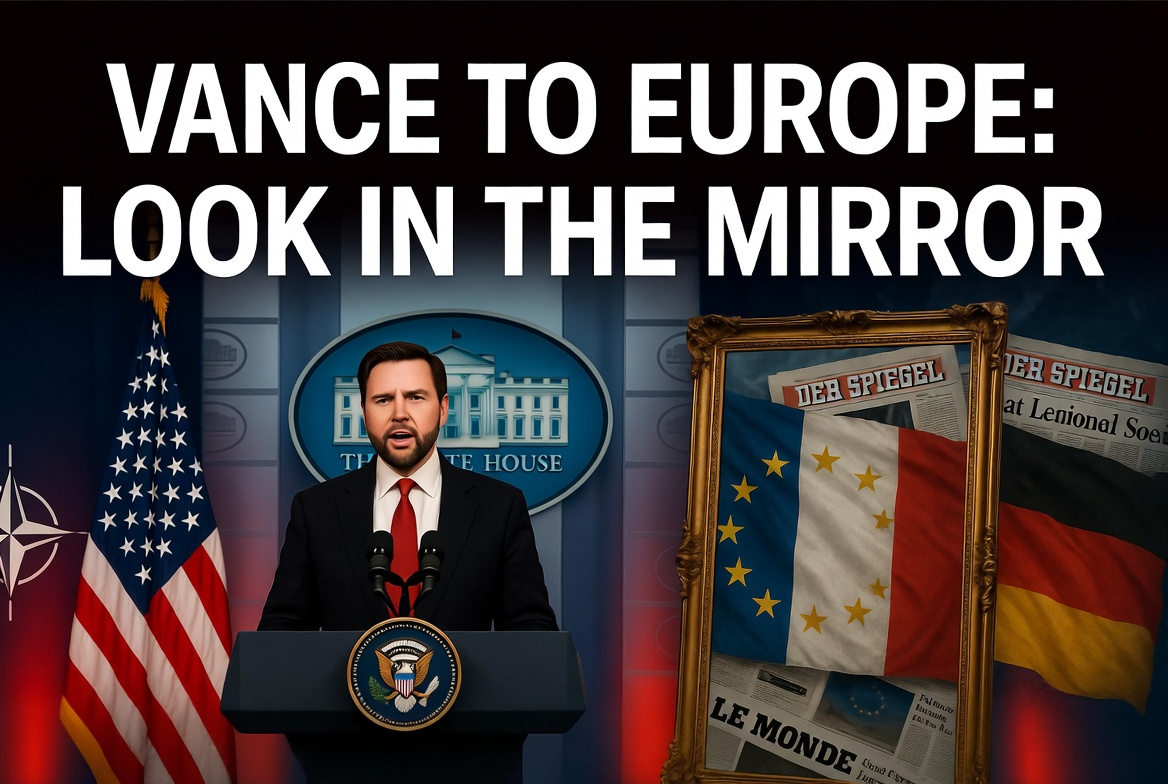
WASHINGTON D.C. May 20, 2026 — Vice President JD Vance sharply criticized European media outlets on Tuesday for their coverage of President Donald Trump, urging them to examine their own continent’s security shortcomings before attacking U.S. policy.
Speaking at a White House briefing, Vance responded to questions about a delayed U.S. troop deployment to Poland, framing it as a routine adjustment rather than a withdrawal. He highlighted America’s long-standing financial and military support for Europe.
“For my entire life, I have heard chirping from the European media about everything that’s wrong with the United States of America,” Vance said. “We don’t have this. We don’t have that. We don’t spend enough on healthcare — even though part of the reason why we spend so much on defense was because we have tens of thousands of troops in Europe.”
“I think that if the European media wants to attack the President of the United States, they need to start looking in the mirror,” he added.
Vance emphasized that the Trump administration supports Europe taking greater responsibility for its own defense while maintaining strong trade ties. “All he has said is we’re going to be trading partners, but it is reasonable for Europe to take a little bit more ownership over its continental integrity,” he stated.
The remarks come amid ongoing transatlantic debates over NATO burden-sharing. The U.S. has long maintained a significant military presence in Europe, with tens of thousands of troops stationed there as part of collective defense commitments. The Pentagon recently paused the rotation of approximately 4,000 troops to Poland as part of a broader review that could reduce U.S. Brigade Combat Teams in Europe.
Vance’s comments align with longstanding Trump administration priorities of encouraging European allies to increase defense spending—potentially toward higher targets—and reducing what the U.S. views as over-reliance on American security guarantees.
The Vice President also touched on U.S. negotiations with Iran during the briefing, stressing clear red lines, particularly that Iran cannot develop a nuclear weapon. He described Iran’s leadership as fractured and noted challenges in communication.
European reactions to the troop delay and Vance’s statements have been mixed, with some viewing it as a signal of shifting U.S. priorities under an “America First” approach. Supporters praise the push for greater European self-reliance, while critics express concern over potential security gaps.
The White House shared a video clip of Vance’s remarks on X, which quickly gained traction. This latest exchange underscores persistent tensions in U.S.-Europe relations as the Trump administration seeks to recalibrate alliances.
About The Author