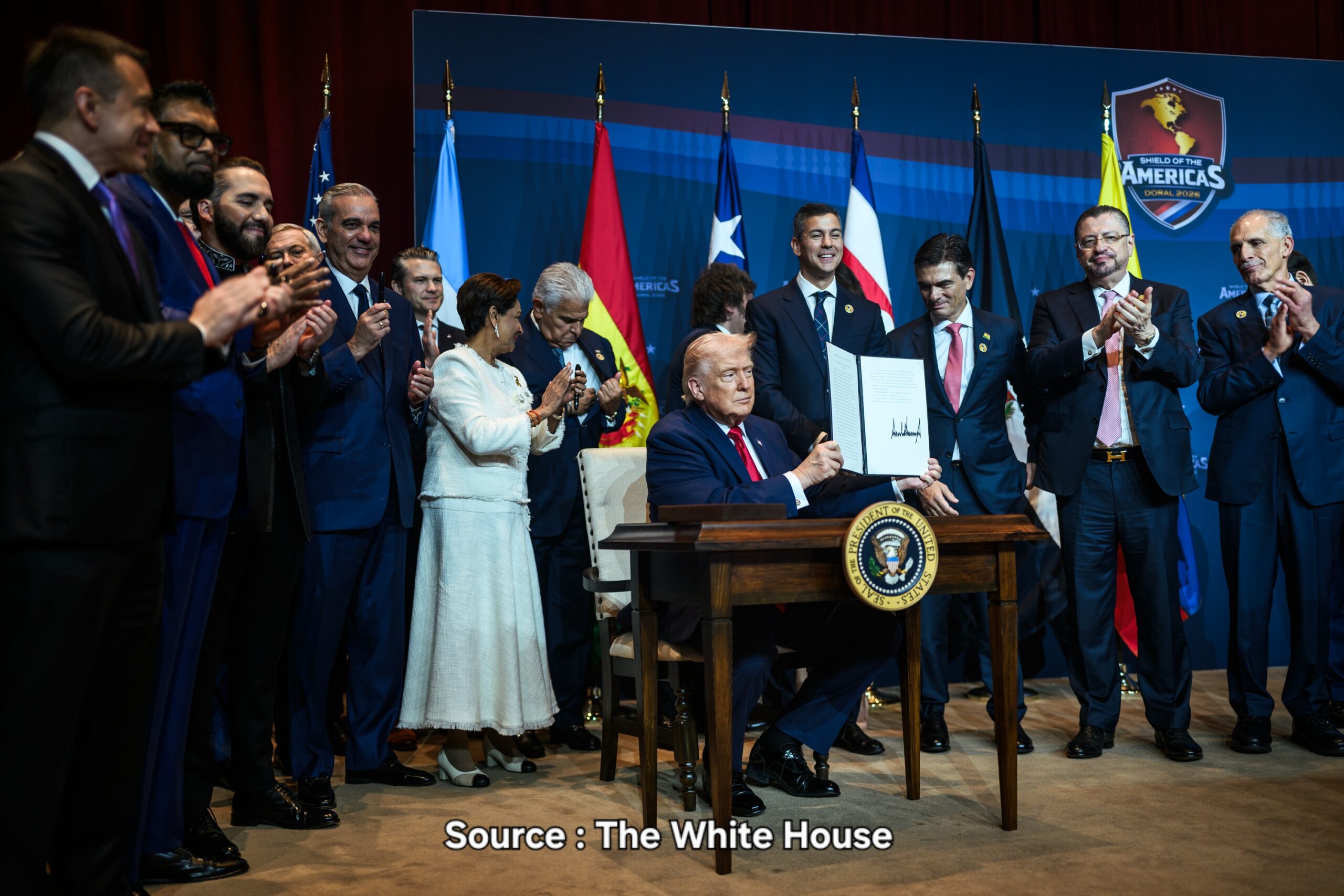
MIAMI, FLORIDA March 7, 2026 – In a bold move aimed at combating drug trafficking and organized crime across the Western Hemisphere, President Donald J. Trump signed the “Commitment to Countering Cartel Criminal Activity” proclamation on Saturday at the inaugural Shield of the Americas Summit. The event, held at Trump National Doral Miami, brought together leaders from over a dozen Latin American nations to form the Americas Counter-Cartel Coalition, a new military partnership dedicated to dismantling cartels and foreign terrorist organizations.
The proclamation outlines a coordinated effort to deploy “lethal military force” against cartels, with Trump emphasizing U.S. readiness to assist partner countries in striking drug networks. “On this historic day, we come together to announce a brand new military coalition to eradicate the criminal cartels plaguing our region,” Trump declared during the signing ceremony, flanked by heads of state from countries including Argentina, Bolivia, Chile, Costa Rica, the Dominican Republic, Ecuador, El Salvador, Guyana, Honduras, Panama, Paraguay, and Trinidad and Tobago. He described the cartels as a “cancer” that must be eradicated to prevent further spread, highlighting the coalition’s focus on using advanced U.S. weaponry and intelligence to target operatives.
The summit, hosted amid ongoing global crises including U.S. military actions in Ecuador and tensions with Iran, signals a sharpened focus on hemispheric security. Secretary of State Marco Rubio and Secretary of War Pete Hegseth joined Trump in underscoring the initiative’s alignment with the “Trump Doctrine,” which extends the Monroe Doctrine by authorizing proactive interventions against threats in the region. Hegseth stated that the U.S. is prepared to lead offensive operations, urging allies to identify cartel locations for joint strikes.
Participating leaders expressed support for the coalition, viewing it as a unified front against transnational gangs that have long terrorized their nations. For instance, Ecuador’s president praised the U.S. for recent strikes in his country, while El Salvador’s Nayib Bukele highlighted the need for collective action to curb migration and drug flows. The agreement also addresses countering foreign interference, such as from China, and tackling illegal migration fueled by cartel activities.
However, the move has drawn criticism from some quarters. Detractors argue that Trump’s past actions, including the pardon of former Honduran President Juan Orlando Hernández—who was convicted of drug trafficking—undermine the initiative’s credibility. Others express concern over the aggressive tone, with Al Jazeera reporting that Trump’s threats of missile strikes in Latin America could escalate tensions and infringe on national sovereignty. Progressive voices have labeled the approach as overly militaristic, potentially overlooking root causes like poverty and corruption.
On social media platform X, reactions were mixed. Supporters hailed the coalition as a “fortress against chaos,” with posts celebrating the end of “half-measures” against cartels. Critics, meanwhile, dismissed it as “talk is cheap,” pointing to inconsistencies in Trump’s record.
The White House described the summit as a demonstration of American leadership, with Trump joking about not having time to learn regional languages but stressing the importance of action over words. As the coalition takes shape, experts anticipate increased U.S. military involvement in Latin America, potentially reshaping regional dynamics in the fight against narcoterrorism.
This development comes as the Trump administration continues to prioritize border security and counter-narcotics efforts, following recent operations that have drawn international attention. Further details on the proclamation are available on the White House website.
About The Author