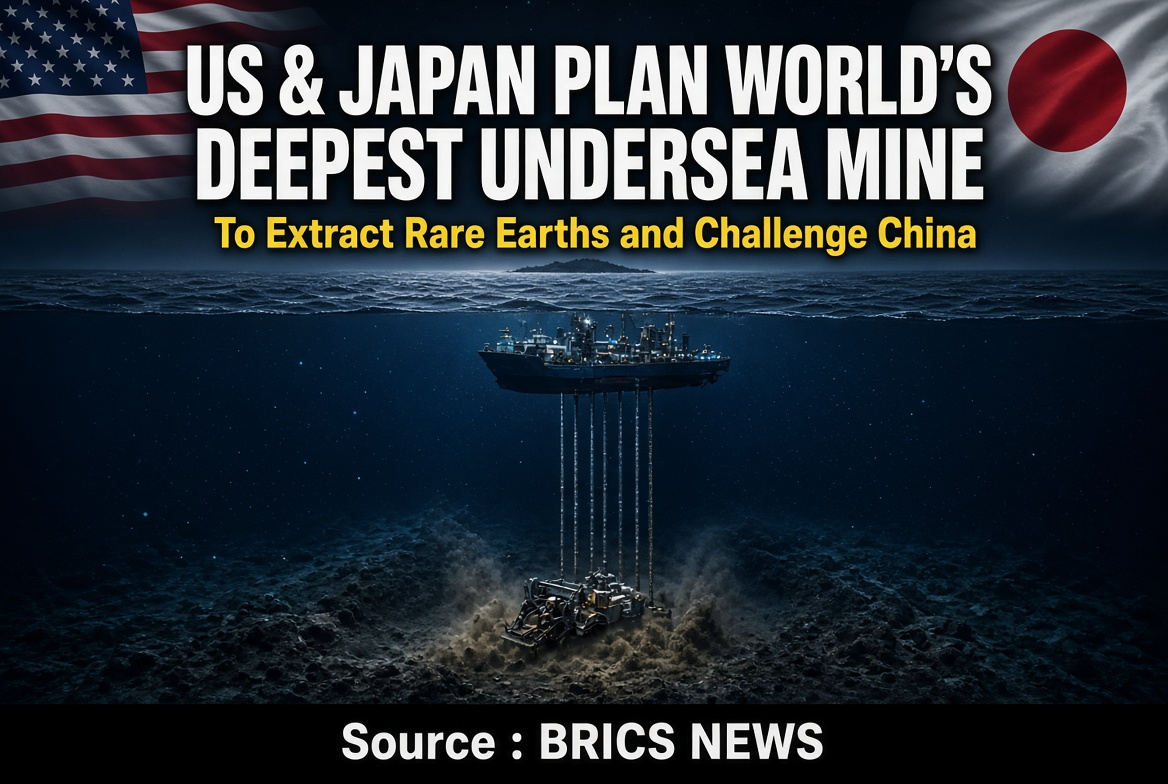
WASHINGTON D.C Aug 12, 2026 – The United States and Japan are moving forward with plans to develop the world’s deepest undersea mine for rare earth elements near a remote Pacific island, aiming to reduce their heavy dependence on Chinese supplies of these critical minerals.
The project centers on deposits of rare-earth-rich mud surrounding Minamitorishima (also known as Minamitori Island), a tiny, uninhabited Japanese territory more than 1,000 miles southeast of Tokyo. The seabed resources lie at depths of approximately 6,000 meters — among the deepest ever considered for commercial mining.
A single deposit in the area is estimated to hold about 16 million tons of rare earth minerals, according to a 2018 University of Tokyo study. That includes enough yttrium to meet roughly 780 years of global demand and enough dysprosium for about 730 years. These heavy rare earths are essential for electric vehicle motors, wind turbines, advanced electronics, and defense technologies.
Discussions between U.S. President Donald Trump and Japanese Prime Minister Sanae Takaichi in late 2025 and March 2026 laid the groundwork. After their White House meeting in March, the two countries issued a statement highlighting the potential of the Minamitorishima deposits to “meet centuries’ worth of industrial demand.” They signed a memorandum of cooperation on deep-sea mineral resource development, creating a working group to share data and explore joint projects. The goal is a closed-loop “mine-to-magnet” supply chain that would give both nations greater security against Chinese export controls.
Japan has already achieved a technical milestone. In January–February 2026, the deep-sea drilling vessel Chikyu, operated by the Japan Agency for Marine-Earth Science and Technology (JAMSTEC), successfully recovered rare-earth-bearing mud from depths of about 5,700–6,000 meters — the first continuous lift of such material from those depths anywhere in the world. Analysis of the samples showed that roughly 54 percent of the rare earth content consists of medium and heavy rare earths, the category in which China holds the strongest global dominance.
A larger demonstration trial is scheduled for February 2027. Japan plans to extract around 350 tons of mud per day, dewater it on the island, and process it on the mainland to test separation, refining, and smelting techniques. A full feasibility assessment for commercial production is expected by March 2028. Several North American companies have expressed early interest in participating.
China currently controls the vast majority of rare earth refining capacity worldwide, giving it significant leverage over high-tech and defense supply chains. Both Washington and Tokyo view the Minamitorishima project as a strategic step toward diversification, though significant hurdles remain. Extracting and processing material from extreme ocean depths is technically complex and expensive. Environmental impacts on deep-sea ecosystems are poorly understood and could draw international scrutiny. Building sufficient refining infrastructure outside China will also take time and investment.
If successful, the initiative could mark a major shift in the global rare earth market and strengthen U.S.-Japan economic and security cooperation in the Indo-Pacific. For now, the partners are treating the coming 2027 trial as the critical next proof-of-concept.
About The Author