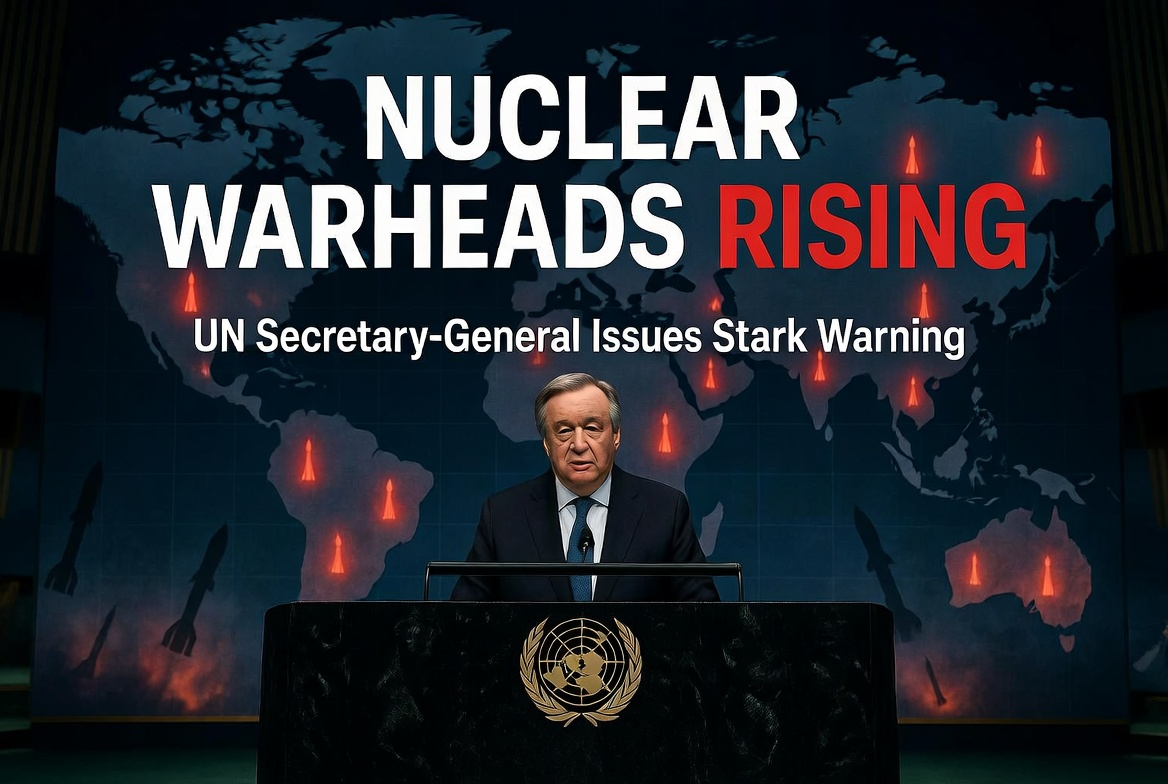
NEW YORK, April 27, 2026 — United Nations Secretary-General António Guterres issued a stark warning Monday that the global number of nuclear warheads is increasing for the first time in decades, urging world leaders to recommit to disarmament and non-proliferation amid rising geopolitical tensions.
“For the first time in decades, the number of nuclear warheads is on the rise,” Guterres stated in remarks to the opening of the Eleventh Review Conference of the Parties to the Treaty on the Non-Proliferation of Nuclear Weapons (NPT), also shared on X (formerly Twitter). “A nuclear war cannot be won and must not be fought. It’s time to re-commit to disarmament and non-proliferation as the only true path to peace.”
The comments come as the NPT Review Conference — running from April 27 to May 22 at UN Headquarters in New York — gathers states parties to review the landmark treaty’s implementation since 2022. Guterres described arms control as “dying,” citing eroding norms, renewed nuclear saber-rattling, and a surge in global military spending to $2.7 trillion last year — 13 times all development aid and equivalent to Africa’s entire GDP.
His remarks echo findings from the Stockholm International Peace Research Institute’s (SIPRI) Yearbook 2025, released last June. As of January 2025, the nine nuclear-armed states (United States, Russia, United Kingdom, France, China, India, Pakistan, North Korea, and Israel) held an estimated 12,241 nuclear warheads in total. Of these, about 9,614 were in military stockpiles for potential use — a figure that has begun rising despite ongoing dismantlements of retired U.S. and Russian warheads.
SIPRI noted that nearly all nuclear powers are modernizing their arsenals, with China expanding the fastest — now estimated at around 600 warheads and adding roughly 100 annually. Other states including India, Pakistan, and North Korea continue rapid modernization programs.
The warning arrives just months after the New START treaty — the last major U.S.-Russia agreement limiting deployed strategic nuclear weapons — expired on February 5, 2026, with no replacement in place. Experts have expressed concern that the lapse could accelerate a new arms race.
In his full address, Guterres called for countries to fulfill NPT commitments “without caveats, without conditions, without delays, without excuses.” He urged strengthening the norm against nuclear testing, bolstering International Atomic Energy Agency (IAEA) safeguards, and addressing new risks from artificial intelligence and quantum computing that could affect nuclear command and control.
“The Treaty is only as strong as countries’ commitment to it,” Guterres said. “With your support and engagement, the Treaty can remain an active and strong foundation for a world free of nuclear weapons in our fast-moving age.”
He also highlighted an exhibition by hibakusha — survivors of the 1945 atomic bombings of Hiroshima and Nagasaki — organized outside the conference hall, referencing the 2024 Nobel Peace Prize awarded to their organization, Nihon Hidankyo. “Disarmament is not the reward for peace. Disarmament is the foundation of peace,” Guterres declared.
The conference follows two previous review cycles (2015 and 2022) that failed to produce consensus final documents, underscoring deep divisions between nuclear-weapon states and non-nuclear states.
Guterres concluded with a call to action: “Let’s break the collective amnesia around nuclear weapons. Let’s renew faith in what we can achieve when we stand as one. Let’s act with urgency to lift this cloud hanging over humanity.”
Delegates will now enter weeks of negotiations on the treaty’s three pillars: non-proliferation, disarmament, and peaceful uses of nuclear energy.
About The Author